A revolt along three borders puts Jerusalem in the company of other Middle Eastern states with large, restive Arab populations:
Sunday’s unrest — which came after activists used Facebook and other websites to mobilize Palestinians and their supporters in neighboring countries to march on the border with Israel— marked the first time the protest tactics that have swept the Arab world in recent months have been directed at Israel.
Deadly clashes also took place along Israel’s nearby northern border with Lebanon, as well as in the Gaza Strip, near Israel’s southern border. The Israeli military said 13 soldiers were lightly wounded in the Lebanon and Syria clashes.
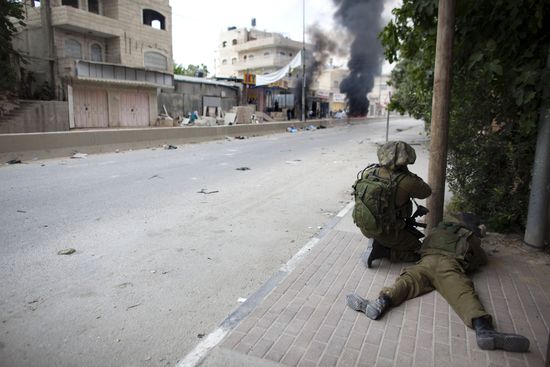
In addition, hundreds of Palestinian threw stones at Israeli police and burned tires at a checkpoint outside Jerusalem before they were dispersed.
Will Jerusalem follow Cairo's lead and allow true democracy for the residents of the West Bank and Gaza, allowing them to forge their own destiny? And how will Washington cope with an important Middle Eastern ally bent on repressing the people whose land it occupies?
The logic of the Arab Spring – self-determination and democracy as a fundamental right – cannot but involve Israel's occupation and continued settlement of the West Bank at some point. Israel is, after all, no longer the only democracy in the Middle East. It is just the only democracy forcibly occupying a foreign land and refusing to give the occupants full civil or political rights.
(Photo: Israeli soldiers take position during clashes with Palestinian protesters May 15, 2011 at Qalandiya checkpoint near Ramallah, West Bank. Today marks the 'Nakba' or 'catastrophe' which befell Palestinians following Israel's establishment in 1948. By Uriel Sinai/Getty Images.)
 The Dish