Yesterday, Andrew Exum provided a must-read on the bloody protests at the Israeli borders. He follows up this morning:
As I said yesterday, the events along Israel's borders should be a wake-up call for the Israeli political class. Although the easy thing to do here will be to claim that Israel has no partner in peace, it is foolish to think the kind of non-violent protests that proved so effective in Egypt and Tunisia will not migrate to the Occupied Palestinian Territories. In the eyes of the world, Israel will look like Ben Ali or Mubarak in the face of a non-violent movement for the creation of a Palestinian state. Is Israel prepared for that?
When I was in Israel 18 months ago doing some research, some security analysts I talked to spoke of the West Bank and the Palestinians as a problem to be managed: sure, there would be an uprising every now and then, but it was nothing Israel could not handle through force. I'm not sure that is any longer the case, if indeed it ever was, which is part of the reason why I believe(.pdf) Western, Arab and Israeli policy-makers should start setting the conditions for a Palestinian state now rather than wait.
Agreed. The sadness on my part is that yesterday non-violence still did not seem to be among the options the Palestinians can agree on. But non-violent, Tahrir-style resistance to occupation would be very, very powerful.
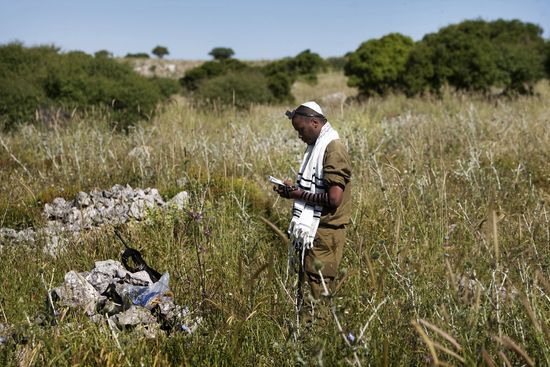
(Photo: An Israeli soldier prays along his country's northern border with Lebanon near the village of Avivim on May 16, 2011, opposite the southern Lebanese village Marun al-Ras where Israeli troops opened fire the previous day on people trying to scale the border fence during a Palestinian refugee protest to mourn what is known as the 'nakba' or 'catastrophe' of Israel's 1948 creation. The clashes along the Lebanese-Israeli border, in which 10 people were killed and 110 wounded, marked the bloodiest confrontation since the 2006 war between the two neighbours. By Menahem Kahana/AFP/Getty Images.)
 The Dish