I disagree with Rick Santorum that there is no value in secularism. I do not believe that people in public life should cite religious teaching to resolve public policy disputes, even though such teaching may legitimately influence them. So my arguments against torture are not Catholic per se and my faith is mentioned in public arguments on this issue a tiny percentage of the time. I am not affirming my own faith in these posts; I am making secular arguments that are designed, however fallibly, for readers of any faith or none.
But Santorum famously believes that this is a fallacious distinction, and that the Church even has a duty to police Catholic politicians who differ deeply with the Vatican on questions of public morality – and even deny them Communion. By Santorum's logic, it seems to me that the Bishops should also deny Santorum Communion on the basis of his open and enthusiastic support for the torture of terror suspects who are prisoners. But Santorum needs at the very least to explain this apparent double standard.
Stripping detainees of their clothes, slamming them against hollow walls, freezing them into hypothermia, depriving them of light, sound and mobility, force-feeding them, shackling them in excruciating stress positions, aiming to remove from them all autonomy as free human beings: these are profound evils, under any name, according to the Church, for whom human dignity is non-negotiable. John Gehring elaborates:
Catholic bishops described torture as an assault on the dignity of human life and an "intrinsic evil" in their 2007 statement Faithful Citizenship. (For a more in depth look at intrinsic evil and political responsibility read this essay by Cathleen Kaveny of the University of Notre Dame in America magazine.) "The use of torture must be rejected as fundamentally incompatible with the dignity of the human person and ultimately counterproductive in the effort to combat terrorism," the bishops wrote in Faithful Citizenship. As Kyle R. Kupp points out over at Vox Nova, Pope Paul VI described such acts as "infamies" that "poison society," do "supreme dishonor to the Creator," and "do more harm to those who practice them than to those who suffer from injury."
I do no believe for a moment that Santorum's attempt to argue that the techniques described above are not torture can survive this standard. The standard is the dignity of the human person. And what he describes as a defense of "enhanced interrogation techniques" is, in fact, even more damning. To destroy an individual's will by physical and psychological terror in order to achieve "compliance" – rather than to seek information through torture – is an intrinsic evil. Nothing can justify it, under Catholic teaching. Moreover, the techniques used are an almost text-book definition of stripping human beings of dignitas.
Hooding people, stripping them, subjecting them to sexual humiliation, near-drowning them strapped on a board, robbing them of light and sound or bombarding them with intolerable noise for days and even weeks on end: if these are not an outright assault on human dignity, what is? And notice too that we are not talking about politicians permitting others in civil society to commit an intrinsic evil like abortion. We are talking about the politicians directly authorizing people under their own command to inflict torture.
The Catholic hierarchy has been so coopted and politicized by the Republican far right that I have given up even hoping for a clear and public denunciation of this evil. But if they find time to condemn gay couples and abortions in the civil and private realm, can they not do so for torture in the public? And challenge a leading Catholic politician who is attacking a core principle of Church doctrine and distorting it to advance his own political career?
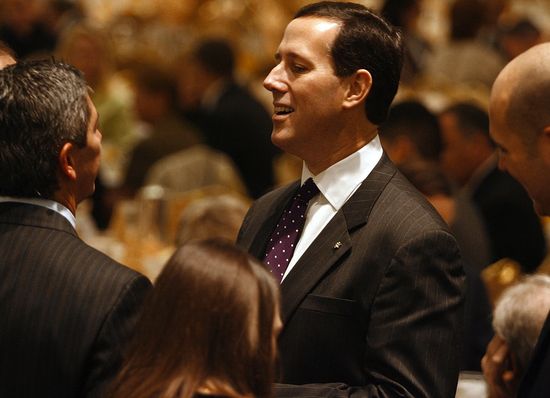
(Photo: Sen. Rick Santorum (R-PA) arrives at the National Catholic Prayer Breakfast at the Washington Hilton on April 7, 2006. President George W. Bush spoke at the breakfast about his support of federal and state initiatives to limit abortion. He said, "the Catholic Church rejects such a pessimistic view of human nature and offers a vision of human freedom and dignity rooted in the same self-evident truths of America's founding." By Chip Somodevilla/Getty Images)
 The Dish