A reader writes:
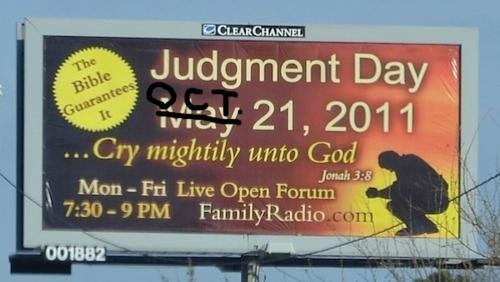
Many Christians such as yourself think Camping is a "nut-ball" because he tried to predict the date of the Rapture. I'm sorry, but isn't it far more crazy to believe that there will be a Rapture in the first place? Yet belief in this supernatural, apocalyptic event is very common in this country. According to a Pew poll, 41% of Americans believe Christ will return by 2050.
Ed Kilgore also flags those findings – "The total number rises to 58 percent among white evangelicals" – and notes their connection to supporters of settlement expansion. Many Dish readers are echoing this one:
You wrote that "not to laugh at such idiocies seems more than a little quixotic to me. And the Rapture nutters are not orthodox Christians – but rather Book of Revelations crackpots. They are not examples of religious faith but of marginal nutballism. Such nutballism begs to be made fun of." My question/criticism is: how is such "nutballism" in any qualitative way different from Catholicism, or Episcopalianism, or Islam…?
I once had a conversation with my brother in which he was laughing at a news report of the image of Jesus appearing on a tortilla or some such. "People who believe in this are silly" he claimed. "But why?" I asked, are they one whit sillier than any of those who believe that 2000 years ago someone revived after having been dead for 3 days?" He was (for once in his life) speechless.
I guess I don't see how the usual apologetics ("Credo quia absurdum est" etc) can't be applied just as easily to "Rapture nutballs" as to anybody else. Yes, of course I recognize that there's a vast body of theology behind (eg) Catholicism, but it still at core requires a Kierkegaardian leap of faith, otherwise it's just arguing about angels on the head of a pin. Once one leap of faith is taken, how do we get to say that this leap of faith is bold and courageous, and that one is nutballism?
I'm genuinely interested to hear your answer, because I think that this is one of the core questions that the Abrahamic religions have to face and answer honestly.
The content of the faith I hold has been honed and corrected and debated for centuries; and it must, by definition, be consonant with truth as we find it on earth. Part of my tradition does not pore over the Book Of Revelation to find Dan Brown-style clues and signs of the Apocalypse. Such a way of reading Scripture is a category error. Of all the books in the Bible, Revelation is the most marginal, the most disputed and, to my mind, more like a bad trip at Burning Man than a serious contribution to our spiritual understanding or quest.
The idea that a leap of faith requires complete abandonment of reason, or the making of distinctions, or careful study of texts in their proper – rather than distorted – context is, in my view, a false one, however convenient it sometimes is for atheist contempt. I am not a fundamentalist; I do not see Scripture as literal, let alone some kind of puzzle to be deciphered for fortune telling.
I am, however, a skeptic of the end-times altogether. Partly because I don't believe that salvation has such a temporal quality. It is outside of time, as God is. That makes me a heretic in one respect.
 The Dish