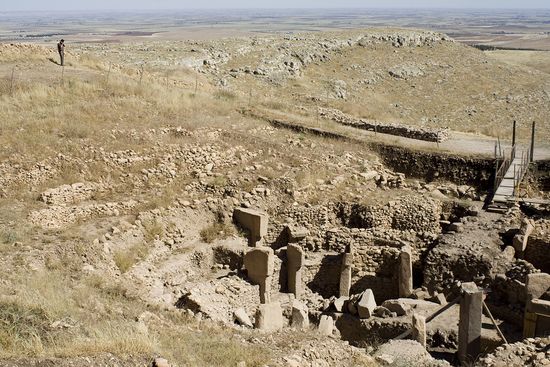
Charles Mann delves into a new theory about the origins of religion. An older theory held that religion sprang from our transition to agriculture; Göbekli Tepe, a temple built 11,600 years ago in what is today Turkey challenges that view:
The construction of a massive temple by a group of foragers is evidence that organized religion could have come before the rise of agriculture and other aspects of civilization. It suggests that the human impulse to gather for sacred rituals arose as humans shifted from seeing themselves as part of the natural world to seeking mastery over it. … "Twenty years ago everyone believed civilization was driven by ecological forces," [archeologist Klaus] Schmidt says. "I think what we are learning is that civilization is a product of the human mind."
Tim Muldoon elaborates:
A provocative takeaway: when religion loses its roots in shared desire and wonder, when it fails to capture people’s imagination, it begins to collapse. People eventually lost interest in Göbekli Tepe around 8200 BC, perhaps because it became too big a project to maintain. Maintenance of the institution crushed the dynamics of desire which gave rise to it. Friedrich von Hugel suggested a similar idea: there must be a balance of the institutional with the mystical and communal aspects of religion. Perhaps ours is the age of recovering the mystical element even as the institutional element is crumbling.
(Photo of "Urfa – Göbekli Tepe #1" by Flickr user Deniz Tortum)
 The Dish