The Philosopher Of St Louis

Kerry Howley recounts the improbable tale of Henry Conrad Brokmeyer, who founded the St. Louis Hegelians:

Brokmeyer sold a warped Hegelianism just flattering enough to believe: History had a direction. That direction was west, from Europe to the United States. History would unfold in the direction of a world-historical city, culminating in a flowering of freedom under a rational state. While Hegel had assumed Europe to be the place to which all of history pointed — when he said “west,” he meant from Asia to Europe — Brokmeyer said history would keep on rolling across the Atlantic, toward the biggest American city west of the Mississippi: St. Louis.
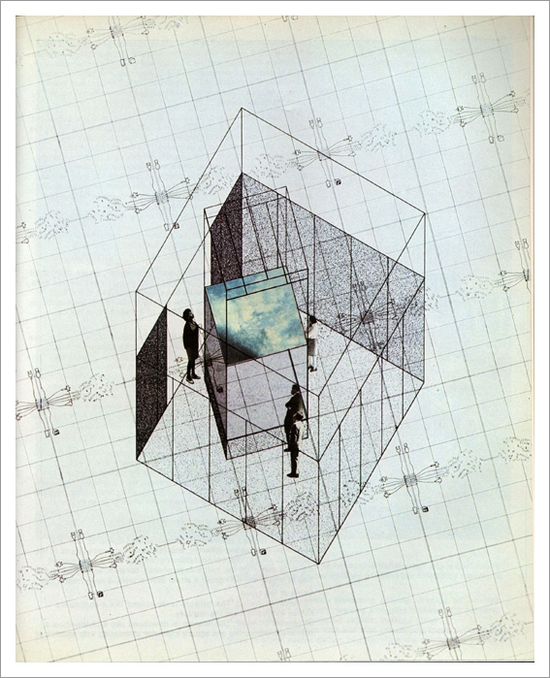

The Scientist’s Agnosticism

18_superstudio2

Adam Frank confesses:

I am not agnostic because I hope that my soul will ascend to Science Heaven, where I could spend eternity learning more about thermodynamics and quantum information theory … I am not agnostic because I hope souls exist. I doubt they do. I am agnostic about what happens after biological functioning because neither I, nor anyone else, understands consciousness and its fundamental relation to biology, chemistry and physics. There are lots of great ideas for sure. But a theory of consciousness? A theory of subjectivity? Not yet. Not by a long shot.

Sean Carroll differs:

Presumably amino acids and proteins don’t have souls that persist after death. What about viruses or bacteria? Where upon the chain of evolution from our monocellular ancestors to today did organisms stop being described purely as atoms interacting through gravity and electromagnetism, and develop an immaterial immortal soul? There’s no reason to be agnostic about ideas that are dramatically incompatible with everything we know about modern science.

Alva Noë agrees.

(Image by the Superstudio Architectural Group, part of a MoMA Exhibit in 1972)

Public Confession

A Green Paper in the UK has proposed reducing the sentences for offenders who enter early guilty pleas. After confronting a man who tried to break into his own house, Mark Vernon contemplates what it means to ask criminals to confess:

There's the risk of perpetrators getting off lightly. Yes. And it's clearly not suitable across the board. But it's not forgiveness that's on offer. Rather, done right, a public confession can allow victims to hand back the crimes committed against them to the perpetrators. That's where they belong. The perpetrators, in turn, must then live with the full knowledge of what they have done. For some, that will be for the good too.

In The Beginning

Gobekli

Charles Mann delves into a new theory about the origins of religion. An older theory held that religion sprang from our transition to agriculture; Göbekli Tepe, a temple built 11,600 years ago in what is today Turkey challenges that view:

The construction of a massive temple by a group of foragers is evidence that organized religion could have come before the rise of agriculture and other aspects of civilization. It suggests that the human impulse to gather for sacred rituals arose as humans shifted from seeing themselves as part of the natural world to seeking mastery over it. … "Twenty years ago everyone believed civilization was driven by ecological forces," [archeologist Klaus] Schmidt says. "I think what we are learning is that civilization is a product of the human mind."

Tim Muldoon elaborates:

A provocative takeaway: when religion loses its roots in shared desire and wonder, when it fails to capture people’s imagination, it begins to collapse.  People eventually lost interest in Göbekli Tepe around 8200 BC, perhaps because it became too big a project to maintain.  Maintenance of the institution crushed the dynamics of desire which gave rise to it.  Friedrich von Hugel suggested a similar idea: there must be a balance of the institutional with the mystical and communal aspects of religion.  Perhaps ours is the age of recovering the mystical element even as the institutional element is crumbling.

(Photo of "Urfa – Göbekli Tepe #1" by Flickr user Deniz Tortum)

Morbid Fascination

Jeff Mason explores it:

For a long time, I have been puzzled by two famous philosophical ideas about death, one from Plato and one from Spinoza. The first is that a philosopher has a vital concern with death and constantly meditates upon it. The second is that the wise person thinks of nothing so little as death. Perhaps the truth is somewhere in the middle. …  In the end, it is useful to think about death only to the point that it frees us to live fully immersed in the life we have yet to live.

As Successful As A Snuggie?

Planet Money likened nerdy and comedic songwriter Jonathan Coulton to a Snuggie for profiting off of a novelty factor. Coulton responded and acknowledged his music isn't for everyone:

[L]eaving aside the pejorative nature of the comparison, I think it’s accurate in some respects, in that a Snuggie is a new thing that somebody invented and marketed and sold to enormous success. Do you know who else is a Snuggie? Nirvana, Ben Folds, Madonna, and the Grateful Dead.

You have to do something new and unique and valuable in order to get anyone’s attention in this business, in fact that’s sort of the point. Just because I did it with “nerds on the Internet” instead of “teenagers in Seattle” or “hippies at ren faires” or “13-year-old girls on YouTube” is incidental, and beside the point. Similarly, Jacob Ganz says in the podcast that I “won the internet lottery,” which is like saying the Beatles won the British Invasion lottery. It’s accurate but unhelpful, because it fails to draw a meaningful distinction between me and anyone else who has had success in this business. It has always been about winning the lottery, and it has always been about being a Snuggie. 

(Video: a fan's video for Coulton's "re: Your Brains")

Milking The Man Teat

Michael Thomsen experiments with trying to make himself lactate:

It was strange to apply a breast pump for the first time. My nipples aren't accustomed to regular stimulation, and though I felt like I was defying the natural order, pumping was surprisingly pleasant. Nipples are filled with nerve endings, after all, and the gentle upward tug of the pump was both comforting and erotic.

Iranian Art That’s Not Allowed To Be Art

Famed Iranian director Jafar Panahi wanted to make a fictional film about the aftermath of the disputed 2009 presidential election in Iran. For that he was sentenced to 6 years in prison and has been barred from making movies for 20 years. His newest project, In Film Nist (This Is Not a Film) just premiered at Cannes. Tehran Bureau reports:

Smuggled into France on a USB stick hidden inside a cake (flavor unidentified to shield the identity of its baker and/or courier), it is officially credited as an "effort" by Panahi and [collaborator Mojtaba] Mirtahmasb. As for the rest of the credits, they give "Thanks to colleagues:" — followed by a blank screen — and "Many thanks to:" — followed by another. At one point, as Mirtahmasb shoots, Panahi says, "Go on, cut." "You can't direct," his collaborator replies. "It's an offense." Indeed. In the absurd, incredible, but very real world of This Is Not a Film, what isn't?

The Right To Be Disgusting

Johann Hari interviews the aging Larry Flynt. The interview takes a dark turn:

I describe "The Naked and the Dead", a Hustler spread in which a woman is forcibly shaved, raped, and apparently killed in a concentration camp. Who, I ask, finds that sexy? "That is satire. That's what I went to the United States supreme court for. It was a landmark judgment. It was a unanimous decision. Supreme Court Justice William Rehnquist, one of the most conservative justices, said sometimes things are done under the name of the First Amendment that are less than admirable but that doesn't give the government the right to suppress it."

I'm not arguing it should be suppressed, I explain.

I support your right to say it – just as I have a right to respond by saying it's vile and asking you why you did it. "It's satire," he says, testily. But what's it satirising? "What?" he says. What's it satirising? "It's satirising the whole idea of a pretty girl being executed." But how is that a concept that needs satirising? How is that even a concept at all? "It wasn't done as any kind of statement," he says. But you just said it was a statement – a satirical one. "There wasn't any malice in it," he says. Really? It's a non-malicious concentration camp?