
Kabul, Afghanistan, 3.30 pm
Kabul, Afghanistan, 3.30 pm
Carl Prine has filed an FOIA to see the bin Laden photos:
I’m doing it because this White House, Pentagon and CIA have to follow the law, like any other taxpayer who foots their bill. And here’s the dirty little secret on Barack Obama’s administration: When it comes to releasing information legally entitled to every American, they’re just as bad as George W’s secret imperial presidency, according to me and many others who routinely seek it out through FOIA.
The libertarians stood firmly against waterboarding, leaving Pawlenty, Cain, and arch-Catholic Santorum endorsing the torture technique. Ben Smith focuses on the former:
Pawlenty introduced the subject unasked: "If it turns out that…the techniques that [Obama] criticized during the campaign led to bin Laden's being identified and killed, he should be asked to explain whether he does or doesn't support those techniques," he said at the beginning of the debate.
Hume noted that Pawlenty, two years ago, refused to endorse waterboarding specifically, citing the "damage it causes not only to the individual but to our values more broadly." Pawlenty said he stood by that sentiment — but that he support[s] enhanced interrogation techniques under limited circumstances."
To say I am embarrassed to be defending Tony Kushner is an understatement. I was one of very few gay men with HIV who found Angels in America to be pretentious, boring propaganda, and like most propaganda, endless and laden with stereotypes and cartoon figures. In the internecine fights in the gay movement in the 1990s, we were on opposite sides. I'd rather have pins stuck in my eyes than attend his new play, ominously titled "The Intelligent Homosexual's Guide to Capitalism and Socialism With a Key to the Scriptures," which like other Important Plays, clocks in at four hours. His sad attempt to exonerate traitors like the Rosenbergs was once perverse; now it just seems at odds with reality. I have no beef with him personally, I should add, although after writing all that, he may feel somewhat differently toward me.
Nonetheless, I really despise the way he has been used by an extremist who has no business being on any board at CUNY. It's only about an honorary degree, and Kushner must be able to wallpaper his living room with them by now. But it's also about a mindset and an argument that truly need to be debunked and tackled and refuted.
The argument is that any criticism of Israel is extremist and a function of anti-Semitism if you are a goy and self-hatred if you are Jewish.
Given the growing religious radicalism in Israel, its corrupting refusal to give up land conquered in war, its insistence on populating that land with its own people, and its brutal bombardment of Gaza two and a half years ago … how on earth can criticism of these actions and policies be self-evidently motivated by anti-Semitism or extremism?
And yet they are if you subscribe to Mr Wiesenfeld's worldview. This is a critical part of it, relayed in a conversation with the NYT's Jim Dwyer:
I tried to ask a question about the damage done by a short, one-sided discussion of vigorously debated aspects of Middle East politics, like the survival of Israel and the rights of the Palestinians, and which side was more callous toward human life, and who was most protective of it. But Mr. Wiesenfeld interrupted and said the question was offensive because “the comparison sets up a moral equivalence.”
Equivalence between what and what? “Between the Palestinians and Israelis,” he said. “People who worship death for their children are not human.” Did he mean the Palestinians were not human? “They have developed a culture which is unprecedented in human history,” he said.
Until you grasp the fundamental belief of some pro-Israel extremists that Palestinians are collectively sub-human, or cockroaches, as Yitzhak Shamir once called them, you never fully understand the mindset that is pushing Israel into an existential crisis. I mean: how can you negotiate with subhumans? Then notice this astonishing hyperbole:
They have developed a culture which is unprecedented in human history.
You mean they are worse than the Boers or the Nazis or the Communists or the Hutus and Tutsis or the Mayans? Or any population in human history? Only once you grasp that worldview can you see how the killing of hundreds of women and children in dense urban areas, as Israel did in Gaza, can be justified. The deaths of Palestinians are not to be mourned, because the Palestinians aren't fully human.
Wiesenfeld is not alone in this viewpoint. Here is Yitzhak Shamir in 1988:
'Anybody who wants to damage this fortress and other fortresses we are establishing will have his head smashed against the boulders and walls.'' … In remarks aimed at Arab rioters, the Prime Minister said: ''We say to them from the heights of this mountain and from the perspective of thousands of years of history that they are like grasshoppers compared to us.''*
Here is Raphael Eitan, Chief of Staff of the Israeli Defence Forces, in 1983:
"When we have settled the land, all the Arabs will be able to do about it will be to scurry around like drugged cockroaches in a bottle."
Here are some popular military t-shirts at the time of the Gaza war:

The t-shirt on the right celebrates killing a pregnant woman because two Palestinians are killed at once.
All of this is a deliberate and sustained dehumanization of an entire people. It's important to see its full context – the cultural PTSD and understandable paranoia of Israelis, and the traumatizing psychological impact of the Holocaust, even now. And I am not saying that this kind of thing isn't also common throughout the Arab and Muslim world with respect to Jews, who are demonized, dehumanized and lied about on a regular basis. It is extremely common; it is far more prevalent than its opposite; and the hideous history of anti-Semitism in the twentieth century makes eliminationist language about the Jewish people and their absolute right to a homeleand repellent in every way. But we would not allow such anti-Semites to sit on university boards judging the work of writers, based on their politics, would we?
So why is Wiesenfeld not just on such a board but capable of commanding instant assent from his peers? How has American public discourse on this question been so thoroughly distorted by the unhinged tribalism of a few maniacs? And when will we begin to stand up to these bullies?
* This quote has been corrected from the first version, which was a tuncation.
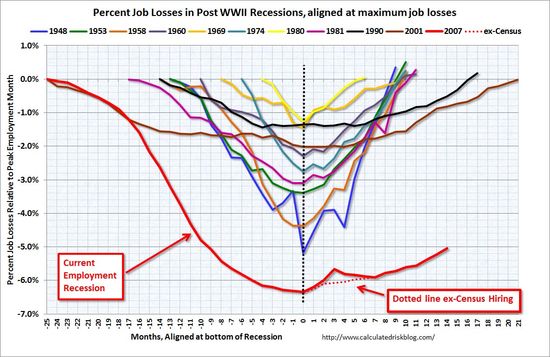
Chart from Calculated Risk, who notes that today's economic numbers were "above expectations for payroll jobs, and below expectations for the unemployment rate." Ryan Avent:
Since the employment bottom in February of 2010, the economy has added 1.8m jobs and the private sector has added 2.1m. Most of those jobs were created in the past year, and about a third of them in the last three months. This is not yet the hiring pace one would hope to see after so deep a recession—there are still 13.7m unemployed workers and nonfarm employment remains nearly 7m jobs below the pre-recession peak. But this is better than anything the American economy has seen in years. The last time the private sector added this many jobs in a month was February of 2006—more than five years ago.
[T]he rise in the jobless rate [which ticked up from 8.8 to 9.0] is not irrelevant. Before today, you could have argued that the employer survey was vastly underestimating the pace of job creation — in other words, the job market was healthier than the employer survey suggested even if it wasn’t quite as healthy as the household survey suggested. After today, it’s much harder to make that case.
Ezra Klein compares the unemployment numbers to corporate profits:
It’s not just tempting to say that the recovery has been good for firms and bad for people. It’s true.
Allahpundit counters Frum and Wiegel:
This poll was conducted before Obama’s announcement of the Bin Laden killing, in case you’re inclined to attribute the huge bounce to goodwill rather than evidence. Needless to say, the key lines are the ones for Republicans and Conservative Republicans; in both groups, the number of Birthers was cut by more than half after the birth certificate revelation. … I argued a few weeks ago that, contrary to big media’s received wisdom, Birthers aren’t a homogeneous group but rather a mix of hardcore and softcore believers, the latter of which were simply misinformed because they weren’t following the issue closely.
I'm with Allahpundit on this. And as heartened by the sanity of the public as I am depressed by the condescension of the MSM.
I'm sorry to say I couldn't handle it, with gauze jammed in my mouth and Vicodin addling my brain. (On the other hand, perhaps those were the ideal conditions for viewing.) But here are some reactions: J.F. at DiA:
The crowd’s favourite, of course, was Ron Paul, who seems to be making a great career out of winning adoring crowds without winning elections. It was heartening to hear the loud cheers that greeted his firm opposition to torture (less heartening: three of the five candidates on stage—Messers Cain, Santorum and Pawlenty—raised their hands when asked if they would support waterboarding).
Santorum backing torture, regarded by his church as an absolute evil, indefensible on any grounds? Funny how these defenders of absolute papal authority and no distinction between church and state just ignore core Catholic values when it suits them. Here's Conor's take:
A lot of people are lamenting the fact that only five candidates were present, but watching the event, I preferred it. The American people were afforded the chance to learn about some of the lesser-knowns. In fact, I wonder if a field of ten candidates should always be split in two sections during early debates. It isn't as if there is much interaction among pols, and once you've got more than six or seven people on stage there just isn't enough time for anyone to be meaningfully interrogated.
Fox wasted airfare, production costs, and the time of some of their marquee names—Chris Wallace, Juan Williams, and Bret Baier—who asked questions of a bunch of also-rans without even pretending to listen to their answers. The first clue this debate was a disaster was when the moderators began to ask the placeholders on stage about candidates who weren’t even there: Mitt Rom-bot, Trump, Daniels, Huckabee, Bachmann, Gingrich, and Trump, again.
The consensus going in was that the lack of frontrunners in the room would minimize the importance of the event. The consensus going out was that the lack of frontrunners in the room minimized the importance of the event—and that Ron Paul's supporters are really loud.
Noah Kristula-Green and Tim Mak:
Pawlenty’s toughest question was the grilling he got on Cap-and-Trade. Fox managed to bring out many speeches and radio ads where Pawlenty had shown his support in the past for a Cap-and-Trade policy. His answer to the question to amounted to “We’ve all made mistakes” and added that there is no such thing as a perfect candidate, challenging anyone who thought they were perfect to declare themselves. Romney wishes he could give that sort of answer on Romneycare.
[S]ome of the expected voices like Jim Hoft and Stacy McCain immediately went into full blow, ALL CAPS DRUDGE MODE yelling CAIN WINS! CAIN WINS! But let’s face it … [I]f we absolutely must pick winners and losers in these things, in the most unsurprising conclusion of all time I’d say round one went to T-Paw. But if Cain can keep turning in performances like that consistently, the rest of the pack may need to start keeping an eye over their shoulders.
Chris Geidner goes back fifteen years to this week in 1996, when DOMA was introduced into the House of Representatives. But he does something much more valuable at the same time. He revisits the struggle within the gay community to get the campaign for marriage rights off the ground. At times in the early days, it felt like just two of us – Evan Wolfson and yours truly – who pushed against the understandable incrementalism of the gay establishment, men and women who, with some notable exceptions (like Tom Stoddard), who really did not want to tackle marriage rights when we did.
It shocks the current generation to be told that marriage equality was fiercely opposed by the right and the left when it emerged as a serious issue in the early 1990s. Here is leftist Michael Warner as recently as 2000:
''At a time when the largest gay organizations are pushing for same-sex marriage, I argue that this strategy is a mistake and represents a widespread loss of vision in the movement.''
My book tour with Virtually Normal, my fully fleshed out case for marriage rights – was picketed in some places – by the Lesbian Avengers. My backing of marriage equality was also the pretext for outing my sex life by leftists who regarded anyone supporting marriage rights having sex when single as some sort of hypocrisy! I was heckled in London – by my fellow gays. HRC was, at best, condescendingly tolerant and, at worst, actively hostile to marriage equality and very defensive on behalf of their Democratic party patrons:
Of HRC's approach at the time … Sullivan is characteristically blunt.
''They were like, 'No, we want to get ENDA. … We know that has higher polling, we can do it.' And my position was, 'Screw ENDA. First, this is a more fundamental issue about the government discriminating against us as opposed to our fellow citizens, and, secondly, if we win this, the argument that we make on this will so change the debate that ENDA will become easy.' And their view was totally understandable — I'm not saying it wasn't.''
But, as Sullivan says he told people at the time, ''It's coming anyway. The courts are going to have to make these decisions.''
And so it came. What has frustrated me these past few years is not the success of the movement, which is simply thrilling, but how that success has in some ways blurred the real and fraught history of this cause both within the gay movement and outside it. Geidner's piece is an excellent first step toward recovering the actual history, with its large share of tensions, setbacks, internal arguments and the battle against and within the Clinton administration.
Nothing is easy; and nothing is inevitable. This was a struggle against both ideological sides toward a sane, humane resolution of a pressing problem. It is not over yet. But its success does cast light on the limits of ideology, if confronted relentlessly with logic and passion and argument.
Assad's army ended an 11-day seige of Deraa yesterday, but his forces are simply shifting elsewhere:
Tanks have taken up positions near the urban centres of Homs, Rastan and Baniyas in the past two day, as activists vowed a "Day of Defiance" on Friday to press a seven-week-old anti-regime campaign in which rights groups say 607 people have been killed and 8,000 others jailed or gone missing. Troops were also deployed in the Damascus suburbs of Erbin, Saqba, Douma and in the town of Tel, north of the capital, the agency reported.
An activist, who asked to remain anonymous for his own safety, told Al Jazeera in a phone interview from Baniyas that the Syrian government was continuing to reinforce its forces, tanks and surveillance on Thursday. "We are facing a sort of a cleansing war against the people of Baniyas," he said.
The bodies are already piling up:
There were reports that five people had been killed in Homs and one in Hama, but Al Jazeera could not immediately verify the reports. "We were chanting 'The people and the army are one' and 'The people want to topple the regime'," a witness told Al Jazeera over the phone. "Then security and thugs opened fire."
The above footage shows live ammunition and tear gas fired at the residents of Homs. More clips here. Live-blog updates here and here.
 The Dish