Tony Dokoupil has details:
Those who endure the full six months swim more than 150 miles, and run some 1,300 more. Then it’s time for more advanced material: high-altitude parachute training, combat tactics, and finally, at least a year of platoon training. By the time a SEAL is combat-ready, the transformation from deck hand to Sea-Air-Land commando costs $350,000 to $500,000, according to estimates—more than the price of two armored Humvees.
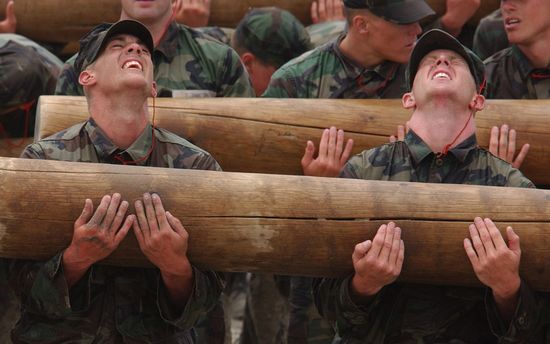
(Photo: Basic Underwater Demolition/SEAL (BUD/S) students participate in Log PT (physical training) during Hell Week June 22, 2003 in Coronado, California.
Log PT is a demonstration not only of physical strength and endurance, but the importance of teamwork. The intense physical and mental conditioning it takes to become a SEAL begins at BUD/S training. During this six-month mind and body obstacle course, recruits are pushed to their physical and mental limits. Further development of the core values, Honor, Courage, Commitment and Integrity, is an essential component of SEAL training and one that is woven throughout a SEAL's career. First phase is the basic conditioning phase and is eight weeks in length. Physical training involves running, swimming, and calisthenics, all of which become increasingly difficult as the weeks progress. The fourth week of training, 'Hell Week,' is five-and-a-half days of continuous training with very little sleep. This week is designed to push students to their maximum capability both physically and mentally. The remaining weeks are spent in hydrographic reconnaissance and basic maritime training. By Photographer's Mate 2nd Class Eric S. Logsdon/U.S. Navy via Getty Images.)

 The Dish