Who We Are

Kevin Drum makes the case for releasing the photos of Osama's corpse:

These are public records of a very public operation against public enemy #1, and like it or not the public should have access to them. The only reason to withhold them would be for reasons of operational security, and I don't think that applies here.

Dave Krueger agrees:

What really galls me is the arrogant position permeating this debate that American’s need to be shielded from the gruesome truth for their own good.  In my humble opinion, if we don’t have the fortitude to see what they’ve done, then they probably had no business doing it.

I'm conflicted here but think the president's position is, in the end, motivated by exactly the right reasons:

"That’s not who we are. We don’t trot out this stuff as trophies."

We celebrate not the death of an individual as such but the blow to his wicked organization, and some closure and justice after his multiple mass murders. To put his head on a digital spike and display his mangled head is, indeed, not the Western way. We are better than that.

How do I square this with my usual unsparing policy of airing all and every image of war? Because this is a named individual and a victim of the war he waged, and we do not display these things like scalps on a wall. Seeing his face does not bring home to us anything we don't already know. It offers no insight into the horrors of war and violates some core Geneva notions of the dignity of captives and corpses.

This is a special case, it seems to me, for restraint as the flipside of a just war. We don't torture and we respect the human dignity of even our worst enemies. This is partly what we fought for – to reverse the barbarism of al Qaeda, not reflect it. We failed for years. We are now beginning to succeed. The right way.

A Day In The Life Of Bradley Manning

David Coombs, his Army Court Marshall Defense Specialist, has some reassuring news:

PFC Manning is now being held in Medium Custody.  He is no longer under Prevention of Injury watch and is no longer subjected to harsh pretrial confinement conditions. Unlike at Quantico, PFC Manning cell has a large window that provides adequate natural light.  His cell also has a desk, a bed, and a toilet.  The cell is approximately 80 square feet.  He is provided with a normal mattress, sheets and a pillow.  None of his clothing is taken away from him at night.

Forgiving Bin Laden, Ctd

A reader writes:

As an individual I have no business forgiving someone who has harmed other people, not me directly.  Perhaps the relatives of those who were murdered on 9/11 feel like forgiving him, then that is their choice, or their gift to be able to do so.  But I think it is dishonorable for people to hand out forgiveness when others were hurt so horribly.  Also in the case of a mass killing, can one forgive for all the other people who were killed, not only one's own?  It is of course also not the business of government to forgive.  For our government capturing and/or killing Bin Laden was a question of policy.

Another writes:

I'm sorry, did I miss something? Did bin Laden actually ask for forgiveness?

Another:

Loving and forgiving our enemies are different things.  Loving our enemies is a base-line duty of Christians.  Forgiveness is a response to people’s acts: forgiveness must be sought.  Admission of error and guilt – acts of penitence and repentance – are necessary preludes to forgiveness.  After all, God Himself loves all sinners, but He will still send them to Hell if they fail to admit to/repent of their sinful nature and ask Him for forgiveness.

I think it’s safe to say that bin Laden never repented or regretted the murders he ordered; and so while Christians may be obligated to love him as a fellow human/sinner, we are under no obligation to forgive him for his acts.

Another:

As an ex-Catholic, now apatheist, I disagree with Catholic theology. However, I give the Church full marks for having centuries of experience with practical human pyschology. Thus, I believe it has some good insights into the subject of forgiveness.

In the Sacrament of Reconciliation, there are several requirements before God, acting through the agency of the priest, will forgive sins. First, one must confess, with specificity, what one did. Second, one must acknowledge that it was wrong. Third, one must express genuine contrition and sorrow for the wrong. Fourth, one must perform penance to make amends for this wrong. Fifth and finally, one must sincerely resolve to never commit such wrongs again. Then, and only then, can one receive forgiveness from God, according to the Catholic Church.

I think these requirements make sense when a person is called upon to forgive other people, not just in the Confessional box. What works for God, works just as well for me and thee. This is the standard I now apply to myself and to others when forgiveness is called for. To ask for forgiveness, is to ask a very great deal. The standard is set high for the penitent. If the standard is not met, forgiveness is not forthcoming.

Osama bin Laden did admit with specificity that he was responsible for 9/11 and many other attacks. However, he never acknowledged that these acts were wrong, nor did he express genuine sorrow for them, nor did he perform penance, and he certainly never resolved to never commit such acts again. Therefore, I do not believe that Christians or any people are "required" to forgive bin Laden.

Another:

C.S. Lewis said a lot of things better than I will ever say them. You probably know his chapter on Forgiveness in Mere Christianity, but here it is anyway. I especially like the idea that if we want "to learn how to forgive, perhaps we had better start with something easier than the Gestapo."

I prefer the words of Reinhold Niebuhr:

Nothing that is worth doing can be achieved in our lifetime; therefore we must be saved by hope. Nothing which is true or beautiful or good makes complete sense in any immediate context of history; therefore we must be saved by faith. Nothing we do, however virtuous, can be accomplished alone; therefore we are saved by love. No virtuous act is quite as virtuous from the standpoint of our friend or foe as it is from our standpoint. Therefore we must be saved by the final form of love which is forgiveness.

My own view is that the imperative of Christian forgiveness is one enunciated by Christ on the cross. He forgave even those who nailed him there. It's a humanly impossible standard. But it is humanity at its highest moral incarnation.
Not At All A Figurehead

Eli Lake reports on what we are discovering from Abottobad:

One U.S. intelligence official who asked not to be named said “a peripheral scan of the data suggests that he provided strategic guidance and direction to al Qaeda’s affiliates. We knew he had contact with the affiliates through couriers, but the evidence we have now is that he delivered the strategic direction to many of these groups.”

The decision not to blow the place to smithereens from the air was both gutsy and smart:

A U.S. official who asked not to be named said bin Laden gave broad orders to al Qaeda affiliates, such as orders to al Qaeda in the Arabian Peninsula, to attack the continental United States. He also said bin Laden received payments from al Qaeda’s affiliates and approved mergers of affiliates.

Ranking The Pundits

James Joyner takes issue with this study:

Prediction is really an odd way to judge political pundits since guessing the future is a mug’s game. … The thing that separates a good pundit from a hack is the ability to analyze facts in an illuminating framework and a willingness to adjust his view as new information comes in.

Megan McArdle makes some of the same criticisms and compares pundits to hedge fund managers:

The study runs for a little over a year, between September 2007 and 2008. … If you were the sort of person who is systematically biased towards predicting a bad end for Republicans, and a rosy future for Democrats, then election year 2008 was going to make you look like a genius.

Teaching About Terrorism

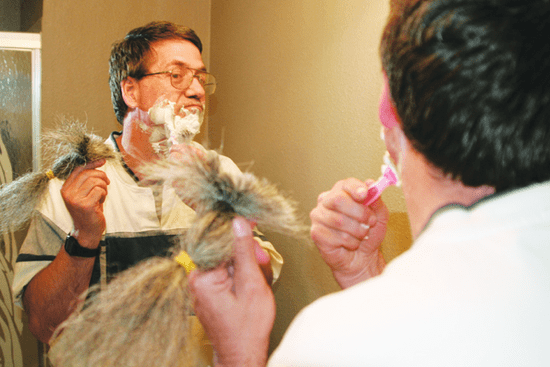
Teacher_Shaves

Liz Dwyer contemplates how teachers addressed bin Laden's death in classrooms given the ignorance of many of their students:

We like to think teachers automatically know the right things to say. But when they're going through their certification programs, there's no special class on how to make meaning from the assassination of a terrorist.

Joy Resmovits has an article on how teachers across the country dealt with the story:

“My first impression is that…most of them have no clue anymore who al Qaeda is and who Osama bin Laden was,” [high school teacher Dan Anderson] said. “He’s some kind of mythic figure to them.” The students, he said, seemed engaged, muttering “uh huh” as they finally received explanations of terms that pervaded the news during their upbringing.

(Photo of Gary Weddle, a middle school teacher who refused to shave after 9/11 until bin Laden was captured or killed.)

The First Republican Debate

Dave Weigel runs through the candidates attending tomorrow's season premiere:

Who benefits from a debate like this? Pawlenty is the only candidate up there seen as a likely or possible nominee. Paul and Johnson are both in the race, essentially, to spread their messages; in Johnson's case, he'll get much more time from moderators than he would (or will) when the race fills out. Santorum and Cain get to vie for the trophy of Most Likely to Make a One-Liner That Dominates Second-Day Coverage.

Get your popcorn. And settle in for the circus about to start.