The Panacea For Pox

Michael Specter chronicles the gory history of vaccination:

By 1700, variolation—deliberate infection with smallpox—had been tried successfully as a preventive measure. It was dangerous, but far less so than the disease itself. Dried smallpox scabs were blown into the nose of an individual, who then contracted a mild form of the disease but was immune afterward. … The actual vaccine—the world’s first—was invented by Edward Jenner, a British country doctor, at the end of the eighteenth century. After noting that milkmaids rarely got the disease, he theorized, correctly, that exposure to cowpox—a virus similar to smallpox but much less virulent—conferred resistance.
The Case For Mystery Meat

Sami Grover makes it using the British staple bangers and mash as an example:

Nowadays if you order that meal at any of the umpteen thousand gastropubs that dot the countryside, you'll most likely be told about the superb bangers that are produced from 100% prime pork meat. Yet I'd be willing to bet that many of my ancestors would find the notion of a banger made from 100% prime cuts of anything to be a ridiculous notion. Isn't the very idea of a sausage to use up trimmings, and perhaps offal, that might otherwise have gone to waste? After all, eating guts, heads, feet and genitalia is greener than eating steak—so long as you know where those body parts came from.

An Empire Built On Excrement

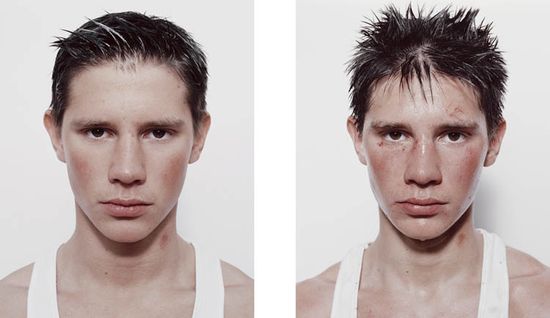
Face

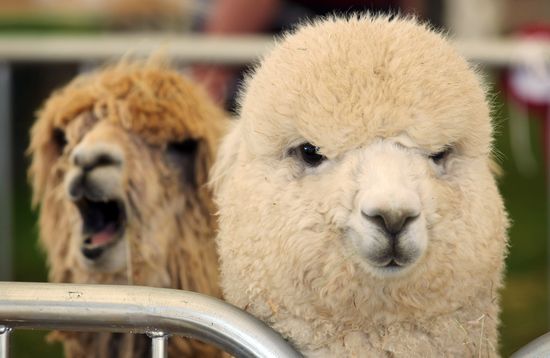
A new study credits llama poop with paving the way for the Incan Empire. According to researcher Alex Chepstow-Lusty, "The widespread shift to agriculture and societal development was only possible with this extra ingredient – organic fertilisers on a vast scale":

[Andean agriculture specialist Graham Thiele] points out that maize could be stored for much longer than other local foods, and also provided much more energy. "It could be stored, and traded and moved over long distances," he says, making it ideal for sustaining an empire. It took almost 2 millennia for the Incas, the greatest of the maize-based societies, to reach their peak. But without the muck-and-maize revolution, says Chepstow-Lusty, they would never have got there.

(Photo: By Matt Cardy/Getty Images.)

Our Dicks, Ourselves, Ctd

A reader writes:

I stopped dead in my tracks upon reading your post where you thought your outward difference represented your internal difference. I had the same experience in high school, except in the opposite way; I am uncircumcised, but nearly everyone else was.

I thought I felt an attraction to men because I was physically different from the other boys. I also remember reading in the bible that I had somehow abandoned a contract with God because I was not circumcised. Because no one ever explained why I was physically "different," I experienced anxiety for years.

The one thing I do know is that parents, whether they circumcise or not, should sit their boys down and explain their rationale either way. Because when they don't, it can be confusing and frightening for a child.

Kafka: Privacy Advocate?

Daniel J. Solove contrasts Orwell's Big Brother state with Kafka's alternate take:

Kafka's novel [The Trial] centers around a man who is arrested but not informed why. He desperately tries to find out what triggered his arrest and what's in store for him. He finds out that a mysterious court system has a dossier on him and is investigating him, but he's unable to learn much more. The Trial depicts a bureaucracy with inscrutable purposes that uses people's information to make important decisions about them, yet denies the people the ability to participate in how their information is used.

The problems portrayed by the Kafkaesque metaphor are of a different sort than the problems caused by surveillance. They often do not result in inhibition. Instead they are problems of information processing—the storage, use, or analysis of data—rather than of information collection. … Legal and policy solutions focus too much on the problems under the Orwellian metaphor—those of surveillance—and aren't adequately addressing the Kafkaesque problems—those of information processing.

The View From Your Window Contest

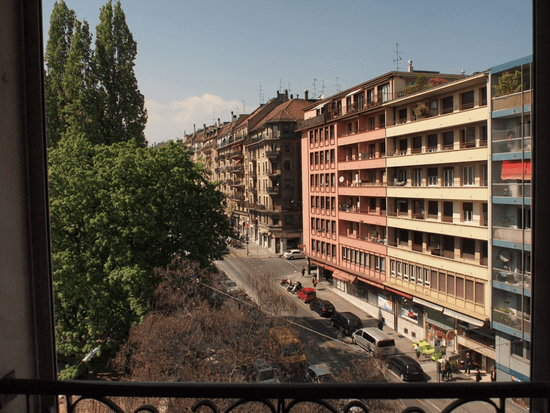
Vfyw-contest_5-30

You have until noon on Tuesday to guess it. City and/or state first, then country. Please put the location in the subject heading, along with any description within the email. If no one guesses the exact location, proximity counts.  Be sure to email entries to VFYWcontest@gmail.com. Winner gets a free The View From Your Window book. Have at it.

Traffic Signs And The Mommy State

Tom Vanderbilt says "Children At Play" signs don't "change driver behavior nor to do anything to improve the safety of children in a traffic setting." Vanderbilt says the bigger problem is residential neighborhoods with speed limits of 35 or higher:

It's not simply that fatality risks begin to soar at impact speeds of more than 20 mph, but that, as a study by John Wann and colleagues at Royal Holloway University in London has suggested, children, until well into their teens, are unable to detect during a normal crossing of the street the approaching speed and distance of cars above a threshold—also 20 mph.

Synthesized Senses

Josh Rothman uses the above video "Synesthesia," by the music-video-directing duo Terri Timely (Ian Kibbey and Corey Creasey) to explain the phenomenon:

Synesthesia is a neurological condition in which your sensory circuits are connected: numbers might have colors associated with them, tastes might have words, sounds might have textures. Experiences in one sense modality borrow the qualities of other modalities. This wacky little film gives you an (exaggerated, Japanese) idea of what it's like. Famous synesthetes includes Vladimir Nabokov (colored letters), Olivier Messiaen (colored chords), Richard Feynman (colored equations), and David Hockney (colored, geometric musical notes).