Moore Award Nominee, Ctd

Many readers are echoing this one:

I'm not a big fan of Michael Moore, but can you actually argue that his statements about bin Laden are factually wrong?  His timing and emphasis may be bad, and we kinda know where he's coming from that's not included in his statement, but what he said is actually true.  We did arm him. We short-sightedly thought bin Laden's only gripe was with the Soviets and that he and the Mujahideen could be controllable, bought off, or would at least turn off the heat once they got what they wanted – ousting the Soviets.

Yes, it is factually wrong. Here's Doug Mataconis:

The evidence, in fact, is fairly clear that the “Afghan Arabs” like bin Laden didn’t interact with the Americans at all. The allegations, on the other hand are based on little more than circumstantial evidence and exaggerations. This idea that the CIA trained Osama bin Laden back in 1980 is simply a myth that needs to die along with bin Laden himself. Moore was wrong, and Sullivan was, it seems to me, entirely correct to call him out for it. This is a myth that has taken hold on both the far left and the far right and it’s time that people stopped lying.

Joyner adds nuance:

I wouldn’t go so far as to call it “lying,” since people are just repeating what they’ve heard. The confusion comes from the Western conflation of the generic “mujahadeen” into a coherent Mujahadeen, much as we’ve done with the various Taliban groups in Afghanistan and Pakistan.

How Was Bin Laden Shot?

Mike Crowley asks for clarification:

What exactly was bin Laden doing in the moments before he was gunned down? Did he threaten the SEALs who confronted him, perhaps by reaching for a gun? Did he have an object that looked like a weapon but wasn’t? Or did someone have an overwhelming human impulse to dispatch perhaps the most hated man in America with a quick “double-tap.”

Was this, in other words, a combat death–or, in all practical terms, an execution? The White House needs to explain this in clear detail as soon as possible.

The Onion has a hunch.

The NYT And Torture: A Breakthrough

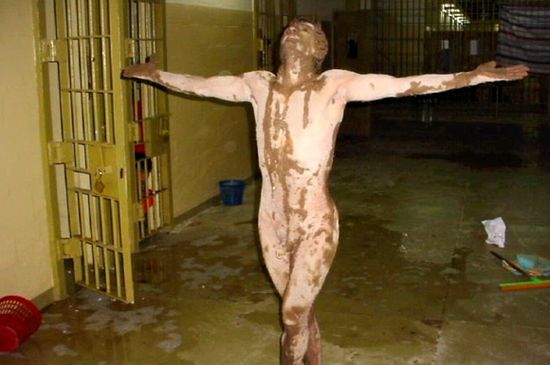
I do not mean the current, alternating headlines in the online and print editions, where the t-word is now popping up. I mean, this story where, because it's about the Iraqi victims of torture, debriefed in Jordan, the NYT will use the word "torture" as plain English has it, because it would not offend their sources in the Bush-Cheney administration. But then … the article reveals American torture. Money quote:

The torturers, clients say, have included the Iraqi Army, American forces, Saddam Hussein’s henchmen, Al Qaeda in Iraq, and the sectarian groups, gangs and militias that continue to terrorize parts of Iraq. Some clients report having been tortured by more than one of these groups. Many clients still fear for their safety, so the treatment center omits victims’ names from its records and uses a code instead.

My italics. And this story has details of what US forces did:

During an interview at the center for torture victims, Jamal — trimly built, bearded, with strong hands, and dressed in jeans and a knit sports shirt — displayed a copy of a document in English and Arabic that recorded his imprisonment. It was a “MultiNationalForces MNF-1 verification of detention” card bearing his name and a serial number. It said he was detained from Dec. 15, 2003, until May 1, 2005.

For the first week, he said, he was held standing up in a tent with a hood over his head, and the soldiers guarding him were ordered to let him sit for only five minutes an hour. The hood was removed only when he was fed. But he said two soldiers were kind, giving him water and letting him sit when the officer in charge was not around. Three times he was taken to an officer to be interrogated. The first time, the Americans asked him about terrorists they were looking for. He knew nothing. They took his clothes off, supposedly to look for tattoos.

In the second interrogation, he said, the officer hit him with a baseball bat. Recalling the encounter, Jamal demonstrated, sliding from his chair to the floor. The officer made him sit with legs apart and hit him repeatedly in the genitals with the bat, he said. During the third interrogation, he said, the officer used an “electric stick” on his arms and legs.

For this victim of US torture, Abu Ghraib, where he was subsequently sent, was actually an improvement. Later,

he was terrified that the Americans would arrest him again. He slept with his shoes in case they came for him during the night, so that he would not be taken away again with his feet bare.

It's good to see – finally – the NYT prepared to use the word "torture" for what this country did to countless victims, in contravention of the law, the Geneva Conventions and core American values. It's also good to see evidence of American decency interwoven with the brutality imposed by president Bush.

Obama’s Leadership In A Photo

Obama_situation

Goldblog waxes philosophical:

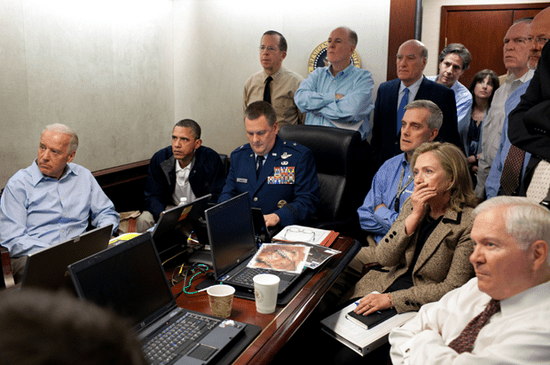
I was struck, when I saw this photo, that the Bush White House would have ever released a similar photograph. This is not to cast aspersions on Bush, but could you seriously imagine his public relations releasing an image of him leading from behind, as it were? … The negative interpretation of this, of course, is that the President wasn't running the meeting, but [David Brooks and I] found this impossible to believe. The positive interpretation is that the President is so confident in his power that he is comfortable even in a corner. This speaks well of him, to my mind; a president who kills America's enemies without swagger is better than a swaggerer who doesn't kill America's enemies.

Alexia Tsotsis tracks the views:

The White House Flickr account averages 100K views per day, and yesterday it received 2.5 million views, and as of 7pm today it already had 3.6 million views an order of magnitude greater than normal. People familiar with the matter are saying that this is the probably the fastest viewed ever photo on on Flickr. Flickr itself will only officially say that it’s the fastest one they’ve tracked…

(Photo via White House Flickr stream)

Isolating Syria

Mona Yacoubian says Assad's regime has "already lost." She claims that "Syria does not possess the vast natural resource wealth necessary to sustain itself over a lengthy period as an international pariah":

Not only has Assad's harsh crackdown deprived him of any legitimacy at home, but these brutal tactics — if unabated — will cement his international isolation. Assad's regime may survive the near-term unrest, but ultimately a severely isolated and heavily repressive Syria is unlikely to have any real longevity in the new Middle East.

Here's hoping. But Iran's coup regime, despite pathetic use of its oil resources, is still hanging on. Maybe Assad's real problem is that he cannot even use religion as a tool. It divides his country far more than it does Iran.

The Big Lie, Ctd

Voc_war_pris_1_pic_abu_ghraib_2

It tells you something that the war criminals of the last administration have rushed to the media in the wake of the demise of Osama bin Laden to claim credit. Yes, as the world heaves a sigh of relief and joy, and president Obama reaps the political benefits of success – just as he would have reaped the whirlwind of failure (can you imagine how the right would be flaying him as Carter today if the helicopters had crashed?) – these men rush to change the subject to justify their own unpunished war crimes.

It tells you a couple of things: first, there is no clear evidence that torturing prisoners played any role in this successful operation; second, that this fact threatens the only narrative politically standing between these war criminals and prosecution under the Geneva Conventions. No wonder they are worried. And no wonder they have persuaded one of their primary outlets, the New York Times, to make this trivial issue in this astonishing Obama success a front-page story.

Take the torture-defenders' strongest point – at one moment in the long process of intelligence work, one prisoner gave some critical information thus:

[A] Qaeda operative named Hassan Ghul, captured in Iraq, … told interrogators that Mr. Kuwaiti was a trusted courier who was close to Bin Laden, as well as to Mr. Mohammed and to Abu Faraj al-Libi, who had become the operational chief of Al Qaeda after Mr. Mohammed’s capture. Mr. Kuwaiti, Mr. Ghul added, had not been seen in some time — which analysts thought was a possible indication that the courier was hiding out with Bin Laden. The details of Mr. Ghul’s treatment are unclear, though the C.I.A. says he was not waterboarded. The C.I.A. asked the Justice Department to authorize other harsh torture methods for use on him, but it is unclear which were used. One official recalled that Mr. Ghul was “quite cooperative,” saying that rough treatment torture, if any, would have been brief.

[My translation from the NYT's newspeak.]

We don't know what was done to this "quite cooperative" source of information, but the very fact that he was "quite cooperative" suggests that torturing him, if that is what was done, was unnecessary. This was 2004. We only found and killed bin Laden Monday. This was no ticking time-bomb scenario in any way – the slim exception to the rule used to create a torture bureaucracy. There was no need to torture. None whatsoever.

Then on to Abu Faraj al-Libi and Khaled Sheikh Mohammed, both tortured by the Bush administration. What we know is that the result of torture was a repeated denial by both of them that the key courier in question was relevant, let alone any details about him:

According to an American official, familiar with his interrogation, Mr. Mohammed was first asked about Mr. Kuwaiti in the fall of 2003, months after the waterboarding. He acknowledged having known him but said the courier was “retired” and of little significance.

Now, al-Libi:

After Mr. Libi was captured in May 2005 and turned over to the C.I.A., he too was asked. He denied knowing Mr. Kuwaiti and gave a different name for Bin Laden’s courier, whom he called Maulawi Jan. C.I.A. analysts would never find such a person and eventually concluded that the name was Mr. Libi’s invention, the official recalled.

This is when it gets particularly truthy. The American war criminals then argue that although neither torture victim gave up the correct information, and one gave an entirely false lead, it was their refusal to tell the truth that proves torture worked! Seriously. It was the failure of torture to get accurate information that proves the validity of the torture! And here you see the psychology of the torturer in graphic light. They know what they did was inexcusable, un-American, evil. And so it must be justified in their minds.

Truths gained from torture legitimize it; lies gained from torture legitimize it. The torturer can pick and choose. This is not a reasoned argument; it is a form of self-exculpation after committing evil that will haunt these torturers to the end of their days, as it should.

And then the argument shifts again. You see: torture wasn't even designed to get information during the torture sessions. It was designed to break down a prisoner's will and dignity so completely and permanently that these shells of human beings became, in the chilling words of one confessed war criminal, "compliant." Money quote:

“The main thing that people misunderstand about the program is it was intended to encourage compliance,” says John McLaughlin, deputy director of the Central Intelligence Agency during the period in which waterboarding was used. “It wasn’t set out to torture people. It was never conceived of as a torture program.”

One former senior intelligence official says that “once KSM decided resistance was unwise, he then started spilling his guts to the agency and started providing lots of info, like the noms de guerres of couriers and explaining how al-Qaeda worked.” Rodriguez says, ”It’s a mistake to say this was about inflicting pain. These measures were about instilling a sense of hopelessness and that led them to compliance.”

Instilling a "sense of hopelessness" meant slamming human beings against plywood walls, near-drowning them scores of times, freezing them to near-death, hanging them in excruciating stress positions, depriving them of sleep for insane amounts of time, or putting them in coffins or threatening to kill their children. It meant torturing them. If the goal was to destroy these human beings in contravention of the laws of war and basic American values and thereby later get accurate information, then it clearly failed. KSM lied months after being waterboarded 183 times. And we are now expected to interpret that as a success for the torture program?

Yes, we are. It's about as desperate an argument as you can imagine. But desperation is clearly necessary. Jose Rodriguez, the former CIA chief quoted above, admits he destroyed the video evidence of the war crimes he authorized and now tries to spin away his disgraceful conduct. Ditto John Yoo. These allegedly independent commentators have a vested personal interest in making this absurd case, even as their torture techniques have been exposed in this instance as having provided false information, and as having been unnecessary, even according to the official accounts.

The capture of bin Laden was done according to American principles under a president who has outlawed torture. It involved countless individuals carefully piecing together shards of clues and evidence over a number of years – people who are not and never were war criminals, the decent ones, the law-abiding ones, the discreet heroes who will not take to newspaper op-ed pages to justify the unjustifiable or to claim credit for themselves for a victory they had almost nothing to do with. It is these people we should be honoring this week, along with the SEALs who pulled this off and the president who made the final call – not the men who brought such shame to this country and such damage to its intelligence.
The Drug Pipeline: Clogged?

David Bornstein examines why there were 800,000 medical research papers published in 2008 and only 21 new drugs approved by the Food and Drug Administration last year:

“Pure science is what you’re rewarded for,” notes Dr. [Ben] Barres. “That’s what you get promoted for. That’s what they give the Nobel Prizes for. And yet developing a drug is a hundred times harder than getting a Nobel Prize. … Until five or ten years ago, working on disease was kind of shunned.”

But if you're trying to hold down medical costs, a dearth of new treatments will, paradoxically, help.

Why Exaggerate?

OBL

Glenn Greenwald is furious that news outlets relayed inaccurate government reports:

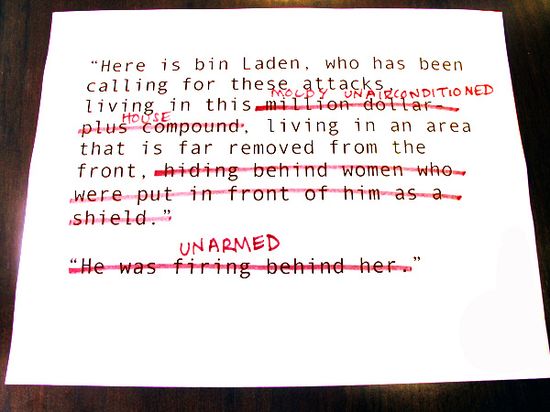
Whether bin Laden actually resisted his capture may not matter to many people; the White House also claimed that they would have captured him if they had the chance, and this fact seems to negate that claim as well. But what does matter is how dutifully American media outlets publish as "news reports" what are absolutely nothing other than official White House statements masquerading as an investigative article. And the fact that this process continuously produces highly and deliberately misleading accounts of the most significant news items — falsehoods which endure no matter how decisively they are debunked in subsequent days — doesn't have the slightest impact on the American media's eagerness to continue to serve this role.

Amy Davidson addresses the same subject:

How much does it matter for us to get all the details right? Isn’t there a larger truth: that bin Laden was a bad man, and a murderer, and a plotter of more murderers, and we got him—imperfectly, maybe, but doing our best? It still matters, a great deal. Our victory over him, ultimately, will depend on whether people in the world feel that we are asking them to live with the indignity of being lied to—or are complicit in the lies we tell ourselves—or are, instead, dealing with them honestly. The soldiers who went after him risked their lives; we can live with the truth, whatever it is.

(Image by Alexis Madrigal, via Garance Franke-Ruta, whose own analysis of the administration's shifting account is worth reading.)