The Daily Wrap

Today on the Dish, Andrew dismantled the Big Lie that torture got bin Laden, and student geographers got pretty close to predicting where Osama had been hiding. We debated whether to release the photos, the White House walked back some of Osama raid details, readers maintained skepticism, and Obama's approval rating jumped. Beinart praised Obama for altering the course on Democrats and foreign policy weakness, Larison urged caution, and Palin kept it classy.

Hitchens summarized bin Laden's preaching, and a reader wondered what we would have done with him if we'd caught him instead of killed him. A Marine cried but understood why we celebrate, a Catholic grappled with forgiving bin Laden, and Conor nailed Limbaugh's hedge on Obama. Salman Rushdie rejected Pakistan's double game, some came to Pakistan's defense, and Bruce Schneier parsed Americans' ability to feel secure. Egypt moved to relax its border with Gaza, and Juan Cole envisioned Obama's grand plan to change the reception of America in the Middle East.

We sized up Ron Swanson's politics, Matt Steinglass reached to sympathize with the birthers, and Palin's foreign policy crew deserted her. Trump compared gay people to putters, Krugman's predictions were fairly spot on, and Felix Salmon discounted individual actions against global warming. The South's racism hindered its economics, we contemplated abandoned malls, and Charles Kenny didn't want to return to pre-modern, uncontacted tribal lifestyles. Alcohol made us want cocaine more, Angry Birds crossed over to mind control, the hunt for Dishterns continued, and a perfumer recreated the musk of a man's butt.

First Muslim playmate here, Moore award here, Yglesias awards here and here, cool ad watch here, quotes for the day here and here, correction of the day here, FOTD here, MHB here, VFYW here, and contest winner #48 here.

–Z.P.
Democrats Own Anti-Terrorism, For Now

Education_Egan

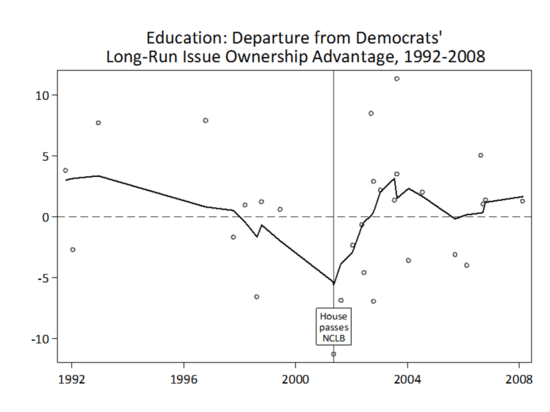
Patrick Egan expects Democrats will temporarily become more trusted on terrorism:

This is the kind of event that happens only every once in awhile: elites from both parties praise action taken on an issue by the party that does not “own” the issue.  What we’ve seen taking place after similar events in the past is a significant but only temporary dip in the reputation advantage held on the issue by the owning party.

As an illustration, consider the issue of education, where the parties’ issue reputations are in reverse.  Compiling poll results from the past two decades, I estimate the long-run advantage held by the Democrats on education (controlling for any concurrent general sentiment toward the two parties) to be about six percentage points on average.  As shown in the [above figure], the passage of Bush’s No Child Left Behind in 2001 (with the imprimatur of liberals like Ted Kennedy) caused a significant dip in the extent to which the public trusted the Democrats more than the Republicans to handle the education issue.   But this change was temporary: by the end of Bush’s first term, the Democrats’ advantage was back to its equilibrium level.  That’s my best guess about what will happen with regard to the Republicans’ reputation advantage on terrorism in the wake of the killing of bin Laden.

Spreading The Intelligence Around, Ctd

Robin Hanson claimed that opposition to GPA redistribution paired with support of income redistribution is evidence of "natural hypocrisy." Andrew Sprung counters:

GPA is more tightly tied to individual performance than earnings are. Granting that a) grading is an imperfect measure of the quality of student input, and b) earnings bear some relationship to performance, it's still true that student performance bears a closer relationship to grade than the social utility of the average person's work does to that person's earnings. 

Also, we have the right as a community to take some pay back as price of admission, and no right because no motive to take GPA back. Collectively, we pay someone for performing a service because we want what they're selling. Taxing back a measure of that payment is as organic to human society as paying it out  in the first place, since tax of one kind or another is the price of admission to any human community. "Taxing" the measure of school performance, on the other hand,  only makes sense if you regard GPA as a commodity rather than as a condition for further learning.

The Feeling Of Security

Bruce Schneier weighs security trade-offs in a compelling TED talk:

Ezra Klein summarizes key points from Schneier's talk and ponders the impact on policy:

If Congress does a bad job fortifying our ports against terrorist attack, there still might never be a successful attack on our ports. And if there is a successful attack, it likely won’t happen for years, at which point it’ll be another Congress’s problem. So if voters are demanding you make them feel safe now and you’re not likely to be around for, or connected to, the consequences of ignoring risks that no one is thinking about, it’s pretty natural to focus on the dangers your constituents want addressed rather than the dangers that actually need to be addressed.

Alex Tabarrok's thoughts on childhood safety trends add more data points to the debate:

It is true that one of the most horrible things we can imagine, homicide, is up. For kids aged 5-14 homicide mortality went from 0.5 per 100,000 in 1950 to 0.8 per 100,000 in 2005. Overall, however, kids are much safer today than in the 1950s. Accident mortality, for example, is down from 22.7 per 100,000 in 1950 to 6.2 per 100,000 in 2005 (see Caplan’s Selfish Reasons for more details). Maybe buckling up and ocean supervision isn’t so bad. Maybe parents today worry too much. Probably some of both.

Cutting Our Carbon Footprints: Pointless?

Felix Salmon discounts solitary actions against climate change:

[I]ndividual attempts to minimize our carbon footprint are not going to make any real difference. When I see people suffering a significant loss of utility because they’re watching their footprint and refuse to fly, for instance, it’s pretty clear that the personal cost of their decision is much greater than any global benefit. Even if they act as a role model and persuade others to follow their lead, they’re still perpetuating the idea that individual actions count. And I’m not sure there’s any evidence for that. Especially when the single most carbon-intensive thing that anybody can do — having children — is the last thing that they ever will (or should) give up for the sake of the planet.

In Defense Of Pakistan As An Ally, Ctd

Scoblete concedes that Larison makes a "very fair point with respect to Pakistan and their support for the Afghan Taliban" but he doesn't "think it applies to allegations that they sheltered bin Laden or other al-Qaeda members":

Keeping bin Laden secreted away doesn't advance Pakistan's aims vis-a-vis India or Afghanistan, as far as I can tell. And even if the ISI did have some kind of rationale, so what? Ultimately, we have to have some red lines and harboring fugitives responsible for slaughtering Americans on American soil is surely one of them.

Correction Of The Day

Science Insider updates their post on the student geographers' guess of bin Laden's location:

The figure initially reported was incorrect; the model predicted a 88.9% probability given the distance. Also, the model only predicts the probability of his being within a geographic radius of his last known location, not a specific city.