Another Bloody Friday

Several more Syrians were gunned down today:

The killings came amid renewed demonstrations after midday prayers on Friday, dubbed "day for the Guardians of the Homeland" by pro-democracy advocates in an effort to reach out to the army to join their 10-week uprising. … Khodr, our correspondent, said the number of casualties had been low in comparison to previous Friday protests, "a sign that the Syrian government is realising that it cannot stop these protests by relying [only] on a security option" without dialogue.

In the above clip, demonstrators in Qamishli are shouting "Leave, Leave, Leave!" More footage from around the country here.

The Herman Cain Bubble, Ctd

Jonathan Bernstein deflates it:

The larger idea here has to do with what a nomination process is really all about. Josh Putnam makes the point today: "The party decides these things — more often than not." Or to put it another way, it's a mistake to think about presidential nominations as elections between equally matched candidates appealing to mass electorates. Instead, then of it as a political party — which is a sprawling, unorganized combination of people and organizations — trying to make a decision.

Oprah-ism vs Spy-ism

Viginia Postrel compares Oprah to Spy Magazine:

Both Spy and "The Oprah Winfrey Show" sold gossip and personal stories. Both made their audiences feel like members of a club of superior people. Both were self-congratulatory. But the bases for their self-congratulation were, of course, very different. Spy and its audience prided themselves on being wised-up, clever and edgy; Oprah and her audience on being empathetic, optimistic and resilient. If "Oprah" was about uplift, Spy was about putting people in their place.

Palin’s Bus Tour Ad

Does this sound like someone not running?:

John Dickerson ponders a Romney vs Palin primary fight:

We know what President Obama's strategists would like: a civil war between the Romney's establishment Republicans and Palin's Tea Party populists. They would like it to mirror the 1996 GOP race, in which Steve Forbes drained Bob Dole of resources, weakening him for the general election.

Netanyahu’s Prerogative

Michael Walzer nails it:

Why did he focus on the line about ’67 and pick a fight? There is a simple answer to that question: he isn’t interested in the peace process; he doesn’t believe that there is a peace process; he is thinking only of his political position at home. His speech to Congress was his reelection platform.

Walzer looks ahead to September:

Actually, if the Palestinians are smart, as they are these days, they won’t walk across the lines, for that raises the specter of return, and the right of return doesn’t (yet) have sufficient international support. Come September, after the UN recognizes their state, they will march inside the 1967 lines, thousands of them—from Nablus, say, into the nearby settlements and army bases, asserting their own sovereignty and territorial integrity. And what will Israel do then? Many Israeli rightists would, almost certainly, prefer a new terrorist campaign, which would put the Palestinians once again in the wrong. That is certainly possible, but it is, suddenly, less likely than peaceful protest.

Virtual Hard Labor

Bizarre:

Liu [Dali] says he was one of scores of prisoners forced to play online games to build up credits that prison guards would then trade for real money. The 54-year-old, a former prison guard who was jailed for three years in 2004 for "illegally petitioning" the central government about corruption in his hometown, reckons the operation was even more lucrative than the physical labour that prisoners were also forced to do.

The New Zionists

114677953

Yglesias watches the rise of post-Jewish Zionism:

That’s not to say that there are no Jewish Zionists in the United States (or Canada, etc.) but merely to observe that Jews as such are decreasingly relevant to the politics of Israel. In Europe, too, we’re seeing a boom of far-right parties (True Finns, Geert Wilders’ Freedom Party, the Danish People’s Party) with strong pro-Israel stands. And why shouldn’t there be? An Israeli government whose policies are based on putting zero moral weight on the welfare of Arabs is a natural partner for xenophobic anti-Muslim parties who appeal more to Europe’s local sociocultural majorities than to its small Jewish communities.

Daniel Levy says demographic changes in Israeli society track with Netanyahu's shift to the right:

Whereas settlements catering to the ultra-Orthodox population barely existed when Netanyahu first became prime minister, the two fastest-growing settlements today — Modiin Illit and Beitar Illit — are both ultra-Orthodox. (Their combined population is 80,000 today, compared to 10,000 in 1996.) It is worth noting that the average age in Modiin Illit is ten years old, the lowest of any Israeli city. Clearly, the political influence of the ultra-Orthodox settlers will only grow in the coming decades.

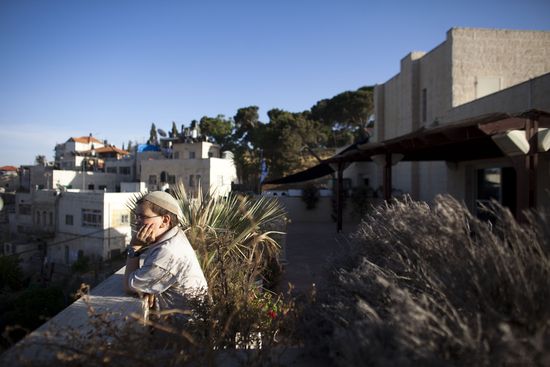
(Photo: A Jewish settlers boy looks on from his balcony during the inauguration ceremony of new settler homes on May 25, 2011 in the Jewish enclave of Maaleh Zeitim in the Palestinian neighbourhood of Ras al-Amud in east Jerusalem, Israel. Maaleh Zeitim was financed by American millionaire Irving Moskowitz who has bankrolled other settlement projects in the occupied West Bank, and east Jerusalem. By Uriel Sinai/ Getty Image.)

What Israel Does For The US

Noah Millman outlines the "psychic benefits" of the American-Israeli relationship:

Israel has been a particular friend to America in one respect. When we want to assert our exceptionalism, Israel has consistently supported that assertion. Much of the rest of the world wants to subject American power to something resembling a system of laws and norms through institutions like the International Criminal Court. America, for understandable reasons, has resisted this, even when parts of the system were our own creations, designed to legitimate our own supremacy by limiting its absolute scope. We can debate whether our resistance is wise or not, but my point is that Israel has been consistently supportive of our resistance – again for obvious reasons. The psychological component of this comraderie is that we are simultaneously able to maintain our sense of ourselves as boundless and universal, and relieved of some of the burden of our solitude in such a position.

Nicely put. But I would not discount the religious themes underpinning this, which are very potent in the current GOP. Evangelicals view Israel and America as uniquely sacred entities, united in an eschatological struggle between good and evil. Each country is thereby exempted from the usual international laws and rules, because G-d himself has anointed both of them in a pre-ordained battle of existential power.

When Romney preposterously declares that Obama has thrown Israel under the bus, he is sending a message to evangelicals. Allegedly betraying Israel at this pre-apocalyptic hour is the work of Satan. Any partition of the chosen land is the goal of the anti-Christ – hence the incomprehension and shock at any mention of the 1967 borders. Just as the early Puritans saw their new land as a new Zion, so did the first Zionists in Israel. And you cannot rationally negotiate with these kinds of convictions. Alas, in Israel, the pre-existing population didn't die en masse by unwitting biological warfare. Hence the need, as Palin and Huckabee have urged, for a much more aggressive Jewish settlement of Judea and Samaria.

These are profound psychological affinities and beliefs. They were deepened by 9/11 and the rise of Jihadism. The American and Israeli Zionists are flummoxed and terrified by the Arab Spring because it scrambles this Manichean dichotomy. The whole idea that the US should make strategic decisions about its worldly self-interest, when an other-wordly imperative demands a different approach, strikes them as bizarre. Like the settlers in Judea and Samaria, these American theocratic exceptionalists are not a majority; but, like the settlers, they are redefining one political party and thereby redefining America.

I fear this apocalyptic thinking is self-fulfilling. Which is why it chills me. And why a Palin presidency which would unleash this dynamic into a vortex of religious global warfare terrifies me.