A Marine Killed In His Own Home

Balko is all over the tragic story of yet another marijuana raid gone wrong:

As the SWAT team forced its way into his home, [Jose] Guerena, a former Marine who served two tours of duty in Iraq, armed himself with his AR-15 rifle and told his wife and son to hide in a closet. As the officers entered, Guerena confronted them from the far end of a long, dark hallway. The police opened fire, releasing more than 70 rounds in about 7 seconds, at least 60 of which struck Guerena. He was pronounced dead a little over an hour later.

The Pima County Sheriff's Department initially claimed (PDF) Guerena fired his weapon at the SWAT team. They now acknowledge that not only did he not fire, the safety on his gun was still activated when he was killed. Guerena had no prior criminal record, and the police found nothing illegal in his home.

A likely reason why Guerena was armed with a rifle: Two of his wife's relatives were murdered and their children shot by intruders last year.

What A “Colored Girl From The Backwoods Of Mississippi” Achieved

Rebecca Traister absorbs the meaning of Oprah’s last show:

BabyoprahOprah has made blackness more visible, has helped familiarize a country’s daytime  audiences — not always the most politically progressive — with people they might otherwise not have known. Thanks to her, viewers know Steadman and Gayle, Toni Morrison and Maya Angelou. Her book club members have read “Song of Solomon,” “Sula,” and three books by Faulkner with race at their core.

So I’m Allergic To Wheat! Ctd

A reader writes:

Be grateful that you are NOT gluten-intolerant or celiac!  Whew!  The possibilities are so much wider with a wheat allergy than they are with those problems. The increased diagnosis and awareness of gluten intolerance, however, is a real boon to those who cannot tolerate wheat.

Another writes:

I am weirdly pleased by this announcement – not for your sake, but for the sake of the growing numbers of people who are discovering they have celiac or who are also allergic to wheat. Celiac disease is has gone from being a crackpot idea a few years ago to a condition considered by some doctors to be among the most underdiagnosed in the population. ( I believe the estimate is now 1 in 200 people.) And it can be a very difficult condition – I know a couple of people with celiac, one a little girl whose parents thought she was dying of cancer before she was finally diagnosed at age 4, and a medical professor in his 60s who was only diagnosed a couple of years ago – before, he looked absolutely awful, easily 10 years older than he was – scrawny, blotchy, and weak. "I'm a believer now," he said, after starting his gluten-free diet.

Another:

I'm a long-time reader.  I'm also a gastroenterologist and researcher specializing in celiac disease, and would like to offer the following:

Going gluten-free is absolutely necessary in patients with celiac disease. This is diagnosed via intestinal biopsy during a gastrointestinal endosocopy.  This condition is increasingly common and now occurs in 1% of all individuals in the US.  Physicians often fail to recognize the symptoms of celiac disease, and a recent study by our group has found that biopsy practices nationwide often fall short of the recommended practices, i.e. physicians are not submitting an adequate number of specimens during biopsy, further contributing to underdiagnosis.

At the same time, there are many people in this country who do not have celiac disease but are going gluten-free.  Some, as in your case, have an allergy test that suggests a wheat allergy.  Many others go gluten-free without the advice of a physician or dietician, and report improved symptoms of all sorts (such as abdominal pain and bloating, depression, and energy level).  Most of these patients, when tested for celiac disease, do not have it.  The scientific community is only starting to study this phenomenon, which is called "gluten sensitivity" – a medical term that hides the fact that we do not understand why or how some people feel better when restricting gluten. 

I do not believe that gluten is toxic in the general population.  At the same time, if someone is suffering and going gluten-free leads to an improvement, it stands to reason that he should stay gluten-free, even if he does not have celiac disease.

That said, going gluten-free has its downsides.  In addition to being expensive, inconvenient, unpalatable for some, and potentially socially isolating, a gluten-free diet can be deficient in certain essential vitamins and minerals.  Unlike wheat, gluten-free substances are often not fortified.  I have seen patients on a long-term gluten-free diet develop vitamin B12 and other B vitamin deficiencies.  For this reason, I recommend that individuals on a gluten-free diet (regardless of whether the patient has celiac disease) take a daily multivitamin and have vitamin levels checked periodically.

Another:

Going gluten-free has been a fad for some folks and a necessity for those with celiac disease. But both groups have made the world easier to live in for anyone who must or wishes to remain wheat-free. Product labels, recipes and some restaurant menus have been rejiggered in such a way to make your allergy more of an inconvenience than a huge life change.

How Popular Is Medicaid?

Medicaid

Jonathan Cohn touts a new poll:

In a new poll from the Kaiser Family Foundation, 60 percent of respondents said they oppose Republican Medicaid plans and only 35 percent said they support them. (The rest responded “don’t know.”) But even more striking were the responses to follow-up questions. When the Kaiser Foundation asked respondents about their personal exposure to the program, 63 percent said they knew somebody who’d once gotten insurance from Medicaid, and 58 percent said they knew somebody who’d paid for long-term care with Medicaid.

Victory?

Jonathan Rauch celebrates this poll:

As I argued here, when moral disapproval falls below a certain critical mass, the whole superstructure of discrimination will eventually topple with it. … Political polls bob up and down, but never in my career of covering politics and society have I seen such rapid movement of public opinion on a core social values. But I think one must bow before the accumulating evidence and say this: we are at a Berlin Wall moment in gay-straight relations. Right now.

Adam Serwer fears a backlash. Steve Chapman notes it will not affect the GOP one iota:

The recent emergence of a majority that favors same-sex marriage constitutes a turning point. So did the Battle of Gettysburg — and at that moment, the Civil War was only about half over.

I take Chapman's point. There are moments when history shifts, but those most threatened by change dig in even harder. Think of the Arab Spring and Netanyahu. It takes a while before tectonic change reshapes the landscape. And sometimes it's brutal when it comes.

The Second Coming Of Gary Hart?

Steve Kornacki yawns at Palin's candidacy:

A Palin campaign would probably play out similarly to the second phase of Gary Hart's 1988 presidential campaign, when he jumped back in the race (seven months after dropping out amidst a sex scandal) two months before the New Hampshire primary, and quickly found himself atop the polls. But all was not well. Hart, who had been the frontrunner when he'd dropped out, still had many grassroots admirers, but his negative numbers were also unusually high, among all voters and even among Democrats. And the party establishment treated him like poison; they didn't want him anywhere near their general election ticket. He couldn't build a serious campaign organization, rank-and-file voters got the message, and Hart — even though he'd been a national political sensation between 1984 and 1987 — was a nonfactor in the '88 primaries.

But Palin has never dropped out of a race. She just dropped out of a governorship. And there has been no massive Monkey Business-style scandal yet – just a constant drumbeat of petty scandals which, for many, sounds like white noise. And Hart's appeal was cerebral; Palin's is gastro-intestinal. The latter – fire in the belly and all – endures. But, gee, I hope Kornacki is right.

Quote For The Day II

“Charlie Crist had everything, right? He had name ID, tons of money in the bank. He was the sitting governor, he had all the advantages of incumbency, and yet this ragtag insurgent movement connected to a capable candidate and blew up that whole model. In some ways Romney looks like the Charlie Crist of this cycle: he’s got all the money, he’s got the name ID … It’s not just about money anymore. It’s about grassroots organization and an ability to organize,” – Matt Kibbe, from Freedomworks, a Tea Party group that intends to do all it can to defeat Romney's candidacy.

Spying On Linguistics

Ideasfood

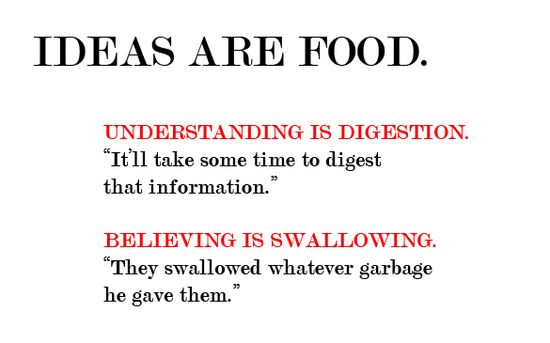
Alexis Madrigal investigates the government's Metaphor Program, run by the Intelligence Advanced Research Projects Activity [IARPA]:

The Metaphor Program may represent a nine-figure investment by the government in understanding how people use language. … The assumption is that common turns of phrase, dissected and reassembled through cognitive linguistics, could say something about the views of those citizens that they might not be able to say themselves. The language of a culture as reflected in a bunch of text on the Internet might hide secrets about the way people think that are so valuable that spies are willing to pay for them.