2012 Tea Leaves

Dismissing the advice of pollsters, Jon Chait reads into NY-26:

I think the race is quite significant. Yes, the race is almost certainly an outlier, in the sense that if Democrats everywhere could overperform the partisan division of their district as much as Kathy Hochul seems likely to, then they’ll easily sweep control of the House next year. That seems unlikely. Even as an outlier, though, this race fits together with other data to tell us that the political landscape has fundamentally shifted in the six months since the last elections.

Are Harsh Prisons Effective?

Erik Voeten finds research that suggests they aren't:

Inmates housed in higher security levels are no less likely to recidivate than those housed in minimum security; if anything, our estimates suggest that harsher prison conditions lead to more post-release crime. Though small sample sizes limit the precision of our estimates, we argue that our findings may have important implications for prison policy, and that our methodology is likely to be applicable beyond the particular context we study.

Ditching The Ryan Budget

Nate Silver says Republicans ought to worry about the snowball effect:

[E]ach Republican lawmaker who comes out against the bill makes it a bit less popular — and that in turn increases the incentive for other Republicans to break ranks too. Some Republican House members might be willing to stomach voting for a bill that has the support of 45 percent of the voters in their districts, but if popular support is just 40 percent, or 35 percent, they may throw in the towel. So a feedback loop develops, and one defection begets another.

Thinning Out The Prisons

Yesterday the Supreme Court upheld a ruling that forces California to release over 30,000 prisoners in order to address prison overcrowding. Mark Kleiman sees an opportunity:

For the cost of keeping a prisoner, we could watch not only him, but several others with a combination of drug-testing (where relevant) GPS position monitoring (enabling curfews and making it hard to commit new crimes undetected), and HOPE-style sanctioning: swift, certain, and mild penalties for every violation of conditions. Less crime, less spending, fewer prisoners. What’s not to like?

Friedersdorf wonders if "the stars are aligning for the nation's largest ever early release-with-ankle-bracelet experiment."

Getting To Know T-Paw

103359655

Conor Friedersdorf reads Pawlenty's book, Courage to Stand, so you don't have to:

Politicians usually emphasize these anecdotes about the decline of industry in the Midwest and a job being "more than a job" when they're about to transition into populism. … As far as I can tell, the endlessly repeated narrative of growing up around blue collar people when their industry went bust builds to no special Pawlenty insight or policy proposal (even a counterintuitive one). There's never even a hint that he has an opinion of who was right during the major labor versus union battles that happened in meat packing. So why does he tell these stories? Is Pawlenty's emphasis on growing up around blue collar workers meant to signify anything of substance?  Is the mere fact of it sufficient to win votes?

Wolcott is less evenhanded:

On the morning that Pawlenty was passed over as McCain’s V.P. pick, he took the dog out for a walk and, bending to scoop her poop, thought, “Well, this is the only number two I’ll be picking up today.” After giving himself a good chuckle, “I tucked that slightly crass, self-directed joke into my proverbial pocket, thinking it might be fun to share it at an appropriate moment during the Republican Convention the following week.” Such evaluations are subjective, difficult to adjudicate, but I think it possible that Pawlenty, or T-Paw, as his imaginary followers call him, may be a bigger crock than Mitt Romney.

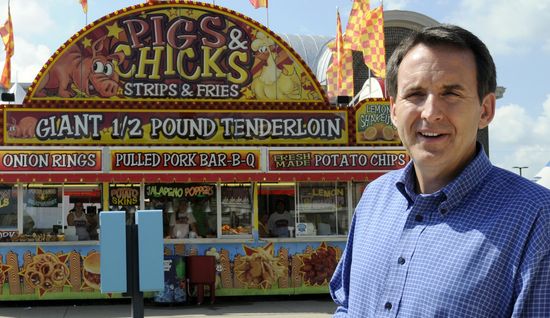
(Photo: Minnesota Gov. Tim Pawlenty strolls the grounds at the Iowa State Fair August 12, 2010 in Des Moines, Iowa. By Steve Pope/Getty Images)

The Power Of AIPAC, Ctd

The prime minister of Israel gets more standing ovations than the president of the United States. Money quote:

Netanyahu's speech – and the thunderous bi-partisan response – was a clear challenge to the idea of using the 1967 boundaries – with or without “swaps” — as a basis for a peace deal. Netanyahu also got big ovations with hard-line statements on two other perennial sticking points to Israeli-Palestinian peace agreements:  No right of return for Palestinian refugees, insisted, and “Jerusalem will never again be divided. Jerusalem must remain the united Capital of Israel.”

And with those conditions, he ensures no peace. Because, as Josh Marshall notes, he wants no peace. Just more expansion and more war. The US is, as he once said, "easy to push around." This conversation is worth remembering at a moment like this:

Netanyahu: The Arabs are currently focusing [on] a war of terror, and they think it will break us.  The main thing, first of all, is to hit them.  Not just one hit, so many painful hits that the price will be too heavy to be borne.  The price is not too heavy to be borne now.  A broad attack on the Palestinian Authority [will] … bring them to the point of being afraid that everything is collapsing.

Woman: They’re not afraid; they’re making fun of us.  They shoot into our settlement and make fun of us.

Netanyahu: Fear that everything is collapsing – that’s what leads them to … (makes a hand motion).

Woman: Wait a moment, but then the world will say: “How come you’re conquering again?”

Netanyahu: The world won’t say a thing.  The world will say we’re defending.

Woman: Aren’t you afraid of the world, Bibi?

Netanyahu: Especially today, with America – I know what America is.  America is something that can easily be moved; moved to the right … [direction].

Child: They say they’re for us, but, it’s like…

Netanyahu: They won’t get in our way.  They won’t get in our way.

Well, Congress certainly won't.
Crime Falls Further, Ctd

Kevin Drum attributes the recent fall in crime to anti-lead policies:

[M]y recollection of the evidence is that recessions have a mixed effect on crime rates. On the other hand, the cohort effects from lead abatement efforts and the introduction of unleaded gasoline probably continue to make themselves felt, so this might not be as mysterious as it seems.

Karl Smith goes further, writing that "crime and poverty in the first world are biological diseases." Drum ponders this and claims that "belief in biological determinism should make you into a liberal."