I guess you could see this coming.
Month: May 2011
No Bulk Tylenol In Britain
Drugstores in England stopped selling big bottles of headache pills in order to cut down on suicide attempts. Stephen J. Dubner explores the consequences. The view of psychologist David Lester:
They started doing that about five years ago, and they restrict the numbers, and they put them in plastic blisters so you have to tear them out. And again, you’d think all I have to do is go to six drugstores, you know, buy packets in each of them, all I have to do is just tear them out. But it has cut down the number of overdoses. It’s also cut down the number of serious overdoses that have led to kidney damage. Now, very few people die of an acetaminophen overdose. So it’s been hard to document that it cut the number of deaths, but certainly the number of attempts.
Sarah Palin’s Alaska – As Seen From Britain
The one silver lining: we get to read the reviews! Dish fave:
Her calculation seems to take a leaf out of the book of her near neighbour Vladimir Putin (whose country, lest we forget, is visible from Alaska). His vacation snaps depict him wrestling with mammoths, lassoing yaks and taking semi-automatic potshots at Chechens. Palin looked just as macho fishing the same waters as huge brown bears, whose aggressive snarls she met with a nauseating panoply of faked-up orgasmic squeals … Meanwhile back at home the baby’s diaper was changed on the bearskin rug. A wall-mounted caribou looked on impassively. Various people called things like Truck and Trog, Troop or Trib or Troll wandered about, walk-on players in this risible woman’s delusional pitch for power…
Tina Fey, you can retire.
Then this one:
She is just this incredible force for boredom. It's like a magic trick; she can take an observation that is already inherently boring, then make it 10 times more boring with unenlightening statistics, a Newspeak vocabulary and this ghastly cheerleader delivery.
Quote For The Day
"It has been a really tough weekend," – Harold Camping, the radio preacher who convinced hundreds of followers that the Rapture would occur on Saturday.
The Importance Of Being Snooki
Jersey Shore as performed in the inimitable dead-pan of Oscar Wilde:
The Hunger Of Revolutions, Ctd
Lester Brown sounds the alarm about the coming food crisis:
Fearing they might not be able to buy needed grain from the market, some of the more affluent countries, led by Saudi Arabia, South Korea, and China, took the unusual step in 2008 of buying or leasing land in other countries on which to grow grain for themselves. Most of these land acquisitions are in Africa, where some governments lease cropland for less than $1 per acre per year. Among the principal destinations were Ethiopia and Sudan, countries where millions of people are being sustained with food from the U.N. World Food Program. That the governments of these two countries are willing to sell land to foreign interests when their own people are hungry is a sad commentary on their leadership.
Another worry:
The potential for conflict — and not just over water — is high. Many of the land deals have been made in secret, and in most cases, the land involved was already in use by villagers when it was sold or leased.
Why Dogs Can’t Return To The Wild
An anecdote from a Radiolab short:
When Lulu Miller first heard the call of coyotes as a teenager at her family’s cabin in Cape Cod, she loved the sound—it was a thrilling taste of a world that hadn’t been tamed. But one night, she and her family came back to the cabin to find that their much loved, and very domesticated, terrier Charlie was missing. When they called him, they heard a loud yelp from the forest, followed by a chorus of howls … and never saw Charlie again.
A commenter reiterates the point:
I have lived in the wilderness of the ozarks for a long time… I had a Border Collie named Nicki. She was a sweet dog. She watched over our cattle, and was great company when I would be out mending fence. At night we would sit on the front porch and watch the sun set in silence. So silent that nature would begin to emerge from the woods, and begin its nightly rituals completely ignoring our presence. As we sat there we began to see a coyote jumping around in our field. It was like a playful dance. A dance that had been passed down from mother to cub. Nicki (Our Border Collie) began to whimper, and the urge to run was beginning to take effect in her legs. She started to shake with anticipation of play. Normally, when we gave her a command she obeyed instantly, but this was something deeper calling to her.
I quietly whispered, so not to be heard by the coyote, stay Nicki. She listened for a bit. … Then out of nowhere, I lost my control of Nicki. She bolted off of the front porch as only an extremely fast Border Collie could. So fast, that I didn't have time to reach her. At break neck speed she ran to join the frolicking coyote. They played for only a few seconds. But then the two other coyotes which I had been watching dove after her. She fought for a second or two, but it seemed to me like it was for a long period of time. When she realized that she was out matched she ran back in horror. I could actually see the look of fear in her eyes.
No More Lunchables?
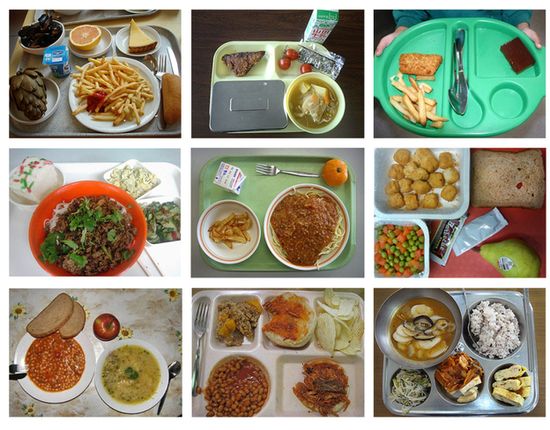
Andrew Gelman reacts to one Chicago school's decision to ban lunches brought from home:
If I had read this two years ago, I'd be at one with J. Justin Wilson and the outraged kids and parents. But last year we spent a sabbatical in Paris, where . . . kids aren't allowed to bring lunches to school. The kids who don't go home for lunch have to eat what's supplied by the lunch ladies in the cafeteria. And it's just fine. Actually, it was more than fine because we didn't have to prepare the kids' lunches every day.
A commenter, Igor Carron, offers an interesting explanation:
In France, the meal is paid for through the mayor's office. … If the kids don't eat right, the mayor gets to hear about it very fast and she/he wants to make sure that she/he is not seen as "starving the children". In Texas, the whole school (educators, canteen,…) are all dependent on one administration (the school district). If the food is not good, then someone on the school board may hear about it and then drown the problem and point the fingers to the "inefficient" school's administration. But there are so many issues at the school level that I don't think you can loose an election on the school board based on that one particular item.
(Photo from NPR's slideshow of school lunches from around the world.)
What Is An Internship Worth?
Molly Fischer reviews Intern Nation: How to Earn Nothing and Learn Little in the Brave New Economy by Ross Perlin:
Perlin’s call for an end to legal weaseling and economic unfairness is entirely appropriate. But what if doing menial labor, provided that it is under fair and transparent conditions, can be worthwhile way of learning about the working world? Jobs are not always personally fulfilling and professionally enriching and led by supportive mentors; and life is not educational entertainment advancing reliably toward the realization of dreams. Perhaps these are not such terrible lessons to learn. Jobs are jobs.
The Stress Of Growing Up Poor
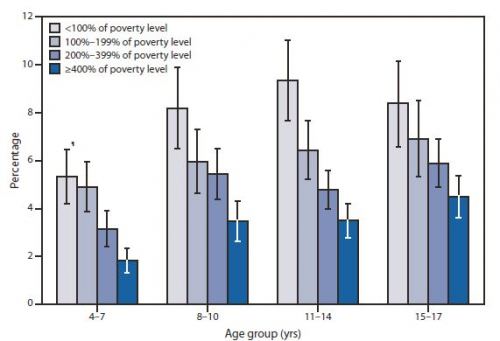
Daniel Lende captions the above chart, "The percentage of children with serious mental or behavioral difficulties is shown as a percentage on the left. The drop-off as income rises is dramatic." He excerpts the summary of the full report:
This study was designed to examine the possible association between household family income and the hippocampus, a brain region central to many important cognitive and emotional processes. … Taken together, these findings suggest that differences in the hippocampus, perhaps due to stress tied to growing up in poverty, might partially explain differences in long-tern memory, learning, control of neuroendocrine functions, and modulation of emotional behavior.
 The Dish