A reader makes an important point:
You've been writing things like the following piece of sarcasm:
"Obama committed a foul by actually stating out loud that the 1967 border is the obvious line around which a territorial settlement can be made. He violated the Washington consensus that the American president must let Israel direct and guide his entire relations with every other power in the Middle East."
Let's be fair here. The "US policy" you speak of isn't so much a US policy as it is a US attempt to "direct and guide" Israel's "relations with other powers in the Middle East."
Now, that's not to say I'm against you. The outrage against Obama's position is inexcusable, but that's not because Obama's positions are strictly an American concern and Israel doesn't get a say. It's inexcusable simply because Obama's position is so sensible that nobody should oppose it, regardless of whose mouth it comes from.
I'm also not trying to say that we should follow the lead of one side or the other. America and the international community play an important part in any attempts to broker peace, and if there's to be any hope of achieving this, we and other nations must be able to suggest compromises and exert diplomatic pressure in their support.
What I'm saying is that I think it's important that we see the issue clearly. America is a major power using its influence to interfere in affairs where it has no legitimate state interest. This is justified on humanitarian grounds. (The following are American policy interests which do not morally justify our interference: propping up a useful ally, vindicating our embarrassing past failure to help solve this issue, or pandering to American voters and AIPAC.) All of this is fine, and is nothing to be ashamed of. I would go so far as to say Israel and Palestine themselves should be grateful that the international community is willing to play a role in solving the problems they can't solve themselves.
But I think we lose credibility when we treat the borders of other nations as a "US policy" issue and claim that those nations have no right to criticize this policy. It starts to look like imperialism. And there's just no reason for it: least of all on this issue where we're so obviously right. Wouldn't we be better served by a humble stance which would accentuate how badly the hard right is overreacting?
Tactically, yes, which is what Obama is doing. Strategically, yes, as long it isn't interpreted as weakness or lack of will. But here's my core disagreement with my reader: I do think that a two-state solution in Israel-Palestine is a legitimate state interest. I didn't a few years ago. I thought that the whole morass was so fucked up we'd be better off ignoring it.
Two things changed my mind: the realization after 9/11 and the Iraq war that we cannot readjust our relations with the Muslim and Arab worlds by military force alone, that the legacy of the Bush administration was potentially catastrophic without a major re-set, and that Obama's presidency and then the Green Revolution and Arab Spring have given the US a uniquely propitious moment to advance our interests across the globe, defang Jihadism and make strategic advances in the war on terror. The alternative is one Gaza war or Abu Ghraib after another.
And this is a second reason for urgent change. The corruption of permanent warfare, the damage it does to our moral standards, the polarizing effect it has everywhere, the dangers it poses to our constitution: these have persuaded me that we really do have to make a change – as an urgent matter of national self-interest. I see Obama as a providential vehicle for that change. Which is why I want him so desperately to persevere and why I am furious at Netanyahu's Cheney-like contempt for him.
And whether it is fully justified or not, Israel's refusal to agree with a real, contiguous, independent, demilitarized Palestinian state with its capital in East Jerusalem gets in the way. It is the concrete wall between our being able to defuse and defeat Jihadism and our being at its permanent mercy. Sticking to this alliance as doggedly as we have in the past is not helping us and not helping Israel. Obama has been brave in stating this fact, something that is integral to his global promise. He is not just representing the US, he is representing a global generation that will not tolerate this brutalizing kind of dead-end neo-colonialism any longer.
It may well be that the Palestinians will squander yet another golden opportunity. In fact, that seems more than likely. But it is in our core national interest to keep the opportunity alive. It seems to me that the reason Netanyahu is so recalcitrant is that he is afraid that he might get yes for an answer from the Palestinians this time. Hence his desperate attempt to outlast Obama and this window of hope.
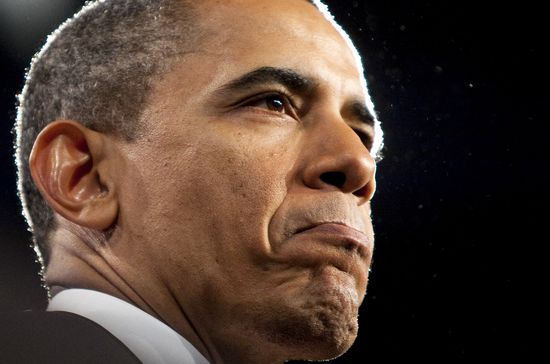
(U.S. President Barack Obama speaks to the American Israel Public Affairs Committee (AIPAC) on May 22, 2011 in Washington, DC. Obama spoke to AIPAC reaffirming U.S. support for Israel and calling for Israelis and Palestinians to seek a two-state solution.By Joshua Roberts/Getty Images.)


 The Dish