Alex Pareene imagines Newt's various paths to victory. Dish fave:
The Rapture does happen this weekend, but only Mitt Romney, Tim Pawlenty, Mitch Daniels, Michele Bachmann, Sarah Palin, Chris Christie, and Jeb Bush ascend to heaven.
Alex Pareene imagines Newt's various paths to victory. Dish fave:
The Rapture does happen this weekend, but only Mitt Romney, Tim Pawlenty, Mitch Daniels, Michele Bachmann, Sarah Palin, Chris Christie, and Jeb Bush ascend to heaven.
Douthat points out that all reforms to Medicare would ration one way or another:
Ryan’s critics (or at least those critics who don’t want to leave Medicare exactly as it is, and just hike taxes to unprecedented levels and beyond) need to recognize that they’re often just haggling over the degree to which we ask seniors to “buy their own damn health care,” and not whether we’re asking them to pay at all.
Gregg Easterbrook suggests reducing emissions of methane, which is "20 times more potent as a greenhouse gas than carbon dioxide." He argues that "methane regulation has more short-term potential to slow climate change than does carbon regulation" and that "there would be no economic harm" from such regulation because "methane leaks from natural gas drilling, for example, don’t serve any economic purpose":
[One] reason methane goes overlooked is that environmental advocates want global warming concerns framed as blame-America-first. Because the United States energy economy is dependent on coal and petroleum, U.S. carbon dioxide emissions are high. Because the European energy economy is dependent on natural gas, European methane emissions are high. By keeping the global warming focus on carbon dioxide, enviros keep the finger pointed at the United States.
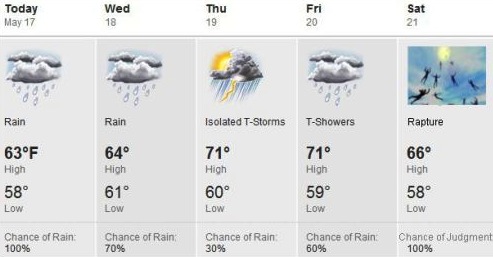
Bryan Curtis talks to Robert Fitzpatrick, a man who has spent his life savings to warn others about the rapture:
“Living with this idea, it’s not easy,” Fitzpatrick says. Even an ad buy of biblical proportions doesn’t calm his thoughts. He stands in the subway handing out Gospel tracts and each day sees dozens—no, hundreds—of the unsaved. He knows these poor souls will die in the earthquake, or else cling to life before the whole universe is vaporized on October 21. “That’s one of those things that could really get to you if you let it,” he says. Fitzpatrick’s mother has dementia, and he’s not sure if God will make a special dispensation for her.
Knowing the date of the judgment is only half the Rapture equation. The other half is knowing whether you’ll be among those who will “meet the Lord in the air,” as it says in 1 Thessalonians. When I ask Fitzpatrick if he’s sure he’ll be raptured, I notice that his confidence takes a small but perceptible hit. He can’t say for certain. He uses the words “strong suspicion,” lawyerly language he would never use about the date of the Rapture.
(Weather forecast via Cynical-C)
Today on the Dish, we previewed Obama's Mid-East speech and live-blogged it too. The right accused Obama of destroying Israel for mentioning the 1967 borders, while also calling him a neocon. Serwer argued until the Israeli Palestinian issue is resolved, opinion of the US won't change, and Israel responded with new settlements. Andrew argued that Catholic Bishops should deny Santorum Communion, and suggested O'Reilly move to Britain, and the U.S. finally imposed sanctions on Syrian officials but it may have been too little, too late.
We checked for a pulse on the Ryan budget, Frum grasped at some measure of fiscal conservatism, and Drum signaled the Tea Party might be over. Felix Salmon proposed not paying Congress to solve the debt ceiling crisis, and Palin finally weighed in on Gingrich and "indebtness." Readers pushed back on Andrew's fascination with a faked birth certificate, and Andrew wasn't buying Palin's campaign "strategy." Romney emerged as a front-runner, Nate Silver hoisted Rick Perry's chances up, but Texans weren't believing it.
Serfs are better off renting, taxing driving is the same as taxing gas, and DSK's actions could mean a rise in anti-immigration sentiment in France. Protestants and Catholics pulled away from Christianists on marriage equality, and Cheryl Thomas applauded the US for our legal repercussions for rape. We revisited the linguistic implications of Timberlake's Superbowl boob moment, marveled at disease and DNA, and Mormons went wild at their own beach week.
Moore award here, quote for the day here, chart of the day here, creepy ad watch here, confession of the day here, VFYW here, contest dissents here, MHB here, and FOTD here.
–Z.P.
After absorbing Sean Hannity's description of today's rather subtle speech, which changed the US government's position held by many presidents by barely a comma, as a "radical", "historic" event of seismic proportions, I guess I shouldn't be fazed by Gingrich's latest simple statement that he never said what he actually clearly said.
But it remains amazing how the essence of Palinism – the world is what I say it is, regardless of actual reality – is now endemic on the right. Money quote:
"And by the way, it was not a reference to Paul Ryan. There was no reference to Paul Ryan in that answer."
The broader context and the specific context of the on-the-record quote is as follows:
MR. GREGORY: But not what Paul Ryan is suggesting, which is completely changing Medicare.
REP. GINGRICH: I, I think that, I think, I think that that is too big a jump. I think what you want to have is a system where people voluntarily migrate to better outcomes, better solutions, better options, not one where you suddenly impose upon the–I don't want to–I'm against Obamacare, which is imposing radical change, and I would be against a conservative imposing radical change.
A reader writes:
I resent the notion put forth by your reader that I can't "be truly part of any culture from the inside." The beauty of America is that we are still relatively new as a country so that "culture" is still a bit amorphous. And we are so big that culture differs everywhere. In a community full of transplants, like Los Angeles, culture is what we make of it. I fit in anywhere and everywhere. I don't have to seek out other white, upper-middle-class Jews to hang out with to find some sort of identity. I'm the only Anglo in my place of employment (the others are Latino or Asian), but I've lived in LA for 34 years and feel like a part of this place, no matter that my roots aren't from birth.
Another writes:
To your insightful reader who managed to quote both Ms. Flannery O'Connor and Mr. Alasdair Macintyre in two paragraphs, I have to humbly suggest that he missed the point of the original TCK letter.
The reader said, "Travel the world and try to transcend your culture all you want, but you won't ever succeed. Not really." But a child growing up as a TCK makes no concerted effort to transcend anything – he just gambols through childhood like any other kid. The difference is that because of his parents, the childhood is spent in a constant state of exploration, investigation, adventure, and awkwardness. This experience often does result in a person described in the original TCK letter. Even the term itself suggests not an elevation over the mother culture, but a hybrid – a way of being American while also being immersed in other cultures. "Transcendence" suggests a lofty, haughty air. I suggest, rather, that growing up a TCK has very much rooted me in a world where culture isn't always a binary choice; it's not always one or the other.
And, to the rest of reader's reply, one shouldn't doubt the American-ness of American TCKs. It's true, I didn't always eat turkey on Thanksgiving nor did I always light firecrackers on Independence Day. But growing up overseas, I was often reminded by natives that I was American – that I'd never roll my Rs or that I'd never master chopsticks. I doubt the reader growing up in Middle America had to defend, explain, or represent America on a daily basis.
Another:
As for the O'Connor quote, a "tour of Europe" hardly compares to the experience of Third Culture Kids. A vacation in Europe means going to tourist spots, eating funny food, and maybe playing with the local kids for a few hours at the pool before you crash at the hotel. But TCKs plunge into school and friendships without a net; I mean, imagine going into a corner store with your new friends and being faced with a rack of candy…. and you don't recognize anything. And it's all in Vietnamese anyway, so you can't even read a wrapper to pick something, so you end up jumping in headfirst and just guessing, again and again and again. And when you're stripped of brands and culture and language, you know what you use as guideposts? Human behaviour. Which is what O'Connor was studying from her front porch in the first place.
But your reader's note was also disorienting in another way: what is with this implication that people who have lived in the US for their entire lives are somehow better, or more patriotic than the rest of us?! Your reader writes: "That's not a fate that I or many so-called Middle Americans want. Believe it or not, we actually love this country." Seriously, what? TCKs love America too; that's why we live here, as opposed to the other countries we've visited at length.
Another:
The game of "Who sees the world more broadly?" is a silly one to play. And also dangerous in these times when what we really need are shrewd leaders who are so intimately familiar enough with American politics and culture that they not only see the breadth of our problems, but also their depth.
Sorry, I respect the reader's pride and appreciation for their heritage, but this is plain wrong. I spent the first 20-something years of my life growing up in Texas and living the classic middle American lifestyle. I've spent most of the last four years living abroad on four different continents and now speak three different languages. I've been to 33 countries in all. I can honestly say that I have transcended my American cultural, but also that I have not lost it. In fact, I feel more proud of it than ever, not because I've seen more NFL games and eaten more blueberry pies on a porch than before, but because I've taken a step back and with clear-eyes and an inquiring brain actually looked at what we do, what we say and what we stand for in a much greater context than what the local gas prices are this week.
When children grow up in a family, they always assume what their family does is normal, and it's not until they leave the home and meet other people and experience other families that they begin to get an idea of what's normal and what was actually dysfunctional. But discovering that dysfunction doesn't remove you from your family, in fact it often brings out your loyalty and dedication in new ways. It allows you to reconnect with your parents and siblings in ways you didn't know possible before.
David Frum absorbs the GOP's fiscal recklessness:
We’ve evolved in the space of a decade from “deficits don’t matter” to “defaults don’t matter.” It seems flabbergasting that a conservative party could arrive at this destination.
Erica Greider, from Austin, doesn't expect Perry to run:
The "niche" here is socially conservative rather than Southern, and it's not really a niche. The conceptual division in the party is between the people who prioritise economic issues and those who are more interested in the social side. All of the candidates that have been mooted so far, except for Mr Barbour, have been clearly aligned with one side or the other. That's why there's not a clear frontrunner. If there was a candidate who had credentials on both sides (like Mr Perry) he or she would post a strong showing. In the absence of such a candidate, the eventual nominee will probably be one of the business types.
Another Texan writes:
I wouldn't be shocked if Perry decided to run, but I don't think that will happen.
He was re-elected as a "it's either him or the Democrat" candidate last fall and since then, he's angered a large portion of the electorate in his own state with his bungling of the state budget. Texas has a massive budget shortfall and has started drastically slashing state welfare and education. The education part has especially drawn flak because of the way it was handled. The policy directive was to start laying off teachers as a first measure instead of a last resort and Perry originally flat-out refused to use any of the "rainy-day fund", his personal project bucket, to help close the gap. He's since reversed that position partially, but everyone's still mad.
I'm a moderate Democrat in a state full of hardcore conservatives that openly hate Obama and actually believe Fox News is the most honest news channel out there. However, most of the people I know down here also openly dislike Perry now too. I could see him winning Texas in a general election against Obama because of the anti-Democrat feeling that runs so strong here, but I don't see him winning the primary because there's just too much negativity surrounding his governorship right now. I've had discussions with plenty of staunch conservatives that openly disliked Perry, didn't want his policies, and didn't even want to vote for him but still did anyway. When I asked why, they simply said something along the lines of "Because he's not a Democrat".
Another reader:
Isn't there something incongruous about a governor who threatened to secede from the union running for President of the UNITED States?
 The Dish