
Greenwich Village, New York, 5.45 am
Greenwich Village, New York, 5.45 am
This:
The United States has imposed sanctions on Bashar al-Assad, the Syrian president, and six senior Syrian officials for human rights abuses over their brutal crackdown on anti-government protests. The White House announced the sanctions on Wednesday, a day before Barack Obama, the US president, was to deliver a major speech on the uprisings throughout the Arab world with prominent mentions of Syria. … The sanctions will freeze any assets Assad and the six Syrian government officials have in US jurisdiction and make it illegal for Americans to do business with them.
Andrew Malcolm isn't impressed:
Here's the problem with that deal: With months of warnings, the Syrian ophthalmologist-turned-dictator and his cronies don't have enough money left in the U.S. to buy a kabab. Given the proclivities of pouting American pols for phony PR gestures — think Jimmy Carter boycotting the Moscow Olympics — no bad guy with half a mind would put any loot in a U.S. credit union CD.
Meanwhile, Mike Crowley checks in on Yemen:
[C]ounterterrorism adviser John Brennan, who is something of a de facto U.S. envoy to the al-Qaeda hotbed of Yemen, phoned that country’s embattled president, Ali Abdullah Saleh, to urge him to sign a political transition agreement that would lead to his departure. But this isn’t the first time Obama and Brennan have nudged Saleh, a canny political survivor who has been stalling the transition deal for weeks, and it’s not clear whether another push will help.
1500 new settler homes in East Jerusalem. And don't forget the threat unilaterally to annex the West Bank settlements entirely if the UN recognizes Palestinian statehood.
Chait reads the last rites. He uses the above ad from the NY-26 special election as evidence:
Yes, there's a Tea Party spoiler. But the important fact here is that the Republican is trying to win not only by abandoning the Ryan message but by attacking her opponent from the left
Both Nate Silver and Charlie Cook caution that special election doesn't mean much for 2012. Dave Weigel differs:
[That] American Crossroads, the American Action Network, the Tea Party Express, the DCCC and the NRCC are all playing in here indicates that it's close. Cook's own rating service says the race is a toss-up. I'll find out why shortly, but is it as easy to imagine a toss-up if Republicans were riding high and not struggling to explain and defend their Medicare plan?
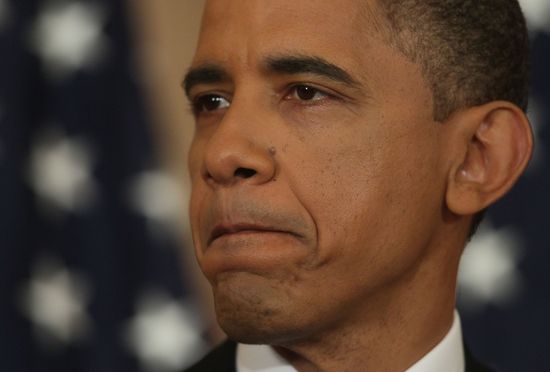
1.20 pm. A small indication of what will come from the far right. Obama's mere reference to the 1967 borders prompts Drudge's headline: Obama Sides With Palestine. If we acknowledge that the 1967 borders have long been the template for US policy – with mutually agreed land-swaps – then every president in memory has been siding with Palestine. As every American president should.
1 pm. What to say? It strikes me as a classic example of Obama's community organizer past, except the community he is now attempting to organize is the maelstrom of passions and pathologies that define the Middle East. He pledges American support for democratic principles, while still not cutting off outreach to the murderous Assad. He proposes an interim negotiating structure for the Israelis and Palestinians, while not rejecting the Hamas-Fatah reconciliation in advance. He offers debt forgiveness and investment in Egypt and Tunisia, while recognizing there is no fiscal capacity for a new Marshall Plan. He seems to capture the classic Obama tendency to see all sides, in a reflection of his unique Third Culture Kid capacity. And if he is leading, it is from behind, with an almost pathological pragmatism, combined with these periodic oratorical framing devices.
It is very hard to see how this will unfold and whether it is a rubric within which the long-despotic region can be fully understood. In a way, he is trying to do with the whole Middle East what he hoped to do with Israel: hold a mirror up to it and persist in requesting that it recognize pragmatic reality rather than ideological or religious perfection.
At home, this attempt at unifying, see-both-sides pragmatism has been greeted by the Tea Party, Sarah Palin, Roger Ailes, Paul Ryan and the ever-marching brigades of the far right. Tactically it has failed. But strategically, it may well be working – as the country observes how far the GOP has migrated to the ideological far right, and swings back toward a president who looks much more likely to be re-elected today than he did six months ago.
It is this pragmatic persistence that is the hallmark of a president who was once an inspirational candidate. And such persistence requires a long view and two terms. But given the alternative – a US foreign policy devoted to exacerbating the religious divide globally, enabling Israel's suicide, making no distinctions within the Islamic world – we already know it must be our primary hope.
And there is a distinction between hope and optimism. There always has been. But there is no region in the world more immune to the distinction than the Middle East. It is Obama's acid test.
12.57 pm. The attempt to identify the current revolutions in the Middle East with America's own experience:
For the American people, the scenes of upheaval in the region may be unsettling, but the forces driving it are not unfamiliar. Our own nation was founded through a rebellion against an empire. Our people fought a painful civil war that extended freedom and dignity to those who were enslaved. And I would not be standing here today unless past generations turned to the moral force of non-violence as a way to perfect our union – organizing, marching, and protesting peacefully together to make real those words that declared our nation: “We hold these truths to be self evident, that all men are created equal.”
12.53 pm. He seems to be arguing that the status of Jerusalem and the right of return should be punted for now in favor of agreements on territory and security. Hamas is not completely shut out for now. But the Palestinians have to provide "credible" answers to "legitimate" Israel fears about the newly unified Palestinian leadership.
12.51 pm. Again the bleeding obvious:
Precisely because of our friendship, it is important that we tell the truth: the status quo is unsustainable, and Israel too must act boldly to advance a lasting peace.
But he has already enunciated a clear opposition of the Abbas attempt to get the UN to declare Palestinian statehood. All of which is sane – even if the region is basically insane on this question.
12.48 pm. The audacity of hope:
There are those who argue that with all the change and uncertainty in the region, it is simply not possible to move forward. I disagree. At a time when the people of the Middle East and North Africa are casting off the burdens of the past, the drive for a lasting peace that ends the conflict and resolves all claims is more urgent than ever.
12.44 pm. "If you take out oil exports, this region of over 400 million people exports roughly the same amount as Switzerland." Ouch. But the forgiveness of Egypt's debt matters a lot. I see much to be gained by focusing almost exclusively on protecting the democratic revolutions in Egypt and Tunisia, Egypt especially.
12.38 pm. Now a defense of the right of Islamists to make their case in the public square – as long as they do not seek to oppress the right of free speech to others. This is one thing that we never heard from George W. Bush. It is important to me for the US to accept that many in the Muslim world are geniunely attracted to the deadly illusions of fundamentalist government. The best response to this is to vent it, not repress it. That's a big risk, of course, especially given the openly anti-democratic theologies behind the Muslim Brotherhood, Hamas, et al. But it's an expression of self-confidence n American ideals, rather than a fear of the Other.
12.35 pm. At last! Some public condemnation of the Bahrainian repression. But again: measured.
12.31 pm. He makes a defense of the Libyan intervention as the corner stone of the American principle of siding with the street vendor against the dictator. To Assad: "he can lead that revolution or get out of the way." But Obama is still not shutting Assad off – while denouncing the hypocrisy of Iran's coup leaders. And this is important: to cite the Green Revolution as the first moment of the democratic revolution in the Middle East. I wish he had done this at the very start. Before Tunisia, there was Iran.
12.26 pm. The "world as it is" vs the "world as it should be". A little RFKish.
12.19 pm. Personalizing the revolution – and recapturing the moral nonviolent inspiration that sparked the revolution – strikes me as an essential context. So too the simple reality that change is fitful and unknowable – while the arc of history moves inexorably toward more openness, democracy and free communication.
12.17 pm. First up: distinguishing al Qaeda's vision from the Arab Spring, something Osama tried to erase in his final video. From OBL's murderous fundamentalism to the legacy of Mohamed Bouazizi.
12.12 pm. It's worth pausing for a moment to observe the seamless unity between Obama and Clinton. This is, in many ways, one of the most remarkable achievements of the president. Most presidents are lucky to neutralize the primary foes; this one coopted his after one of the most brutal and long primary campaigns in memory.
12.10 pm. An interesting take on the real-world constraints on American foreign policy: Jewish donors threatening not to donate if the president actually pressures Israel on a two-state solution.
(Photo: Mark Wilson/Getty.)
A reader writes:
It’s quite misleading to label the birth certificate for Arnold’s out-of-wedlock son “faked.” In California, as in many states, the husband of a mother is legally presumed to be her child’s father. In many states that presumption is so strong that a man outside the marriage who claims to be the child’s biological father has no standing to challenge the paternity of the mother’s husband. Certainly there is no legal requirement for mom to name the biological father on the birth certificate.
Whether the husband was deceived into thinking the child was his own, or knew everything and was willing to accept the child as his own, is left by the law as a private question between the couple. This strong presumption of legitimacy within marriage is thought to lend stability to families and ensure child-support for children, even though – perhaps especially because – everyone knows that many children born within marriage have fathers from outside the marriage.
So, while the birth certificate might not have been honest about biology, it wasn’t required to be. Listing mom’s husband as father was totally legal, and nothing was “faked.” (Why her husband used a different last name is another question.)
Another writes:
The birth certificate you linked to is neither a fake nor a crime. Under California law, there is a presumption that the husband of the birth mother, when neither impotent nor sterile, is the father. (Cal. Family Code Sec. 7540). While I do not know the specifics in California, New York has a similar presumption which exists to preserve the legally established family unit, not because anyone believes that legal marriage necessarily implies genetic parentage.
In fact, several years ago, the New York State Department of Health began applying this presumption to lesbian couples legally married out of state, where one was the birth mother, listing both as "parents." This rule was applied whether or not the other spouse was a genetic parent: it simply reflected the appropriate operation of the legal presumption, and did not somehow render the resulting certificates "fake."
Also, I have no idea what is meant by your mocking comments regarding a faked birth certificate being "beneath presss inquiry." If I understand correctly, this is apparently based on the (misguided) notion that because the birth certificate of Arnold's son is faked (as noted above – it is not), someone else's could be too. Perhaps this is a reference to Trig, but it could just as well be cited by the folks at World Net Daily, who produce article after article on a daily basis alleging that the valid Hawaiian birth certificate of our president must be falsified whenever a jit or jot thereof appears to them imperfect.
I don't know how comfortable you are to be in this company; I, for one, would not be. Good press inquiry does not mean endlessly raising questions about the validity of clear evidence, even when there is no basis to do so.
I take the point. But it implies that all birth certificates are not necessarily proof of biological paternity, or of anything much but what the mother decides. Another reader points to a recent NYT Magazine piece on the topic of paternity. Another:
A meandering, side thought to the whole Arnold deception: Doesn't this put a deeply, deeply ironic backdrop on the landmark case-to-be now known as Perry v. Schwarzeneggar? Yes, of course, he was being sued in his official capacity, and he didn't really oppose the cause. But still: he's the Defendant in name, representing the side purportedly committed to protecting the institution of marriage. Amazing.
She targets Newt as someone willing to cave in to media pressure. Which puts her off the near-comic party line, parroted by Sean Hannity, that this Gingrich-Ryan rift is now over. And she insists that his “right-wing social engineering” remark be affixed permanently to him. And that the real enemy is the “lamestream media”. But it’s obvious she isn’t running, isn’t it?
Bonus Palinism: “indebtness.” And she calls out David Gregory for asking “racist” questions.
I watched him last night parry with a somewhat bemused Karl Rove as he inveighed against the personal brutality of the web and its effect on chilling the incentive to go into public life or public service. He acknowledged that there was no solution, given the ubiquity of the web and the First Amendment. And I sympathize with the gawkering everyone gets for even tiny mis-steps in their lives. Nonetheless, the alternative is pretty dire. Look at Britain where legal "super-injunctions" against the press are increasingly common and increasingly used to protect the powerful from scrutiny. To wit: Fred Goodwin, the head of the Royal Bank of Scotland when it went belly-up and was bailed out by the taxpayer to the tune of over $30 billion, has sought a secret legal injunction against any press mention of an alleged affair between him and a senior colleague:
The existence of the draconian injunction – so strict it prevents Sir Fred being identified as a banker – was disclosed by John Hemming, a back-bench Liberal Democrat MP, in a question during a business debate at the House on Thursday morning. His comments are protected by parliamentary privilege.
He said: "In a secret hearing Fred Goodwin has obtained a super-injunction preventing him being identified as a banker. Will the government have a debate or a statement on freedom of speech and whether there's one rule for the rich like Fred Goodwin and one rule for the poor?"
Britain has a last resort: Parliament where anyone can say anything without fear of being sued for libel. Goodwin, of course, cuts a particularly noxious profile:
Sir Fred, nicknamed Fred "the shred" for his management style … left [RBS] with a pension of £700,000 a year and a lump sum of nearly £3 million. Following a public outcry he later agreed to reduce his payout by £200,000 a year.
Stephen Walt previews Obama's Middle East speech today, and how most of the characters involved are "trapped":
Israeli Prime Minister Netanyahu is trapped too: by his ideological devotion to the dream of "Greater Israel," by the even more hawkish stance of the settlers and his Foreign Minister, Avigdor Lieberman, and by the uncertainties created by the recent upheavals in the Arab world. He can't do the right thing and move swiftly towards the creation of a viable Palestinian state–even if he wanted to, which is highly unlikely–though this step would end the demographic threat to Israel's democratic and Jewish character and remove the main reason why people around the world are increasingly critical of Israel's conduct.
Marc Tracy lays out the importance of the coming week:
Tomorrow, Obama gives a big speech on the Arab Spring; on Friday, Prime Minister Netanyahu comes to the White House; on Sunday, Obama speaks to the AIPAC conference; on Tuesday, Bibi addresses the U.S. Congress. The next several days will probably dictate the shape of the Israeli-Palestinian conflict at least through the 2012 U.S. elections. Tragically, the Fatah-Hamas unity deal—something that in some form had to happen before a state could exist (since how could you have a state encompassing two discreet areas governed by rival authorities?)—has likely foreordained an administration policy of taking no more bold moves on the peace front and nixing Palestinian statehood should it come to a binding U.N. vote in September. … [W]hile I don’t know how I’d feel if I were a Palestinian and suffered the occupation and the degradation of statelessness that they do, it is silly to expect the U.S. president to respond to this decision with anything other than a sad shrug and, in September, a veto.
Jonathan S. Tobin takes a more pessimistic approach:
What Obama seems most interested in is a statement that will buttress his attempts at outreach to the Arab world. But what the president fails to understand is that his attempt to link the struggle between Israel and the Palestinians to the Arab Spring won’t increase his influence in the region. Israel and the United States are both irrelevant to the protests. And nothing Barack Obama does will change that.
Jacob Stokes and Kelsey Hartigan drafted the speech they'd like to hear:
The president must also double down on calling out Iran's hypocrisy in seeking to claim the movement as a second Islamic awakening, even as it oppresses its own citizens at home. He must firmly rebut the violent crackdown in Syria and elsewhere. And eventually – even if not in this speech – he must put forward a plan for settling the Israeli-Palestinian conflict. Lacking a resolution, America's relationship with the Arab world will always be fractured.
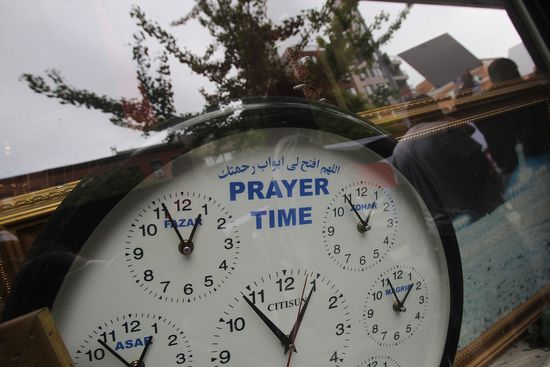
(Photo: Supporters of the people of Yemen march a past a prayer timing clock during a demonstration calling for the departure of President Abdullah Ali Saleh and his regime May 13, 2011 in the Brooklyn borough of New York City. By Mario Tama/Getty Images)
Another poll finds majority American support for marriage equality. Two things worth noting: Catholics and non-evangelical Protestants have pulled away entirely from the Christianists:
A solid majority of Catholics and white mainline Protestants (56% and 55% respectively) favor allowing gay and lesbian couples to legally marry, compared to only 23% of white evangelical Protestants.
And the generational divide seems to be declining as time goes by:
Sixty-one percent of 18-34 year olds support allowing gay and lesbian couples to marry, but so do nearly 6-in-10 (57%) Americans between the ages of 35 and 49.
 The Dish