Following a measles outbreak in Massachusetts, McArdle begs parents to vaccinate their children:
[V]accine resistance is spreading among parents who want to free ride on the herd immunity of others. If these diseases were widespread, they'd be rushing to vaccinate their kids. But they can delay, or forgo the vaccines entirely, thanks to other parents who are willing to risk their kids in order to do the right thing.
Devin Leonard warns that the USPS is nearly insolvent:
Last year its revenues were $67 billion, and its expenses were even greater. Postal service executives proudly note that if it were a private company, it would be No. 29 on the Fortune 500. The problems of the USPS are just as big. It relies on first-class mail to fund most of its operations, but first-class mail volume is steadily declining—in 2005 it fell below junk mail for the first time. This was a significant milestone. The USPS needs three pieces of junk mail to replace the profit of a vanished stamp-bearing letter.
[A]bout half of all private-sector workers already have some kind of sharing arrangement with their employers; sharing tends to make employees happier, more productive and better off, as long as they do not take on too much risk by over-investing in the company they work for, and companies often benefit as well, showing improved performance along several different dimensions.
Scott Adams delineates how Angry Birds satisfies our most basic urges:
The player flings birds from a slingshot and tries to destroy various structures and kill the pigs within. It's a basic hunting metaphor, and pigs are a symbol for food in Western cultures. That part is obvious. The less obvious part of the addiction is the joy of destroying structures that are man-made. I believe this taps into our basic need to tear down the accomplishments of others in order to feel better about ourselves. It's Shadenfreude – the satisfaction or pleasure we get from the misfortune of others. Someone unknown built those structures, and presumably they would be unhappy to know you knocked them down. The game would be far less satisfying if you were destroying trees or other natural creations.
Why do [we] ban activities with very low risks yet celebrate very high risk mountain climbing? Status seems the obvious explanation. It takes a lot of money to even attempt to climb Everest. We celebrate high status risk-takers, and ban low status ones.
Regarding Lloyd Alter's "food cost" post, bicycle couriers spend all day riding their bike, while most commuters ride between 30 and 60 minutes per day. The calorie requirements for a bike courier versus a commuter look rather different, based on the number of hours they ride, and the fact that couriers often ride harder and faster than regular commuters. So that $17 for couriers would be more like $2-$3 per day for commuters. Sorry, Lloyd.
I could also mention the fact that my 40-minute round-trip commute means that I get my daily recommended dose of exercise. This should lead to reduced health care costs down the road, as well as saving hundreds in gym membership costs each year. Just two more "economic" advantages of riding a bike.
Another writes:
What about the opportunity costs of the extra time a bike commuter spends to get to work? My 15-mile car commute takes 25-30 minutes. To ride that same distance, it would take me at the very least 1.5-2 hours, each way. My round trip commute could go from one to four hours. All those extra hours are ones I could have spent working – or you know, doing anything besides commuting.
Another:
I'm all for being green and fit. Unfortunately though, the whole concept of biking to work is nonsense. I've worked with about 1000 people in my life and I have known 1 person who regularly biked to work. I can't bike to work because biking results in my body sweating, thus offsetting the purpose of my morning shower. So next time we calculate the cost of biking, can we factor in the cost of smelling like sweat all day and getting fired because no one wants to sit within 15 feet of you?
Lawrence O'Donnell makes an impassioned case that Palin won't run (and sets himself up for a Von Hoffmann award):
A reader summarizes:
O’Donnell's segment really changed my mind about Sarah Palin and whether or not she’s running. Lawrence has an odd speech pattern and he was hard to listen to but I listened to the whole thing and by the end I am absolutely certain she is NOT running. In a nutshell:
1. The “re-hires” are not people who run campaigns, they are assistant types. The kind that are particularly useful when you have a speaking circuit job, not a campaign.
2. The moment she is confirmed to be not running, her speaking fees will drop considerably.
3. The movie is opening in Iowa so that she can stoke the speculation and thus increase her fees and attention.
4. Fox News did not cancel her contract. Just like Huckabee, unlike Santorum. This alone tells you all you need to know!
Another writes:
A CNN poll out Friday has Giuliani leading among likely or possible Republican contenders. Just like Donald Trump, it's an indication that Republican primary voters want anyone but Romney AND Palin. How can the most recent VP nominee have so little support is the question that should be asked.
Compare Palin and Romney to Clinton and Obama. Their support wasn't transferable to other candidates. Staunch Obama and Clinton supporters of course would vote for the eventual nominee but their support among their core supporters in the primaries was bedrock. Where is that kind of support for Palin? Her so-called loyal supporters have shown to be willing to dump her for Trump, Herman Cain, Huckabee and now Giuliani.
These Tea Party folks are not devoted to Palin; they are devoted to hatred and defeat of Obama. Please stop comparing Palin now to Obama in 2007. Voters didn't know Obama, but the more they got to know, the more they liked. Palin has been the opposite; the more voters have gotten to know her the more they dislike. That's a fact you can't seem to accept.
Some varied Palin speculation from readers:
Regarding "Palin's Bus Tour Ad" and your introductory comment ("Does this sound like someone not running?"), have you considered that what she is really doing is establishing her residency to run for McCain's Senate seat?
Another:
The bus tour, the movie release, the multi-million dollar home purchase in Arizona … such big news! The timing of which has NOTHING at all to do with the barely-tweeted, bizarrely-timed, midweek, jeans-clad wedding of the eldest Palin child.
And finally, a dissent:
I think you've earned a Moore Award for overheated rhetoric with your comparison of Palin's "Undefeated" to "Triumph of the Will." Or maybe just a Godwin award. Anyway, I don't see how it's particularly useful to compare some trash that Sarah Palin made to the seminal Nazi propaganda film.
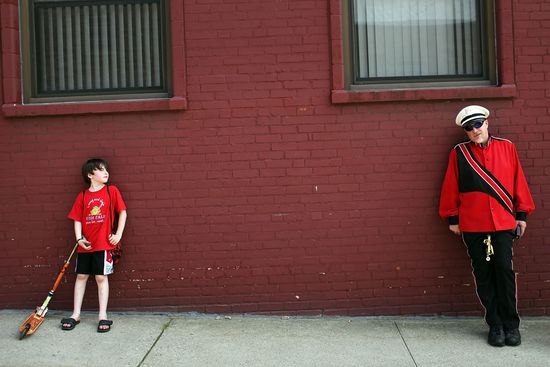
A band member takes a break from the heat during the Memorial Day Parade in the economically depressed region of the Connecticut Valley on May 29, 2011 in Ansonia, Connecticut. Hundreds of towns and cities across America will celebrate Memorial Day with parades, cookouts and family gatherings. Memorial Day, the unofficial start to the summer season, was conceived as a day for Americans to commemorate U.S. Service Members who died in every war, including current conflicts in Afghanistan and Iraq. By Spencer Platt/Getty Images.
Sharon Begley fears the near-term consequences of climate change:
Picture California a few decades from now, a place so hot and arid the state's trademark orange and lemon trees have been replaced with olive trees that can handle the new climate. Alternating floods and droughts have made it impossible for the reservoirs to capture enough drinking water. The picturesque Highway 1, sections of which are already periodically being washed out by storm surges and mudslides, will have to be rerouted inland, possibly through a mountain. These aren't scenes from another deadly weather thriller like The Day After Tomorrow. They're all changes that California officials believe they need to brace for within the next decade or two. And they aren't alone. Across the U.S., it's just beginning to dawn on civic leaders that they'll need to help their communities brave coming dangers brought by climate change, from disappearing islands in Chesapeake Bay to dust bowls in the Plains and horrific hurricanes in the Gulf of Mexico. Yet only 14 states are even planning, let alone implementing, climate-change adaptation plans, says Terri Cruce, a climate consultant in California. The other 36 apparently are hoping for a miracle.

 The Dish