Romney “Surges”

A Suffolk poll claims that Romney has "become the clear front-runner" now that Huckabee and Trump are out:

In the GOP primary, Romney’s 20 percent was followed by Sarah Palin (12 percent), Newt Gingrich (9 percent), Rudy Giuliani (7 percent), Ron Paul (5 percent), Michele Bachmann (4 percent), Herman Cain (4 percent), Mitch Daniels (4 percent), Tim Pawlenty (3 percent) and Rick Santorum (3 percent), with 20 percent undecided. Jon Huntsman, Gary Johnson and Buddy Roemer all received less than 1 percent.

Allahpundit retorts that an "eight-point lead … over a candidate who’s not even a candidate yet must surely be the thinnest 'frontrunner' status in political history":

What if Palin jumps in and instantly siphons off the bulk of support from “true conservative” all-stars like Bachmann and Herman Cain? The elites will go into panic mode and look to rally around a single centrist-type candidate in hopes of heading her off, but there are potentially four prominent governors in the race capable of filling that role — Romney, Pawlenty, Daniels, and Huntsman. How will the establishment choose one and then clear out the rest in order to pose a clear “Palin/Not Palin” choice for primary voters? The answer, presumably, lies with New Hampshire. If the winner in Iowa looks like he/she could sweep all the way to the nomination, then the winner of the de facto centrist primary in NH will be anointed the best bet to stop them.

The Daily Wrap

Today on the Dish, Andrew raised an eyebrow about how Arnold managed to hide a 14-year-old child, and marveled at a faked birth certificate. Readers reacted to defending elite friends, and Andrew sympathized with children of unknown biological fathers. Andrew felt ill listening to John Yoo moderate a panel on torture, and juxtaposed Orwell's 1984 with Santorum and Marc Thiessen. Dorothy Parvaz recounted her time in a mini Guantanamo, and Andrew nailed Obama's Osama intentions in 2009.

Newt nosedived, and Fallows begged the press to ignore him. Wilkinson believed in Romney, Palin solicited money for her PAC, and Bachmann befriended Christianist heavy metal drummers. We sized up Rick Perry, Palin's ethics advisor got stripped of his law license, and Larison called Bachmann the anti-Romney. Frum tackled healthcare, Douthat weighed in on the Gingrich/ Paul Ryan schizm, and social security accounts for over 90% of income for a third of people over 65. Glenn Greenwald sighed over spouses deported, Alex Massie yawned at the Queen's visit to Ireland, and we picked apart third culture kids.  Doctors don't love autopsies, David Brooks dropped in on "Scream", and climate science nerds exacted their revenge. Serwer approved of funny women, Yglesias approved of repatriating  t-shirts, and Andrew celebrated the San Francisco Giants' "It Gets Better" video. Books went viral, gifted readers filtered their G&Ts, and Jesus had a problem with moderates.

Bean bag of the day here, Malkin award here, headlines of the day here, self-flagellation of the day here, quote for the day here, FOTD here, MHB here, VFYW here, and VFYW dissents here.

–Z.P.

“Welcome To Mini-Guantanamo”

Dorothy Parvaz, the Al Jazeera journalist who was just released by Syrian and Iranian authorities after 19 days of detention, tells of her "terrifying experience":

I was taken to a second cell, this one, with smears of blood on the wall. I found what looked like a bloodless corner and perched until called upon again – at around midnight. I was again handcuffed, but this time, before the blindfolds went on, I caught sight of a young man, no more than 20, chained to a radiator outside the hallway. He had a legal pad on his knees, was blindfolded, and was quivering so fiercely he could hardly hold the pen with which he was probably meant to ink some sort of confession. Meanwhile, the beatings and cries outside continued. … Most of the our days were spent listening to the sounds of young men being brutally interrogated – sometimes tied up in stress positions until it sounded like their bones were cracking …

Read the rest here.

The GOP Civil War Over The Ryan Budget, Ctd

Douthat moderates the fight:

There’s no reason why [Gingrich] should be expected to endorse the Ryan budget in its entirety, and every reason for a politician who fancies himself a deep policy thinker to suggest his own alternative vision. But he didn’t suggest an alternative: He first denounced Ryan for “right-wing social engineering” (for conservatives, them’s fighting words!) and then, when pressed about his own plan for entitlement reform, offered banalities about starting the proverbial “a national conversation” about Medicare and (inevitably) cutting waste, fraud and abuse. This wasn’t a productive response to the Ryan budget; it was an attempt to ignore the high bar that Ryan set, and return the entitlement conversation to the untenable, unserious status quo ante.

Face Of The Day

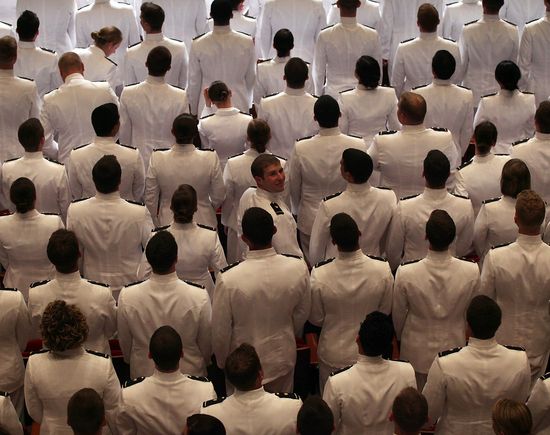
GT-COAST-GUARD-FACE-110518

An Ensign turns around to smile at his relatives before taking the Oath of Office at the conclusion of the 130th graduation at the U.S. Coast Guard Academy that was addressed by U.S. President Barack Obama on May 18, 2011 in New London, Connecticut. It is a tradition that the president speaks to a graduating class at each of the nation's four military academies during his term. Obama is expected to make a major speech to the nation on Thursday that will address recent events in the Arab world, including the death of Osama bin Laden.  By Spencer Platt/Getty Images.

Your Gifted Child Isn’t Getting More Gifted, Ctd

A reader quotes another:

The thing that always pissed me off about G&T programs is that they pulled "gifted" students from core curriculums and gave them extra assistance on "advanced" curriculums. Students of every level benefit from extra-assistance. Focusing resources on those who have a greater chance of succeeding to begin with is akin to providing extra healthcare to healthy patients.

Your reader completely misses the point. Once the "gifted" kids had learned the core curriculum in a fraction of the time of the “normal” students, schools divert them to a G&T classroom to do advanced work during their otherwise unproductive time. This decreases the student load on the core classroom teacher, thus enabling the teacher to give extra attention to the kids learning the curriculum at the normal rate. So, following the reader’s analogy, the G&T program was basically "sending the healthy people home from the hospital so the doctor could focus on the patients still needing acute care."

Another writes:

First, G&T makes me think of gin and tonics.

Second, one of your readers objects that "Focusing resources on those who have a greater chance of succeeding to begin with is akin to providing extra healthcare to healthy patients." However, isn't the flip side that resources should be allocated to where they will do the most good? Spending $12k/year on a kid who doesn't want to go to school, and is indifferent at best, seems silly when you could spend the money more productively on a kid who wants to be in school, is reasonably gifted, and is not disruptive. Similarly, if you were a track coach, would you put your time into the guy who runs a 4:15 mile, or the one who runs an 8:20 mile? I would put my resources into the 4:15 runner, but that's just me.

Another:

Your reader who said, "Focusing resources on those who have a greater chance of succeeding to begin with is akin to providing extra healthcare to healthy patients" is correct, but that's a feature, not a bug.  We don't tell healthy people to sit down and stop exercising so that other folks who need it more can use the club's only treadmill, do we?  We exhort the healthy to remain healthy because that is what is best for our society.

The real debate should be centered around that reader's previous sentence:  "Students of every level benefit from extra-assistance."  Why is this an either/or situation?  As a civilized society, shouldn't we be discussing how to provide the resources necessary to best educate every child?  The discussion you are hosting assumes, from the beginning, that we cannot afford to educate every child.  I find that a very troubling assumption.

Another:

The reasons why gifted children may suffer in regular classes also lead me to conclude that gifted and talented programs aren't the most important thing we can do to help them learn. Rather, we should better train teachers to include these students and respond to their needs, and we shouldn't allow teachers who can't handle such kids to be responsible for them.

When I was in a "regular" classroom with a teacher who allowed those who finished their assignments to continue working or reading independently while she or he helped those who were struggling, I was blissfully happy. I already knew most of the curriculum, but was able to push my own intellectual boundaries further while still blending in comfortably with the rest of my peers. Sometimes teachers even encouraged those who were done first to help those who were still working, which brought everyone closer together rather than alienating some for being "too brainy".

However, when I was in a classroom with a teacher who insisted on holding everyone back to the same slow pace, and demanded excessive "busywork" or even punished students for wanting to do more than they were asked, then I was miserable. About a quarter of my teachers were like this, and some were even sarcastic and cruel to students who tried to exercise creativity or do more than they were asked. Being trapped in a classroom and forced to go through the motions even though nothing new is learned is harmful to any child. When the teacher also resents the bright kid for being too quick, the experience is rather like being in jail.

Another:

One of the primary arguments against G&T programs, in favor of "inclusion" programs, is that by mixing all the students, the less gifted students are inspired by the more gifted students – or at least that was the justification given to me by the director of my charter high school.

My own experience was the opposite; I couldn't help answering questions in my Algebra class with an ease that made the struggling students face a sad reality: they weren't as smart as me, and even when they worked far harder than me, they weren't as good at the subject.  One girl who sat near me, four years older, became depressed and withdrawn.  Eventually, I convinced the teacher to let us go to the library instead of attend class, where I helped her learn some of the fundamentals she was missing. The teacher had no time to teach her, in a class where he had to teach to the middle.  It alleviated my boredom, and helped her far more than being in a classroom surrounded by kids who, by being themselves, saddened the less capable kids around them.

Another:

I'll give some personal examples that I think are fairly commonplace. Throughout my pre-college schooling, there were teachers – not all of them, but several – who naively thought that assigning seats such that the "good kids" were next to the "problem kids" would help to improve the behavior of the troublemakers.  Trying to harness peer pressure inevitably backfired, as the "good" kids – out of self defense as much as anything – matched their behavior to the "bad" ones, making everyone miserable, not least the "good" kid who was now suffering punishments and lower grades.  Where before the teacher had a few students who were acting out, now there were more of them.  Worse than a waste of potential, it was an active detriment to the whole class.
Who Is The Anti-Romney?

Larison makes the case for Bachmann:

Bachmann can appeal to evangelicals as “one of them” at least as well as any of the other candidates, and she can use the fact that mainstream journalists and pundits dismiss or mock her as part of her “populist” appeal. Other than Ron Paul and Gary Johnson, Bachmann becomes an obvious non-Romney figure on the right to support, and that likely comes at the expense of Pawlenty and Daniels.

Jonathan Chait can't quite accept this:

What I don't understand is why the party elites have so little enthusiasm for Tim Pawlenty, who seems like an adequate nominee — lacking any special political skills, but not burdened by any prominent weaknesses, either. I haven't really dug into Pawlenty's record, so I don't know if the Republican ennui toward him is based on a real weakness or simply an unrealistic desire to be swept off their feet. If that white knight fails to ride in — or if he rides in and falls on his face — I expect them to reconcile themselves to the generic former Republican governor from Minnesota.

How Does A Book Go Viral?

Go_To_Sleep

The children's book Go The Fuck To Sleep has sold 100,000 pre-sale copies. Reyhan Harmanci wonders whether leaked electronic copies of the book have boosted sales:

In an age of e-books, piracy has been a rising concern amongst publishers for a few years, although none of the publishers contacted by The Bay Citizen could recall a PDF of a book going viral in the vein of “Go the Fuck to Sleep.” This volume had a few key properties that enabled its electronic popularity: an undeniable title, a good-looking cover and a short length, making it easy to read, post and pass on. Also, the long lag time between the book’s pre-sale (it was originally scheduled to go on sale in October) and the buzz made online sharing necessary.

James Joyner partially agrees:

I wouldn’t imagine that distribution of PDF copies would much harm the sales of any printed book. Where it would become damaging would be digital copies of e-books getting out. What would anyone buy a copy for their Kindle or other e-reader if they can get them for free? The same problem, obviously, has long affected digital music and video sales.

A few sample pages can be seen at Tiny Iron Fists.

What Magic Did For HIV, Ctd

A reader writes:

This post touched and saddened me for so many reasons, and I wanted to share my own story of dealing with and losing someone to HIV.

My parents, who were totally wrong for each other but impulsive, ran off together and eloped. By the time I was born, my Mom, who was raised and rebelled against a very strong and strict Catholic upbringing, realized her mistake, and they divorced. I had contact off-and-on with my Father and his family up until his death at 32 of a cerebral hemorrhage.  My Dad was an Air Force brat, and by the time I was born, his small family had pretty much dispersed throughout the country, but I knew he had a brother who lived in San Francisco and was an artist.

On my 21st Birthday, in 1987, I received a package in the mail from him. It contained a beautiful short strand of pearls and a note which read: "Dear Collette, These once belonged to your Great Grandmother Margie Coffman…"  He went on to describe this unusual and forceful woman I'd never met. He added that now that I was 21, and the only female granddaughter in the family, he thought they should go to me. He added that he had recently been diagnosed with HIV, and should I want to get to know him, or have any questions about the paternal side of my family, it would be a good time to get to know one another.

We had five wonderful years of letters and phone conversations to become Uncle and Niece. I flew out to San Francisco to see him after he entered into full blown AIDS. He died in 1992, and was the last and only link to my paternal line.  What I wouldn't give to have him get the drugs which make HIV a survivable disease.

How Did Arnold Get Away With It? Ctd

It seems the question here is more easily answered than I first thought. If the paternity was withheld from the legal father, then only two people need have known until Schwarzenegger told his wife. The false birth certificate would have eased the way for state benefits and the like. And child support could be done informally, in cash. This happens more often than we may think. I have a close friend who found out his biological father at 16. He was kept out of the loop to make him feel less alienated from his siblings. To make matters more complicated, his mother subsequently married his biological father, whom my friend regarded as his step-father for much of his childhood and adolescence. That'll fuck you up if you are not careful.

A reader writes:

My own parents kept the secret of a much older sibling's paternity until they were in their late 80's when the sibling accidentally found a document stating who her real father was. She was then in her 60's.

When my West Pointer father told me that her real father was his commanding officer (this all occurred 20 years before I was born), I went to the Army post where the triangle took place to learn who the biological father was. After I explained my mission, the post historian told me that I was by far not the only Army offspring to seek information about a biological father. My parents never told anyone about this. It was only when my sister became inexplicably abusive to me that my father (both bio and in law) revealed this to me. BTW, though not religious, she was a hard core social conservative, so this new information stuck in her craw. Sixty years that secret festered. So I know it can be done.