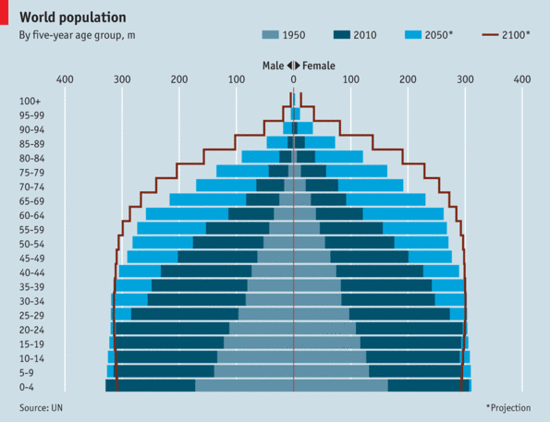
The Economist charts it:
By 2100, 22.3% of people will be aged 65 or over, up from just 7.6% in 2010.
The Economist charts it:
By 2100, 22.3% of people will be aged 65 or over, up from just 7.6% in 2010.
Even babies understand why:
Ten-month-old infants looked longer at scenes in which the bigger object surrendered, indicating that they were surprised at this outcome (the amount of time infants spend studying a scene is a well-tested experimental metric for piqued interest). The finding suggests that babies understand conflicting goals and social dominance, even though they cannot talk or actively fight.
Josh Barro watches the debt ceiling negotiations mangle a talking point:
Over the last couple of years, a common conservative talking point about federal policy changes has been that uncertainty is dangerous. When people don’t know what future government policies will look like, the risk inherent in business investment is greater, without average returns being higher … As with any policy, there could be good reasons to manufacture a debt limit impasse despite the uncertainty it creates. (In my view, there aren’t, but there could be.) Still, opponents of a clean debt limit increase need to account for the uncertainty that their preferred policy will foster.
Kevin Drum suspects "uncertainty has always been a purely political attack, not one grounded in either ideological consistency or empirical evidence."

Machico, Madeira, Portugal

San Francisco

Minneapolis, Minnesota, August 12, 2007.

Endeavour‘s final launch, captured by Stephanie Gordon and forwarded by a reader.
Steven Cherry ticks them off:
Twice in the last six years, the world’s timekeepers have changed our clocks by one second. And I bet you didn’t even notice, because a second is no big deal. Unless you’re an airline pilot. According to an article in the current issue of Communications of the ACM, a plane moves 300 meters in one second. A one-second hiccup in the radar of an air traffic control system is not a trivial matter. … There are no standards for how to plan and manage leap seconds, and most systems go down for planned maintenance instead of trying to deal with leap seconds in real time. The U.S. nuclear arsenal is reportedly put in a so-called special mode for one hour before and after a scheduled leap second.
Today on the Dish, Andrew expanded on DSK and men who abuse their power, and argued HIV treatment is prevention. Newt kneecapped Paul Ryan and played the race card, and readers weren't forgiving Newt, even with his daughter's defense. Andrew nailed Newt as a self-important idiot, and picked apart Panetta's letter to McCain on torture. Gary Johnson kicked off his YouTube campaign, Nate Silver tracked Iowa numbers without Huckabee, and we surveyed the full 2012 tea leaf readers. We hit the debt ceiling, feared for the recovery, and parsed why the Republicans are toying with default. Comparing slavery to anything but slavery didn't strike us as right, rich Republicans needed gay marriage in New York, and readers piled on George W. Colbert played with PACs, and Trump grasped at the last straws of his celebrity.
Israel faced an Arab Spring, Beinart nailed the way forward for Zionism, and Andrew pushed Netanyahu towards being on the right side of history. Gifted kids weren't getting more gifted (but readers stood up for them), we feared all the wrong things, and the NYT had a history of being deferent to the US. Dan Savage couldn't understand his status as an icon, and Sarah Palin ruined the career of Sarah Palin. Alan Jacobs didn't consider Twitter is a popularity contest, Kindles don't make for great study buddies, and email footers aren't legally binding. Lost endings were unearthed, we raised a glass to healthy drinking, sequels soared, and Nicola Twilley sopped up our coffee shirt stains.
Chart of the day here, quotes for the day here and here, beagle playing catch here, VFYW here, MHB here, FOTD here, and the Dish in a picture here.
–Z.P.
Scores of readers are sounding off on this topic. One writes:
I think that Frances Woolley entirely misses the point of gifted and talented programs, which is not to increase achievement. The tests that children take to qualify for the program already identify children with the ability for high achievement. So it does not surprise me that so-called “enrichment” or “G&T” programs do not improve achievement, since kids are already prone to scoring highly no matter what. What these programs do is give focus and challenge to kids who may not be receiving this in general education classes.
I, myself, am the product of gifted and talented classes.
I began these classes in 5th grade, circa 1974. Throughout my 3rd and 4th grade years, I was developing into a problematic kid. I refused to go to school without a fight every morning. Although all my teachers could see that I was doing very well with the actual class work, I was finishing too quickly and becoming a nuisance to the rest of the class. I acted out. I pretended to be sick so that I could go home. I was a general problem. I told people that I hated, Hated, HATED school. I was even beginning to act out away from school.
My teachers recognized this all-too-common psychology for kids like me. I was tested and moved to a new school and began G&T classes. I was suddenly happy. I was interested in school again. I couldn’t wait to go to class. It was the best thing of my young life – even though my mother drove me 15 minutes to a friend’s house where I caught a school bus that took another 30-40 minutes to get me to school. Moving to these classes that challenged me again saved me and my parents from many, many hard days.
Another writes:
By definition, these programs are for the high-achievers. The measure should be how much worse the gifted kids would do if they were not in gifted programs. Not just academically, but in general.
I was in gifted programs and absolutely loved them. They offered a challenge, yes, but also an environment in which I could let my freak flag fly – and being Really Smart is definitely a variety of freak. I didn't have to self-edit and try to keep from seeming like too much of a smarty-pants; everyone was a smarty-pants, and we gleefully tried to out smarty-pants each other. Some of my lifelong best friends were people I met in the gifted programs.
Another:
Outside of the yuppie environs McArdle talks about, we live in a culture where academic acheivement is actually frowned on by peers. I went to a nice, suburban school in Nebraska and I was literally beaten up for getting a high score on a test, made fun of constantly for reading, ostracized both for being smart and for trying to do well in class. I know sharp kids who deliberately didn't try in school and never learned anything because they didn't want to be bullied. Other kids just never saw the value of wasting their time doing busy work to acheive some external approval (grades, test scores) when they could be doing more interesting stuff (sequencing DNA, writing songs and plays, and sadly, for some, drugs). The chances I had to meet other kids like me in an environment of inquiry and openness was a godsend, a sign that not only was I not alone, but that whatever I had going on might have some value.
Once or twice a year there were special (and optional) all-day events dedicated to a specific topic for the G&T kids from all over the district. The summer after eighth grade, I went to a summer program at a local college where I had my first experience doing theatre, which is what I'm still doing nearly twenty years later. This gets at the heart of what I loved about the progams: the freedom to follow whatever I was interested in, rigor and real-world information, being surrounded by engaged and interesting peers, and being taught by someone who is knowledgable and empathetic.
It is possible that the way some of these programs are run or how they select students is faulty, but honestly, the idea that these programs might be useless as a concept, just a kind of parent status badge is infuriating.
Another:
I'm from a small Texas town where the easiest way to have interaction with your peers was to play sports. I wasn't a gifted athlete, but gathering a few times a week with kids from a variety of social and economic groups to solve puzzles, work on research projects, write short stories, play chess, and have conversations that many of my friends in other capacities weren't interested in having, thrilled me beyond words. Though most of us had an easy time in school, I think what was lovely about the G&T program is that it was just learning for learning's sake. And we were rewarded on our ability to be creative, challenge authority, and think outside the box, rather than regurgitate information.
Another:
I was priviledged to be a student in an outstanding G/T program in suburban Buffalo public school district in the '80s. We put on an abridged Shakespeare play in 4th grade, wrote computer programs in BASIC and LOGO, and in 5th grade presented a year-long research project about a world problem in front of an audience of peers and parents. Back in the regular classroom, reading and math were almost unbearably boring. Without G/T, I would have hated school – with G/T, I loved it.
It has always seemed to me that when people speak against gifted education, they are presuming that because gifted kids can already meet their grade level expectations, it is a waste of resources to try to teach and challenge them further. Yet, the purpose of education should be for all students to be challenged and to learn and grow. I don't see how a nation that declines to invest in its best and brightest can expect those same best and brightest to magically transform into the leaders of the 21st century.
(YouTube user LaaDida3 has basically uploaded the entire series of "Freaks And Geeks" – view the dozens of clips here.)
With Huckabee out, speculation about the 2012 GOP nominee has begun in earnest. George Will:
I think we know with reasonable certainty that standing up there on the west front of the Capitol on January 20th, 2013 will be one of three people. Obama, Pawlenty and Daniels. I think that's it.
[T]he most recent available polling has Romney with more support than Pawlenty, Daniels, and Bachmann combined–with a Bachmann to spare. The notion that we “know with reasonable certainty” that either Pawlenty or Daniels will win is nonsense–unless Will figures that no other nominee has a shot against Obama. But there’s no reason to think Pawlenty and Daniels have more national appeal than Romney.
The ultimate beneficiary of Huck’s demurral … is likely to be Tim Pawlenty. His all-in-for-Iowa strategy now looks considerably more promising, and he is appealing to many pragmatic social conservatives as an electable alternative to the unpalatable Mitt Romney and (if he runs) Mitch Daniels. A field without Huckabee, moreover, is a field without a viable deep-fried southern option, which could be great news for a guy like T-Paw in South Carolina and other southern states.
I don’t believe Romney could win a Romney-Pawlenty contest. But he would almost certainly win a Romney-Bachmann race, and could well win a Romney-Pawlenty-Bachmann race. So to the extent he can boost her, it makes sense for him to do so. Having been on the losing end of this maneuver, Romney, I assume, knows how it’s done.
[T]he immediate problem for the Palinites is neither organizational nor financial. It is the fact that, as John wrote last week, her political career imploded and she appears to have gone to ground and abandoned the field to others, such as Michelle Bachmann, who is well placed to garner the affection of her core constituency. Sarah Palin’s moment looks to have come and gone.
Especially with Huckabee handing her, gift wrapped, the USA’s evangelical base, it seems obvious that Sarah will announce her candidacy for president later this year: if she doesn’t, a year from now people won’t even remember how she spells her name. (Is it p-a-l-i-n, or p-a-l-l-i-n, as in “pallin’ around with terrorists”?) … Sarah’s greatest fear is irrelevance.
I think Mike Huckabee's decision not to run for president increases the chances that Michelle Bachmann could win the nomination. In my view, the three main contenders for the nomination are, in order, 1) Tim Pawlenty, 2) A party establishment-friendly Republican not currently running, such as Mitch Daniels or Paul Ryan, and 3) Bachmann. Everybody else, including Sick Man Of The GOP Field Mitt Romney, falls into the longshot bin.
I do think Daniels will get in, which will reduce Romney’s odds considerably. But at this point, the Indiana governor has every reason to wait another six months or so to declare his candidacy — because at the rate we’re going, all of his prospective rivals will have either bowed out or self-destructed by then.
I think Daniels’ natural constituency is the voter who wants the wonk who does not trust Mitt Romney’s or Gingrich’s conservative credentials and who also does not care much about social issues. The voter going here leans establishmentarian, but puts a value on conservative street cred.
While no one was watching, Daniels just engaged in a bit more self-destruction of his own. Thanks to one of my commenters, I came across this report that Daniels had floated Condi Rice’s name as a hypothetical VP nominee. Rice is not pro-life, and that is just one of the problems with Daniels’ hypothetical suggestion. If Daniels weren’t already under fire for his “truce” proposal, this wouldn’t amount to much, but it reinforces all of the doubts that social conservatives have about Daniels despite his obvious credentials as a social conservative.
Roger Ebert marks it:
According to Brandon Gray of Box Office Mojo, who ran his own numbers, 2011 will see a record 27 sequels. … As the leadership of many studios is taken from creators and assigned to marketers, nothing is harder to get financed than an original idea, or easier than a retread. The urge to repeat success can be found even in the content of modern trailers, which often seem to be about the same upbeat film. Even The Beaver, with Mel Gibson battling mental illness, is made to look like a hopeful comedy with a cute stuffed animal.

Rebecca Frankel has a new slideshow on war dogs. Original one here. She captions the above photo:
[W]ar dogs are usually bred and trained by the military or private contractors. Most of them come from one place: Lackland Air Force Base in San Antonio, Texas — otherwise known as the "dog mecca for all service branches." According to Airman Magazine, the Lackland program is tasked with the goal of producing "at least 100 puppies each fiscal year." Above, Rrisky, a Belgian Malinois puppy — just like the one rumored to have gone on the bin Laden mission — greets visitors at Lackland's kennels.
(Photo by U.S. Air Force/Tech. Sgt. Bennie J. Davis III)
 The Dish