Gingrich’s First Divorce, Ctd

GT_BROOKS_110516

A reader writes:

I've always understood that Gingrich brought in the papers for his wife to sign while she was in the hospital, not that he informed her for the first time.  Notice that the daughter's account would still apply, as she doesn't give details as to what happened during that visit.

Kevin Drum dug up original reporting from Mother Jones on the incident and agrees that "nothing in Cushman's account really changes anything we originally reported." Another reader:

Are you taking the word of the daughter, who was thirteen at the time, over that of the wife who was quoted by the Washington Post as saying:

"He can say that we had been talking about [a divorce] for 10 years, but the truth is that it came as a complete surprise," says Jackie Gingrich, in a telephone interview from Carrollton. "He's a great wordsmith … He walked out in the spring of 1980 and I returned to Georgia. By September, I went into the hospital for my third surgery. The two girls came to see me, and said Daddy is downstairs and could he come up? When he got there, he wanted to discuss the terms of the divorce while I was recovering from the surgery … To say I gave up a lot for the marriage is the understatement of the year."

Another:

I, too, looked into this rumor. An online search yields scant knowledge of what went on between the parties involved, save this lone dissent from the daughter. She was 13 at the time of the divorce. Was she in the room every minute of the visit? Were there visits she wasn’t privy to? To what degree is this an unbiased account to be relied upon if your objective is to judge Newt’s character? I hardly think this testimonial puts to rest the reports of Newt’s alleged cruelty and flippant treatment of spouses (both “ex” and current). And then there is this to cap off the daughter’s dispute of the narrative:

My sister and I feel that it is time to move on, close the book on this event and focus on building a great future. We will not answer additional questions or make additional comments regarding this meaningless incident, which occurred more than three decades ago. As I said, my mother is a private person. She will not give media interviews. She deserves respect and should be allowed to live in peace.

Her father is running for President and she preemptively announces that all the people involved in a very character-baring event will remain mum on the matter? I think you’re too quick to put this to bed.

I may be. I was trying to be fair to all parties. Justin Elliott is on the case.

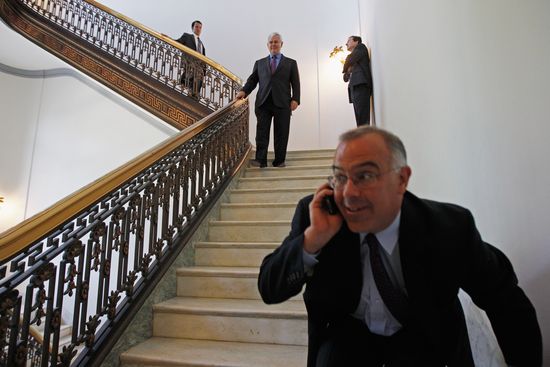
(Photo: New York Times Columnist David Brooks moves out of the way of former Speaker of the House Newt Gingrich as he leaves the Russell Senate Office Building after addressing the Esperanza 2011 National Hispanic Prayer Breakfast and Conference on Capitol Hill May 11, 2011 in Washington, DC. By Chip Somodevilla/Getty Images.)
Now, Israel Faces An Arab Spring, Ctd

Goldblog sees the protests at the Syria-Israeli border as a little too convenient, and regards even Ethan Bronner as a sap for Hamas. Freddie deBoer, meanwhile, thinks Goldblog is changing the subject himself:

What’s interesting is that Goldberg is doing what he accuses the repressive Syrian regime of doing: he is using another set of protests as a distraction from the moral valence of the protests that are inconvenient to him.

But is it not possible that the Syrian demonstrations were obviously manipulated by Assad and that the Arab Spring is redefining the Arab-Israeli conflict, to Israel’s disadvantage? Note what Peter Beinart and others have indeed noted: the protests in the West Bank were kept from the borders. Netanyahu has an opportunity here, to get ahead of, or not so behind, the march of history. Will he fail again?

Now, Israel Faces An Arab Spring, Ctd

Beinart:

The Palestinians are taking control of their destiny because Israel has not. Zionism, which at its best is the purposeful, ethical effort to make Jews safe in the land of Israel, has become—in this government—a mindless land grab, that threatens Jewish safety and Jewish ethics alike. Once upon a time, when the Arabs were hapless and America was omnipotent, Israel could get away with that. Not anymore. If Barack Obama cannot get Benjamin Netanyahu to endorse—and work toward—a Palestinian state near 1967 lines, events will pass them both by. Others will take the initiative; in the Middle East, the U.S. and Israel will increasingly find their destinies in other nation’s hands. For those of us raised to believe that Americanism and Zionism were can-do faiths, it is harder to imagine any crueler irony than that.

Now, Israel Faces An Arab Spring, Ctd

GT_AVIVIM_110516

Yesterday, Andrew Exum provided a must-read on the bloody protests at the Israeli borders. He follows up this morning:

As I said yesterday, the events along Israel's borders should be a wake-up call for the Israeli political class. Although the easy thing to do here will be to claim that Israel has no partner in peace, it is foolish to think the kind of non-violent protests that proved so effective in Egypt and Tunisia will not migrate to the Occupied Palestinian Territories. In the eyes of the world, Israel will look like Ben Ali or Mubarak in the face of a non-violent movement for the creation of a Palestinian state. Is Israel prepared for that?

When I was in Israel 18 months ago doing some research, some security analysts I talked to spoke of the West Bank and the Palestinians as a problem to be managed: sure, there would be an uprising every now and then, but it was nothing Israel could not handle through force. I'm not sure that is any longer the case, if indeed it ever was, which is part of the reason why I believe(.pdf) Western, Arab and Israeli policy-makers should start setting the conditions for a Palestinian state now rather than wait.

Agreed. The sadness on my part is that yesterday non-violence still did not seem to be among the options the Palestinians can agree on. But non-violent, Tahrir-style resistance to occupation would be very, very powerful.

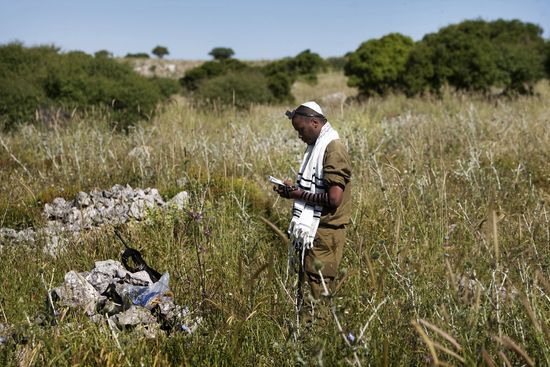
(Photo: An Israeli soldier prays along his country's northern border with Lebanon near the village of Avivim on May 16, 2011, opposite the southern Lebanese village Marun al-Ras where Israeli troops opened fire the previous day on people trying to scale the border fence during a Palestinian refugee protest to mourn what is known as the 'nakba' or 'catastrophe' of Israel's 1948 creation. The clashes along the Lebanese-Israeli border, in which 10 people were killed and 110 wounded, marked the bloodiest confrontation since the 2006 war between the two neighbours. By Menahem Kahana/AFP/Getty Images.)

Rerouting Our Fear

Screen shot 2011-05-12 at 4.29.51 PM

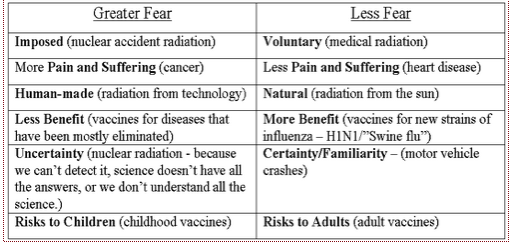
David Ropeik emphasizes why it's important:

We worry about some things more than the evidence warrants (vaccines, nuclear radiation, genetically modified food), and less about some threats than the evidence warns (climate change, obesity, using our mobiles when we drive). … [This Perception Gap] produces social policies that protect us more from what we're afraid of than from what in fact threatens us the most (we spend more to protect ourselves from terrorism than heart disease)…which in effect raises our overall risk.

Kindle As Study Buddy

Kindles don't lend themselves to the same "cognitive maps" of books, according to a new study:

When we read, we unconsciously note the physical location of information within a text and its spatial relationship to our location in the text as a whole … These mental images and representations do more than just help us recall where ideas are located in a given text. We use cognitive maps to retain and recall textual information more effectively, making them useful tools for students who are reading academic texts to satisfy specific goals.

Nick Carr lays out some other advantages:

It's easy to flip through the pages of a physical book, forward and backward. It's easy to jump quickly between widely separated sections, marking your place with your thumb or a stray bit of paper or even a hair plucked from your head (yes, I believe I've done that). You can write anywhere and in any form on any page of a book, using pen or pencil or highlighter or the tip of a burnt match (ditto). You can dog-ear pages or fold them in half or rip them out. You can keep many different books open simultaneously, dipping in and out of them to gather related information. … Whereas a printed book adapts readily to whoever is holding it, an e-book requires the reader to adapt to it.