"A library is a good place to go when you feel unhappy, for there, in a book, you may find encouragement and comfort. A library is a good place to go when you feel bewildered or undecided, for there, in a book, you may have your question answered. Books are good company, in sad times and happy times, for books are people—people who have managed to stay alive by hiding between the covers of a book,"- E.B. White, writing to the children of Troy, Michigan, congratulating them on their new library in 1971.
Month: May 2011
Face Of The Day

Matt Stopera compiles 14 more of the "Best Faces At The World Table Tennis Championships".
Online Dating: An Inflated Market
Marina Adshade discourages profile pictures that makes you seem more attractive than you are:
It seems to me that while online dating sites in theory will shorten the search for a mate, the fact that everyone uses their best picture is creating beauty inflation that is driving up an individual’s perceptions of their own price on the market. If prices are artificially high, and slow to adjust as a result of this inflation, then the market will take a long time to clear.
The Most Livable, Milquetoast City
Edwin Heathcote surveys the usual lists of "livable" cities:
Ricky Burdett, who founded the London School of Economics’ Cities Programme, says: “These surveys always come up with a list where no one would want to live. One wants to live in places which are large and complex, where you don’t know everyone and you don’t always know what’s going to happen next. Cities are places of opportunity but also of conflict, but where you can find safety in a crowd. “We also have to acknowledge that these cities that come top of the polls also don’t have any poor people,” he adds.
And that, it seems to me, touches on the big issue. Richard G Wilkinson and Kate Pickett’s hugely influential book The Spirit Level: Why More Equal Societies Almost Always Do Better (2009) seems to present an obvious truth – that places where the differential in income between the wealthiest and the poorest is smallest tend to engender a sense of satisfaction and well-being. But while it may be socially desirable, that kind of comfort doesn’t necessarily make for vibrancy or dynamism. If everybody is where they want to be, no one is going anywhere.
Natty Smith agrees:
There is something about urban living that breeds camaraderie – we’re all in it together. It’s such a profoundly human lifestyle, and it forces us to confront the fact that most problems we encounter are ours (in the global sense), and ours alone.
(Image by Laura Barnard)
A Poem For Saturday
Michael Robbins reviews a new book of poetry by Robert Hass:
It is different in kind from a man and the pale woman
he fucks in the ass underneath the stars
because it is summer and they are full of longing
and sick of birth. They burn coolly
like phosphorous, and the thing need be done
only once.
—From “Against Botticelli”Does ass fucking really require such a high-minded justification? Upon being told someone is fucking someone else in the ass, has anyone ever responded, “What! Why?” I regret to inform the reader that Hass goes on to compare this sex act to the sacking of Troy.
Mental Health Break
Raising the bar on timelapse photography:
24 Hours of Neon from Philip Bloom on Vimeo.
My first attempt at HDR tone mapping timelapse. We start off with normal timelapse and then go into the 3 and 7 bracket tone mapped HDR timelapses. I wanted to create a sense of colour and insanity that Las Vegas gives you. All from one view point. My balcony.
The End Of Shyness
Rob Horning heralds it:
With Facebook, shy people experience greater control over self-presentation at a pace they can handle. Users can manage the flow of social interaction, experiencing social life through a dashboard and time-shifting friendship to suit their needs. On Facebook, no one need worry about volunteering information clumsily or at the wrong time, or expressing enthusiasm with a little too much energy. You don’t have to worry about interrupting anyone or expect to be interrupted. You can’t misjudge the moment, because social media suspends spontaneity.
Charts Of The Day
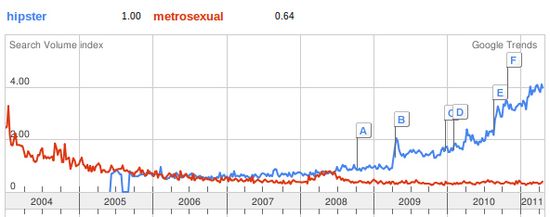
Using Google Trends, Razib Khan charts the fall of the metrosexual and the rise of the hipster:
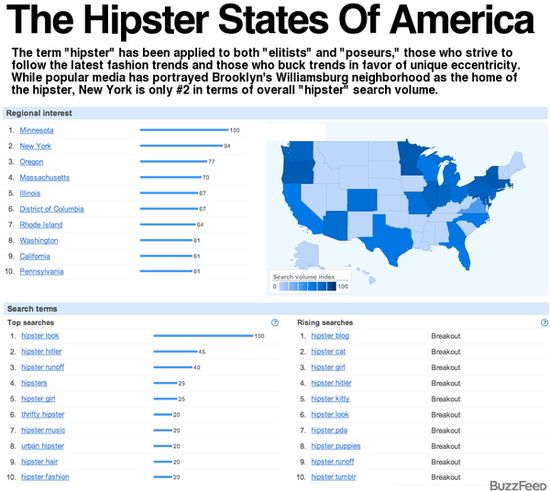
Which dovetails nicely with Buzzfeed's christening of Minnesota as the most hipster state (by search volume):
You’ve Got Privatized Mail
James Meek checks in on the Dutch postal service:
Every week Dutch households and businesses are visited by postmen and postwomen from four different companies. There are the ‘orange’ postmen of the privatised Dutch mail company, trading as TNT Post but about to change their name to PostNL; the ‘blue’ postmen of Sandd, a private Dutch firm; the ‘yellow’ postmen of Selekt, owned by Deutsche Post/DHL; and the ‘half-orange’ postmen of Netwerk VSP, set up by TNT to compete cannibalistically against itself by using casual labour that is cheaper than its own (unionised) workforce. TNT delivers six days a week, Sandd and Selekt two, and VSP one. From the point of view of an ardent free-marketeer, this sounds like healthy competition. Curiously, however, none of the competitors is prospering.
Meanwhile the U.S. Postal Service has lost $2.6 billion so far this year.
The View From Your Window
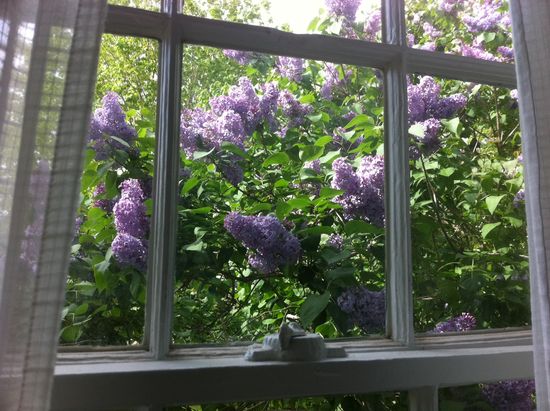
Highland, New York, 7 am
 The Dish