Shades Of Red And Blue, Ctd

Energychart

Ruy Teixeira reads more into Pew's ideology study and finds some green overlap:

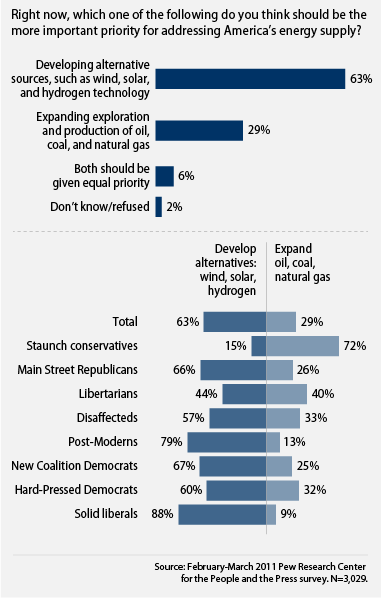
Overall, the public prioritizes developing alternative energy over expanding oil, coal, and natural gas by a 63-29 margin. And, as shown in the chart below, seven of Pew’s eight active typology groups support this position, including a whopping 40-point margin among the Main Street Republican group. Only the staunch conservatives (9 percent of the public) dissent from the rest.

Romney Hides Behind Federalism

Ezra Klein analyzes Mitt Romney's new healthcare proposal. Ezra's bottom line:

The only solution-like proposal left on the table [for Republicans on healthcare] is to devolve responsibility to the states, and Romney is smart to get there first. The question, I think, is whether the GOP unites around some version of this idea or whether Romney has become so radioactive on health care that by proposing a federalist solution, he actually takes it off the table for the Republicans running against him.

The Daily Wrap

Today on the Dish, Andrew critiqued Palin's North Korean-style portrait and the balm it offers for the right, and rejected Andrew Breitbart's vision of a multicultural Tea Party a la the original constitution. Andrew responded to readers on the rules for torture and war, defended Obama against charges of exploiting his success, and went another round with Ross Douthat on Libya. 10,000 protesters were detained in Syria, snipers were ordered to aim for protesters' heads, and Hillary considered Assad's replacements. Scott Horton made the case for releasing the photos down the line, and Tom Ricks outlined a breakup plan with Pakistan.

Andrew questioned the immigration paradox, marveled at the chicken-sh** tax credit, and rallied for Palin to fill Trump's crazy shoes. Larison schooled Mike Gerson on the drug war, Romney flailed on healthcare, and Gingrich promised to love America unless it gets cancer. Cuomo's support for same-sex marriage edged him up for 2016, progressive Christians still couldn't handle families with two moms, and Obama's bounce grew. Ezra explained the logic of Boehner's debt ceiling demands, and Reihan pointed out where the real taxable income lies (spoiler: it's not with the ultra rich). The internet mattered in developing countries before elections, and readers argued the IUD is a form of abortion. We charted how long we live, Conor Friedersdorf remembered the history of the entitlement movement, and rock reviewers are easy targets. Showtime hired women to hire gigolos, graphs matter, and sitting is deadly.

Hathos alert here, quotes for the day here and here, mural of the day here, VFYW here, MHB here, FOTD here, and last call for interns here!

–Z.P.

The Verdict On Romneycare? Ctd

A reader writes:

As a Massachusetts resident, let me respond to the report and the WSJ editorial. Romneycare was, first and foremost, an attempt to include people in the normal healthcare system who were excluded from it. It had no provision to increase the number of doctors. The number of potential patients rose considerably. The number of doctors did not. Simple arithmetic suggests that there will be more competition for doctors' services and hence more waiting time. The increased waiting time is thus an indicator of success, not failure.

(Note, by the way, that a previous poll published [pdf] in the New England Journal of Medicine found that 60 percent of physicians said the law had little impact on how long patients wait to get an appointment. ) Despite this putative drawback, it's important to note that most Massachusetts residents wouldn't want to go back. A summary from Factcheck.org in March of this year:

For now, public support and physician support [for Romneycare] are both high in the state. Surveys by the Urban Institute and the BCBS of Massachusetts Foundation found [pdf] that 67 percent of nonelderly adults in the state supported the health care law in the fall of 2009; in the fall of 2006, a few months after it was passed, 68.5 percent supported it. Another 2009 survey by the Harvard School of Public Health and the Boston Globe found 59 percent of state residents supported it, which was also similar to the poll’s 2006 number, 61 percent. In 2009, 28 percent opposed it and 13 percent weren’t sure. Support was much higher among Democrats and Independents than Republicans. Those are the most recent surveys we found. Among practicing physicians, 70 percent supported the law in a fall 2009 survey, also from Harvard.

Why the lack of complaint? Let me give you one reason. In October 2008 my daughter, then 10, was hit by a bone infection in her hip. Despite surgery and a lengthy round of antibiotics her hip was damaged to the point where a total hip replacement became necessary. Her hip replacement will wear out in 25-30 years even if nothing goes wrong. If she lives a normal lifespan, that is, she will have to replace it twice – two very expensive operations. Under the status quo, she would not be able to get insurance for these procedures – she has a huge preexisting condition, right?

But we live in Massachusetts. Indeed, throughout my daughter's ordeal we were repeatedly told by physicians, nurses and friends that our daughter would, as a practical matter, have to live in Massachusetts for the rest of her life, because if she moved elsewhere in the country as an adult and her hip went out she would face potentially crippling costs. "But at least she can live here," they said. "It's not like the rest of the country, where you're simply fucked."

Stories like this are why people like Romneycare, even if they complain about it. As Obamacare becomes law and situations like this become known, it is difficult for me to imagine a groundswell for throwing children like my daughter into the fire.
The Snipers Of Syria

Enduring America points to a "truly disturbing report from Syria, but one that matches much of the video and eyewitness accounts from the country. An informant from the Syrian Ministry of Defense Special Forces tells France 24 that snipers were ordered to shoot protesters in the head:"

Each officer was to be accompanied by a volunteer sniper [usually a member of a militia or a mercenary]. They were also ordered to position themselves in places from which it would be easy to shoot. They were ordered to aim for the head as soon as they saw a protester. Their goal was to terrify people so they wouldn’t leave their houses.

For readers with strong constitutions, graphic footage of victims can be viewed here and here.

Newt’s Chances

Allahpundit won't write off Gingrich:

I’m not as bearish about his chances as most for the reason I gave last night: If, if neither Palin nor Huckabee runs, then Newt could gobble up their social conservative supporters and benefit from a split on the other side among Romney, Pawlenty, and Daniels. It’s unlikely, admittedly, but not impossible. Nate Silver, after running a bunch of statistical polling models, puts his odds at around nine or 10 percent. I wouldn’t go quite that high — five or six feels better — but it ain’t zero.

 Michael Tomasky differs.

Social Security Number To Keep Your Eye On

Various pundits are beating up on Alan Simpson for ignorance about longevity data. Reihan Salam agrees "the former senator really should be embarrassed about this." But Reihan shifts the debate:

[W]hat really matters in a pay-as-you-go system is the dependency ratio, i.e., the ratio of workers paying into the Social Security system to the number of Social Security beneficiaries. The number of over-65s is a lot higher today than it was at Social Security’s inception. This would have been challenging enough on its own, but a series of Carter-era measures increased the rate at which Social Security benefits grow. It is also worth noting that over-65s were the most impoverished age group when Social Security was established, and that distinction now belongs to under-18s.

Andrew Sprung is in related territory when he mentions that "many more baby boomers will reach age 65 (or 67, or 69) than did their predecessors," which will effect the dependency ratio. Ryan Avent, meanwhile, is willing to consider raising the retirement age, but, like Ezra Klein, he worries about the consequences.

Gingrich Announces Doomed Campaign

Jacob Sullum rounded up pre-reaction. Alex Knapp suggests a campaign slogan:

GINGRICH 2012: HE WILL ALWAYS LOVE AMERICA. UNLESS IT GETS CANCER.

Alex Massie calls it "the only slogan … and commentary his opponents need" for reasons Frum outlined awhile back. Kevin Drum imagines how this will play out:

Gingrich can't escape his past. His primary opponents will stay quiet about his lecherous past as long as he's no threat, but the minute he looks like he might really have a chance to win, at least a few of them will go after him with all guns blazing. Politics ain't beanbag, after all.

Matt Taibbi is dying to hit the road:

I literally cannot wait to get back to covering the insane reality show that is the presidential race, especially since the Republicans seem determined to run the most entertaining collection of mutants seen on earth since Tod Browning’s classic Freaks.

Romney Attempts To Thread Needle, Fails

Chait summarizes Romney's position on healthcare mandates:

If we lived in a country where every citizen was required by the national government to obtain health insurance, it would be tyranny. But if we lived in a country where every citizen was required by their state government to obtain health insurance, it would be ideal. Anybody think this is going to fly?

But Romney supported a federal mandate in 1994.