Chicken Shit In The Tax Code

Last month Obama talked about “spending reductions in the tax code.” Jon Stewart accused the president of Orwellian phrasing because Obama had "managed to talk about a tax hike as a spending reduction." Len Burman rightly dissents:

You don’t believe there’s spending in the tax code???  Here’s a real life example:  the chicken-s**t tax credit.  Really, section 45 of the Internal Revenue Code.  You can look it up.  The late Senator Roth of Delaware (home of lots of chickens and “poultry manure,” as it’s euphemistically called) put this little goody into our tax laws. 

Here’s the backstory:  the EPA said that enormous chicken farms could no longer put their poultry waste in pools or bury it because it poisoned the ground water.  One of the best options to meet the new requirement was to dry the vile effluent and burn it to make electricity, but that was still costly.  Roth didn’t want chicken farmer profits to plummet or chicken and egg prices to rise just because farmers couldn’t use the earth as a giant toilet, so he pushed through the chicken s**t tax credit to create a profitable market for that (as well as all sorts of other crap).

Burman points out that "tax subsidies add up to more than $1 trillion per year."

Dish Interns Wanted: Deadline Approaching

The Dish is looking for two interns to help with editorial content, assist with remedial tasks, and work on larger projects.

Interns will be full time (37.5 hours a week) and will be paid an hourly wage of $10.25. The position, unlike many internships, includes benefits (my bleeding heart insistence) and are a year-long commitment. Applicants must be in DC or willing to move to DC. We are hoping to hire interns within the next month or two. Start dates are semi-flexible.

We've wanted our own exclusive interns for years and now we are at the Beast, we can have them. We're looking for extremely hard workers, web-obsessives and Dishheads, who already understand what we do here. I should add that Zoe, Chris and Patrick all started as Atlantic interns with some of their duties for the Dish, and became full-time staffers because of the amazing work they produced. We're also looking for individuals who can challenge me and my assumptions and find stuff online that we might have missed.

To apply, please e-mail a (max 500-word) cover letter explaining why you want to work for the Dish and a resumé to Dish.Intern@newsweekdailybeast.com. The cut off for applications is Friday, May 13th.

What Continuity? Ctd

Ross Douthat goes point-by-point through my criticisms of his column. Ross insists that “the Bush-Cheney vision of America’s role in the world” endures “in good ways and bad, deep into a presidency that promised to repudiate it”:

[W]here the Libyan war is concerned the Obama White House has displayed both continuities and discontinuities with Bush-era interventionism. On the one hand, our North African campaign has been justified by the same broad worldview and the same kind of arguments that gave us the Iraq invasion. On the other hand, it’s implementation has owed more to Clintonian liberal internationalism than to the neoconservative foreign policy vision. On the other other hand, if you look at military commitments rather than U.N. resolutions, the Libyan campaign is arguably less multilateral than the war in Iraq — and it’s a more striking manifestation of the imperial presidency, in a sense, because we’re fighting it with barely a nod to the need for congressional approval.

Ross’s Libya points are well-taken, especially on the imperial presidency, where we couldn’t agree more. On multilateralism, I would argue that merely counting the number of allies in any mission is not as salient as which allies. If the Arab League had backed the Iraq war, along with France, Russia and China, I could see Ross’s point. He’s also right to see military continuities from 2006 – 2011. But what we understand as the core dynamic of the Bush-Cheney approach was from 2001 – 2006. Those were the years when the deepest holes were dug.

The other important point is that Obama inherited these wars and their apparatus (including the torture bureaucracy). You cannot practically abolish an entire government machine built up over two terms overnight. If Obama puts the torture era behind us, gets us out of Iraq and accelerates the departure from Afghanistan (via a temporary build-up), then I think we will see starker differences than Ross does.

As for the impact of Obama on the Iranian revolution and the Arab Spring, I agree it’s too facile to draw a direct linkage. History and perspective will again help. But the Cairo speech – defending democracy in the heart of the Arab world – was a breakthrough. Bush could never have done it.

The closest he could get was London. But the Obama campaign’s leverage of social media and the call for change was echoed in Tehran and then in Cairo. The fact that a man with Hussein as a middle name killed bin Laden is also pivotal for shifting the propaganda war in our favor.

Yes, the potential for Obama in re-branding the US was partly foiled by the pro-Israel lobby. And that remains the acid test for many Arabs and Muslims. But his election and possible re-election will undoubtedly affect the promise of reform in the region in part because America has finally had the good sense to get out of the way and to speak more quietly and subtly. A return to the crude rhetoric of a Bolton or Romney would help no one.

Yes, the Libya adventure is the drastic exception that proves the rule. Like Ross, I wish we hadn’t done it, especially cutting the Congress out of any substantive role. But its outcome is also unclear. In the middle of deep historical change, we see continuities and discontinuities. I believe the discontinuities between now and then are now much greater than Ross holds. But history in the end will judge both of our assessments with its usual lack of mercy.

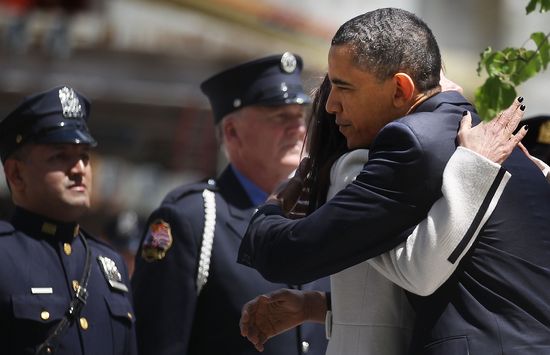
Obama, Osama And Politics

GT_OBAMAWTC_05112011

I fail to see even the slightest trace of crude exploitation here, in a Q and A session at a fundraiser:

AUDIENCE MEMBER: Thank you for getting bin Laden.

THE PRESIDENT: Well, there you go. (Applause.) Case in point. (Applause.) It should inspire us to finish what we started. Because of you, we were able to prevent a second Great Depression. But in the next few weeks, in the next few months, the next few years, we have to make sure that the new jobs in industries of our time are created right here in the United States of America. We have to make sure that America is prepared to win the future.

It's pretty obvious he's analogizing the long struggle to capture or kill Osama bin Laden to the long struggle to bring the economy back to health. But even if he weren't, is Obama not allowed to cite this achievement in making an argument for his re-election? Allahpundit is sane on this:

He didn’t bring up Bin Laden himself — an audience member did — but we’re going to be hearing about OBL on the trail from now until election day so we might as well get used to it. And honestly, I don’t begrudge him that.

More to the point, in extended remarks, Obama did not hog the glory:

“And because of the extraordinary bravery of the men and women who wear this nation’s uniform and the outstanding work of our intelligence agencies,’’ Obama said, “Osama bin Laden will never again threaten the United States.’’

The key point in his favor, it seems to me, is not the success of the raid as such, although it seems the commander-in-chief was involved in the minutiae. It was Obama's decision on winning office immediately to reorient the CIA toward getting OBL after tortured lies had persuaded the Bush administration to conclude he was a figurehead and move on. You think a Republican would hesitate for one second to take credit for that?

(Photo: U.S. President Barack Obama hugs Diane Wall, whose husband Glen Wall perished in the twin towers on 9-11, at a wreath laying ceremony at Ground Zero May 5, 2011 in New York City. By Mario Tama/Getty Images.)

Torture And War, Ctd

A reader writes:

Can you please give your definition of "detained"? Surely you're missing your reader's point, which is that bin Laden was unarmed and thus presumably he was completely within the control of our forces. For all intents and purposes, he had already been "detained" just as surely as if he had surrendered. In this scenario, bin Laden was shot when he could just as easily have been captured (indeed for all intents and purposes he had been captured; he just wasn't wearing handcuffs yet) because it was more politically convenient to do so. By your own logic, surely you agree that this would be unacceptable?

Okay, this might or might not be what happened. We don't have all the facts. Maybe the SEALs were still under fire and it was unclear whether bringing him back to American soil was possible. But aren't you the guy who excorciates the media for not asking questions? Wouldn't you agree that the conflicting stories and the fact that bin Laden was unarmed makes it worth asking?

Yep, I'd love to see more details. But there were plans to capture him and interrogate him. And firefights in houses in the dark are, it seems to me, unfair to judge retroactively. What I'm saying is that no, fighting your way into a house, potentially being attacked by Pakistani forces or by armed men in the compound, in a high-risk raid is not the same as securely having someone detained in a well-lit cell. Another writes:

What drives me crazy in the rush to proclaim bin Laden "un-armed" is that there is no way the SEALs could have known whether he was armed.  Bin Laden said repeatedly that he would rather be killed than captured, and Al Qaeda loves suicide bombing, favoring explosive vests and other clothing.

Bin Laden not having a gun in his hand did not prove that he was not armed: planners had to assume that either he, his room, or the entire building was rigged to explode and that bin Laden only needed to activate a switch.  Unless he actively surrendered (in which case international rules of war would kick in), operators had to assume that he was about to blow them all up.

Exactement.

Is The Bounce Growing?

An AP poll gives the president a 60 percent approval rating. Gallup's economic confidence rating has also jumped. Rasmussen – surprise! – shows almost no change in the president's ratings at all. On Gallup's measure, Obama is now eight points above Reagan at this point in their first term (and tied with Nixon and Clinton).

Immigration: The Third Rail Still Hums

GT_Immigation_Reform_110511

Ronald Brownstein is puzzled by the immigration paradox:

For years, in good economic times and bad, polls have consistently found that most Americans believe immigrants who are in the United States illegally should be provided a pathway to legal status if they take steps such as paying a fine or learning English. And yet, no matter how many times pollsters return that verdict, most Republican and Democratic elected officials alike remain convinced that providing illegal immigrants any route to legal status is a losing cause politically.

It’s difficult to think of another issue on which so many political leaders are so flatly, reflexively dismissive of a consistent finding in public opinion polling. “I have given briefings to Republican congressmen at retreats on Capitol Hill [about those numbers] and they just look at me and say flatly, ‘that’s not what people in my district think,' " says Republican pollster Whit Ayres.

I can think of another: most voters want defense cuts rather than entitlement cuts. But Washington cannot even contemplate such a priority. Besides, the anti-immigrant priorities of the elites are not fueled by 'what people in my district think' – but by 'what the most mobilized and angry people in my district think'. Clive Crook assessed Obama's speech yesterday in El Paso:

Obama is pushing the familiar three-part strategy: tighter security controls at and behind the border; a more liberal regime for highly skilled immigrants; and a pathway (maybe a too-difficult pathway) to legal status for the 11m illegal immigrants already in the country. It is essentially the same formula that George W. Bush proposed, and that once-moderate Republicans such as John McCain used to back. It was good policy then and still is.

Will Wilkinson tries to see the GOP's countermove:

Republicans really are in a tough spot. The GOP's best medium-to-long-run strategy—a continuation of George W. Bush and Karl Rove's efforts to court Latino voters—conflicts directly with the best short-run strategy of conservative candidates who bank on nativist populism to get them in office and keep them there.

Jonathan Tobin isn't buying Obama's sincerity:

[I]f immigration reform had truly been a priority for Obama then he might have spent some time working on it during his first two years in office when his party controlled both houses of Congress. The fact that he didn’t lift a finger on this issue until the Republican victory last November made passage of reform an impossibility makes it hard for even the most partisan of Hispanic Democrats to take Obama at face value on immigration.

(Photo: Kevin Nunoz, 5, marches during a May Day protest May 1, 2011 in Los Angeles, California. Thousands of people marched for immigration reform, among other issues. By Eric Thayer/Getty Images)