According to the below chart it is:

According to the below chart it is:
A reader writes:
All I had to do was read the headline to think of this classic SNL sketch. Thought I’d share it in case you haven’t seen it before or just need a fresh laugh.
Catie Bailard did an experiment where Tanzanians were given 75 free hours of internet access a few months before their general election. She uses the findings to defend the political power of internet access in developing countries:
In developed nations, we have long been inundated with information, particularly political information. So, I can see why we might take for granted the unprecedented opportunity that the Internet provides to access such information. However, imagine yourself in a nation where the ability to access this sort of information has long been severely constrained, and one could perhaps imagine how this new technology may be embraced as an invaluable tool for seeking out and sharing such information.
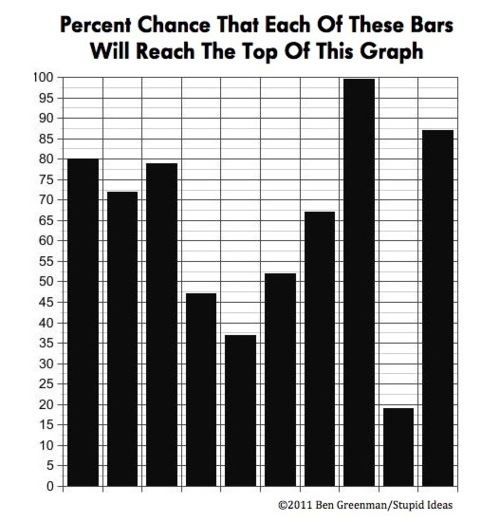
Alex Lundry homes in on the importance of data visualization:
Vision is our most dominant sense. It takes up 50% of our brain’s resources. And despite the visual nature of text, pictures are actually a superior and more efficient delivery mechanism for information. In neurology, this is called the ‘pictorial superiority effect’ […] If I present information to you orally, you’ll probably only remember about 10% 72 hours after exposure, but if I add a picture, recall soars to 65%. So we are hard-wired to find visualization more compelling than a spreadsheet, a speech of a memo.
(Hat tip: Maria Popova; graph via Ben Greenman)
Richard Abowitz suspects that Showtime's reality-show about straight Gigolos is pure fiction:
The Daily Beast was able to reach one woman depicted on the show, and she freely admits her appearance on Gigolos is entirely fictional. She claims she was hired by one of the show’s producers. “They came to me and said they wanted to work with me,” she says. “They found me through a website. They wanted to know what skills I had. Then they created a scenario where I would need an escort, and they hired me.”
This woman asked that her name be withheld for fear of violating a nondisclosure agreement. But she considers her job on Gigolos to be work as an actress. The sex was simulated for the camera, she says; and she claims she certainly did not pay the male escort for anything. “It’s a reality show. No one believes that shit. Everyone knows that’s all scripted. I had fun, and it was great. They were cool people to work with. I would have done a prostitute show if they paid me.”
Today on the Dish, Andrew maintained that killing Osama was moral for the same reasons torture still isn't and never will be. Andrew ran some numbers comparing the Beast and the Atlantic and came around to the hippie, while readers blamed the Boomers for our obsession with the 60s and 70s.
We charted progress in Libya, neocons called loudly for doing "something" in Syria, and Andrew pressed on for truth about the Gitmo "suicides." Beinart juggled the contradictions of a Jewish and democratic state of Israel, fake tears weren't entirely faked, and a pastor could lie about being a Navy SEAL. Trees started to bloom at the 9/11 memorial, children absorbed bin Laden's death, and we examined the morality and legality of FOIA requests for the bin Laden photos. Max Rodenbeck wondered if Osama was already irrelevant, we collected reactions to Chomsky on bin Laden, and a crow could have helped SEALS take him down.
Andrew backed Michael Tomasky's argument for ending corporate and lobbyist tax loopholes, and wagged a finger at Boehner's debt ceiling demands. Huckabee's Christianist extremism freaked us out, Mitch Daniels' rationality discouraged the right's talk radio hosts, and Josh Green pegged Palin's greatest accomplishment (spoiler: she raised taxes). Nyhan butted heads with Nate Silver over early polls, Suderman critiqued single-payer healthcare in America, and we pored over an explanation of high healthcare costs. Schock's white jeans gave us pause, Fat Admirers adopted queer nomenclature, and marriage equality in New York would generate some serious economic activity. Americans worked 2 hours a day to pay for their cars, and barbers used to give enemas.
Sean Avery's greatest hits here, poseur alert here, creepy ad watch here, map of the day here, quote for the day here, MHB here, FOTD here, VFYW here, and contest winner #49 here.
–Z.P.
A reader writes:
At this moment in history, the foibles of right and left are not comparable. The only liberals still living in the 1960s are a tiny fringe with little power or representation; the left could purge every last one and it wouldn't change a thing. Liberals have moved to the right and ARE living in the present. In contrast, the conservatives stuck in the 1970s have tremendous power. They have acquired a massive money and media machine – right wing talk radio, Fox, pundits from think tanks, etc. – that has pushed a majority of political leaders to endorse their world view. Equating the two sides obscures the only solution, which is exposing and reducing the power of those who have led the GOP down this path. There will come a day when the pendulum swings back and power-brokers on the left get lodged in the past, but that's not the moment we are living in.
Another writes:
I think your reader's observations in this post are very astute. But to answer his/her question, "Why is it that the history of 40-50 years ago seems to impact on people’s thinking so much more than the history of 20-30 years ago that ought to be fresher in their minds?" There's a simple answer to this: The Boomers.
That's their politically formative years, and they keep partying like it's 1968-1979 over and over and over again. Generational analysis, both in social science more generally and in foreign policy studies more recently, demonstrates that not only is it difficult for a generational cohort to break out of its past thinking, it actually keeps reinforcing that thinking over time, interpreting incoming data (new events) always through the same lens. Thus, the focus in foreign policy "debates" on and comparisons to, either (take your pick) Vietnam or "Carter's" foreign policy, and the same domestic policy debates through the lens of the 1960s or 1970s.
We just have to wait until the Boomers' dominance on public discourse starts to wane. And if it seems like we've been waiting forever for that to happen, well, we have.
Another:
While I'm not so sure I agree with the overly simplistic take on opposing ideologies, it does illustrate one very important thing. Largely excepting President Obama, our policies and priorities are driven by a group of people whose formative years were the '60s and '70s – which is part of the problem. Our response to terrorism is very Cold-War era (some even argue for a policy of increased containment); the Drug War, an expansive knee jerk response to the '60s and the various iterations of drug control thereafter; our troops stationed overseas in Europe, relics of wars that have no chance of starting again; our dusty policies against Cuba; the right to marry whomever you choose, a next-stage mutation of mixed-race couple nonsense. I could go on.
I hate to be so generationally negative, but really, it's time for some of them to get out of there and retire. I get that it should be "the job" of the upcoming generations to take control through voting, but it's a two way street. The baton can be passed a lot easier than it can be taken away by the vote. Sorta sounds like I'm arguing for term limits, huh?
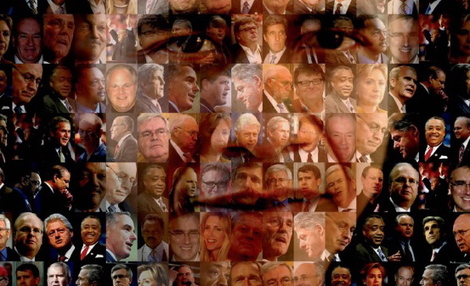
(Image by The Atlantic's Jason Treat)
Douthat dismisses the criticisms of Mitch Daniels parroted by the talk radio right:
The underlying theory behind the talk radio critique of Daniels is basically that you can’t trust a man who disarms liberals with his seeming reasonability, and what you need instead is somebody who takes the fight to the left at every opportunity. This is an excellent description of the qualities required … to be a good talk radio host. But when applied to the presidential scene, it amounts to a kind of politics of schadenfreude, in which actual conservative accomplishments count for nothing, the ability to woo undecided voters is downgraded or dismissed, and all that matters is how much a prospective candidate irritates liberals.
John Hudson nabbed an interview with Michael Oreskes, senior managing editor at The Associated Press, about Freedom Of Information Act requests for the bin Laden photos:
[A] journalist's prerogative is to ask questions and find answers, said Oreskes. "It's our job as journalists to seek this material." "We're not deciding in advance to publish this material," he pledged. "We would like our journalists, who are working very hard, to see this material and then we'll decide what's publishable and what's not publishable based on the possibly that it's inflammatory."
Last week John Cook spoke with Daniel Metcalfe, the former chief of the Department of Justice's Office of Information and Privacy, about FOIA's applicability:
One way to avoid the FOIA, Metcalfe says, is to make sure that Obama, or the White House, are the only people who have the images. … It's far better for the White House to treat this photo as sui generis, and even though it was once in Defense Department or CIA hands, for it to simply leave the executive branch and enter the inner White House, where the FOIA does not apply. So if this photo is sitting on Obama's desk and there's no other copy, Defense can say to any FOIA requester, 'We used to have that, but the president has it now and good luck trying to get it.'" …
The trouble with that route is that digital images are sticky. If the photos were delivered digitally from Pakistan or Afghanistan to Langley, Va. and Washington, D.C., there could be any number of government servers or devices that retained copies. It would take a coordinated—and possibly illegal—effort to destroy every digital trace of such images at the Department of Defense and CIA. If any such traces remain, they're FOIAble.
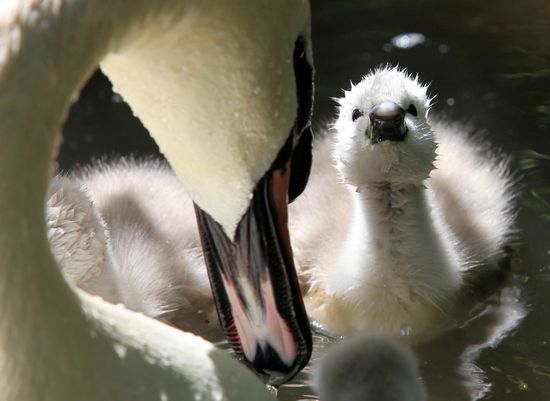
One of the first cygnets to hatch early takes a dip in the water at Abbotsbury Swannery, on May 10, 2011 in Abbotsbury, England. The first of more than 1,000 cygnets that will hatch over the next six weeks have started arriving two weeks earlier than normal this year, the second earliest date ever recorded since the swannery began 600 years ago. It's thought that the high temperatures in March and April encouraged the swans to nest early. There are currently about 900 swans and 150 nests at the site, which is the world's only managed colony of wild mute swans. By Matt Cardy/Getty Images.
 The Dish