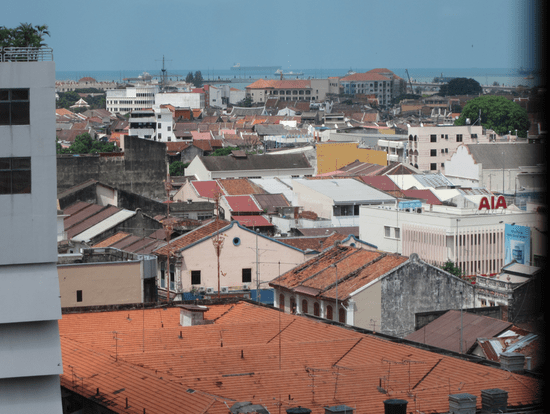
A reader writes:
Amazing how many AIAs there are out there. The only one that really scares me is “Arizonans in Action.” (We have seen enough of that, thank you.) But I must be on the wrong track because somehow I don’t see ocean going vessels anchored off the coast near Tucson. For no particular reason, I am going with Veracruz.
Another writes:
The architecture suggests Iberian colonial Africa. The oil tankers suggest that we are most likely describing Equatorial Guinea or Angola, which likely means that the “AIA” on the building at right could be the Angolan Industrial Association on Rua Fernando Cladiera in Luanda. Photo appears to have been taken from two blocks north of there which would be a building on Rua … oh, hell I don’t have time to waste on any more wild hunches, since I can’t win without an engaging story and have no entertaining connections other than a former student from Luanda who was on a Sonangol scholarship and once shared some photos of her hometown. Time to return to real life.
Another:
Port town, clay tile roofs, the building with the letters AIA, which is some type of Asian insurance company, and the tightly clustered houses. Feels like Viet Nam, but which city? I’m going with my hometown, Nha Trang, a beautiful seaside city full of charm. Best part of growing up there? The school was minutes from the beach. There was no such thing as recess, but that didn’t stop us kids from taking a swim any chance we get. Good times, good times.
Another:
The picture was taken in Malad East, a suburb north of Mumbai. I googled AIA buildings and scanned the images. Two of them popped up on junk URL squatters, so I ran Whois searched to get the addresses if the URL owners. I didn’t get addresses but did get names, one of whom has a Facebook profile and a bunch of Indian-looking friends with Indian-sounding names. I then googled images for AIA India, and quickly found contact information on AIA.com. I don’t have the skills to triangulate the location of the building from which the shot was taken, but Google and I got the town down in about six minutes. I won’t win, but I had fun.
Another:
I hate this fucking contest.
I am addicted to it and wait for Saturday and Tuesday 1PM. I always hope and pray that the picture is not familiar to me in any way possible, so that I can get back to my mundane chores. But once in a while, the buildings and scene are familiar. And then I spend hours and hours and HOURS hunting for the exact location. It’s a ridiculous search, brought on by pure hubris, hoping that I can match all those well traveled and/or tech-savvy folks who come up with the stunningly accurate locations.
India. Mumbai. Indira docks in the background. A view taken from the Bombay stock exchange building perhaps.
How is this consequential in any way, shape or form?! I am HOURS behind schedule. I will have nothing to show for it, except intense regret that I wasted so much time. I will probably not be on the right continent. Who cares. This is the LAST time I will spend time on it. (ha ha! Ya right.)
Another:
This looks like Johor Baharu, Malaysia looking over the Singapore Strait. I lived in Singapore for six years and my husband’s family is there, so we still make an annual visit to that part of the world and are always taken by seeing the ocean going vessels offshore.
Another:
Georgetown, Malaysia is my guess based on the location of the water, the AIA sign and the mixture of architecture. I am off for a great Saturday visit with friends I have not seen in years, so I am not going to fall into my usual VFYW mania of flickr searches and obscure googling. I have gotten a few in the past, but I have been on quite the cold streak recently. Here is to hoping I’m back on track!
On the right track, but this reader has the correct Malaysian city:
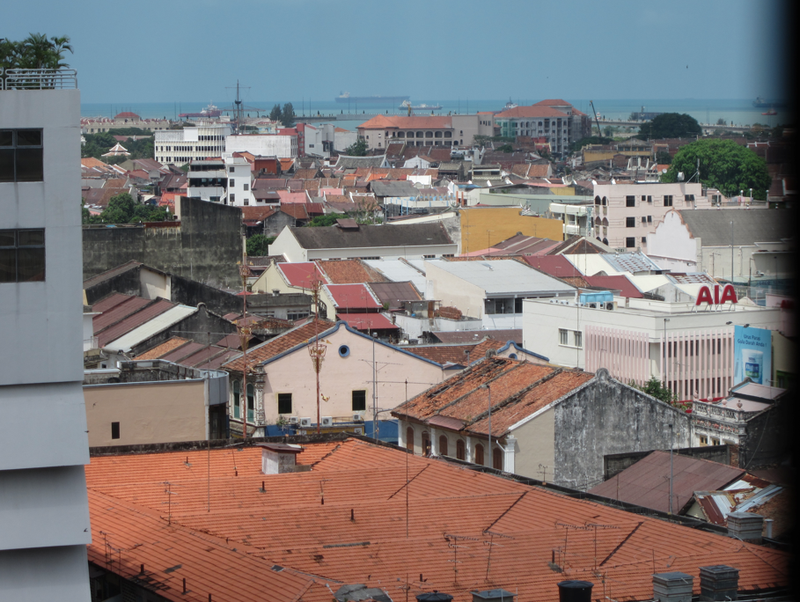
This view is of Melaka (or Malacca Town) in the state of the same name in Malaysia, looking roughly south-southwest out to the Strait of Malacca from an upper floor of the Putra Specialist Hospital. The roofs are what got me; I was lucky enough to live nearby once. Oh, the food!
Another:
I’m an American living in Singapore, and this photo has the look and feel of Malaysia. I thought either Melaka or Penang. I think I can see the Flor de la Mar (replica of the Portuguese ship which sank in the waters off Melaka). So I’ll go with Melaka.
As I think the real genius of VFYW is the perspectives it gives on different geographies, I’ll give an insight into living in the region. Melaka is about a 3.5 hour drive from Singapore and I believe about 2/3 hours south of Kuala Lumpur. It is a common tourist spot as an old port town with interesting Portuguese and British colonial history. Its quite common to travel back and forth from Singapore to Malaysia. At one time I was driving up into southern Malaysia (about a 45 min drive + some time at immigration) to play golf every weekend. When I went back to the US for Christmas in 2001, I got pulled aside and was asked why I have so many passport stamps for Malaysia, a Muslim country. Going every weekend to play golf must have seemed like an odd answer, but eventually I was let go and luckily avoided a cavity search.
Another:

Having spent an absurd amount of hours triangulating things from people’s tourist snaps of the Maritime Museum, the Chinese quarter, the peculiar curved building in white, the absence of the ferris wheel, I finally realized that the AIA corporation’s website actually just spelled Melaka a different way than my previous google searches. Attached is a screenshot pinpointing the AIA building; a google search revealed the Renaissance Melaka Hotel‘s distinctive building-gills and palm tree-topped roof (attached).
Close, but the photo wasn’t taken from the Renaissance, as many readers guessed. Another:
This week’s VFYW was way too easy … taken from either the Putra Specialist Hospital or the Bayview Hotel in Jalan Bendahara, 75100 Melaka, Malaysia, looking SW toward the Straits of Malacca.
One reader went with Bayview:
After panning around Penang for an hour proved hopeless, I turned my eyes on Melaka (where I had visited in 2008) and was shocked when after five minutes of searching, the four courtyards with the tiled roofs came up! The white building in the 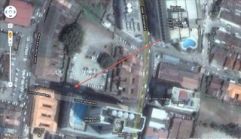 left of the picture is the Northwest corner of the Renaissance Melaka Hotel service wing (with a pool on top that the potted palms on the roof overlook).
Now from where is the photo actually taken? That’s a little harder, as the obvious location is taken up by a parking lot. Either the Google Maps view is out of date and a building has since been constructed there to provide the window for the view, OR the picture is taken with a telephoto lens from the Bayview Hotel Melaka OR the Putra Specialist Hospital, both located one block away on Jalan Bendahara. Since the poster is more likely a tourist, I’m betting on the Bayview Hotel, on a lower floor (6th, perhaps). I have attached a screen shot that has the location and the direction of the view of the photo.
Another guessed the hospital:
This one was a particularly challenging contest, but through a few key clues I was able to solve it! On the billboard on the right-hand side of the photo I was able to make out the word “anda,” which is an Indonesian or Malay word for “you” or “your.” This 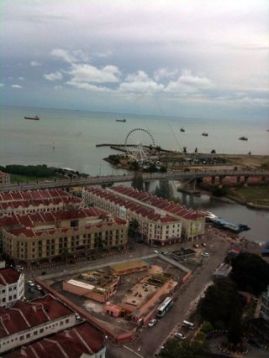 whittled down my prospect list to either Indonesia or Malaysia. Another clue was the oil barges as this photo was obviously taken at a city with an oil port. I was very close to going with Jakarta (and wanted to since I am Dutch-Indonesian), given its location on the sea and the “old city” style roofs in its Dutch quarters.
However, I needed more confirmation. I searched and searched and searched for that AIA office in Jakarta, but could not find it. I decided to do a quick google search of AIA locations near the sea in the Indonesia/Malaysia region, and found many AIAs to be in Malaysia. One particular AIA branch stuck out to me in my search. It was situated in the city of Melaka, which is located on the Malacca Strait, where many pirates are known to wreck havoc on passing ships. Wanting to give city a chance, I saw the distinctive quadruple rectangle-orange-roof building on the google maps, matching the roof on the bottom part of the photo and in close proximity to the AIA building.
The photo was taken behind the Renaissance Hotel (the white building on the very left), facing out towards the “old town” section of the city and the Malacca Strait. In the contest photo towards the water, you can notice a bridge, which actually spans a canal entering in from the strait (photo attached). I believe the photo was taken from a hospital – just like last week’s! – that lies behind the hotel.
So close, but not the hospital. Another reader nails the right building:
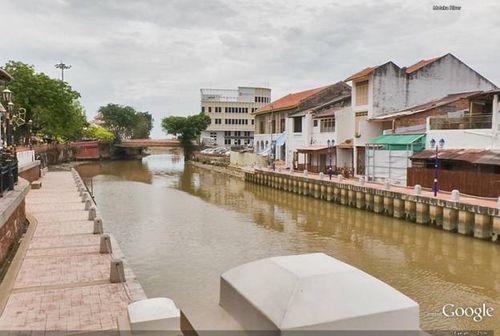
This had a familiar look from my childhood years in Singapore, so I was immediately thinking of that part of the world. AIA, among many other things, turns out to be the American International Assurance company, which operates throughout southeast Asia. The billboard outside the AIA building looked to be in Malay or Indonesian (does it really say something about blood sugar level??), so we are looking for a busy port in Indonesia or Malaysia – not enough skyscrapers to be Singapore. Looked around Penang for a while without finding a match, but then I matched up the white building in the left middle distance with this one in Melaka (or Malacca). From there it was just a matter of lining up buildings to get the viewpoint. The building cutting off the view on the left is part of the Renaissance Hotel, so this was taken from the Majestic Hotel, looking about SSW towards the Melaka river and the sea:
A few readers correctly guessed the Majestic, but only the following one guessed the exact floor of the hotel:
This has to have been the hardest of these I’ve done, let alone gotten. Starting with that AIA building (they serve primarily South-East Asia), I was able to narrow my search down to about 100 cities which had an AIA office and were near the coast. Korea didn’t have palm trees, and Vietnam never looked quite right (it was too densely populated, I think). Seeing that bridge over the river at Melaka, followed by the tall-ship once I googled some pictures, convinced me I was in the right place, finally.
As for the window itself. The white building to the left of the frame is the Hotel Renaissance Melaka, and we’re looking at the top couple stories of its nine-or-ten floor base, and we’re looking from nearly directly north. The buildings immediately across the street from the Renaissance don’t seem to be nearly tall enough to give that sort of view (although I can’t tell! Google maps has failed me here!). The one that is most likely seems to be part of the Hotel Majestic, a part which so new that it doesn’t appear on google maps, but can be seen here. I’d guess on the 8th floor. The address is 188 Jalan Bunga Raya, Melaka.
After having got Paris and Barcelona on the basis of spotting details I recognised, I think I’ve got this one through repetitive hard work. At least, I hope I have.
You have! A window view book is on its way.
(Archive)
 The Dish