Watching Yourself

 Daniel Akst contemplates the origin of virtue:

Inhibition often begins with the sense that somebody is watching; experiments have demonstrated that simply installing a mirror makes people behave more honestly when, for example, they pick up a newspaper and are supposed to leave their money on the honor system. Mirrors also seem to diminish stereotyping, promote hard work, and discourage cheating. In one study of children, the mere presence of a mirror reduced the stealing of Halloween candy by more than 70 percent. You can think of other people as human mirrors.

Dan Ariely's post on self-control is in related territory.
The More The Merrier

Charles Kenney celebrates population growth:

Yes, threats to global sustainability are clear and present dangers. But the 10,760-fold increase in aluminum production reported by environmentalist Clive Ponting, or the 380-fold increase in oil production, or even the 24-fold increase in global GDP over the course of the last century isn't driven by population growth. It is growing consumption per person that is the problem.

And that, of course, is not the fault of Africans. The blame lies with wealthy countries that do nearly all of the consuming. The poorest 650 million people on the planet live on about 1 percent of the income of the richest 650 million. Each year, we add 1 percent or more to the incomes of those richest people – GDP per capita growth rates in wealthy countries are at least that high.  And that 1 percent growth has the same impact on global consumption as would doubling the number of people living on the income of that bottom 650 million of the world's population. So, those people sitting in rich countries pontificating on unsustainable global populations might want to start off with the bit of that population they see in the mirror every morning.

In Defense Of Magic

Jessa Crispin defends Maud Gonne, occultist and wife of muse to Yeats, noting that the "atheist versus faithful debate has become whether it is 'sad' or weak or immoral for someone to believe in anything unprovable":

Wasn’t the Enlightenment supposed to wash the world of its sins of superstition and religion? And yet humanity keeps clinging to its belief systems, its religious leaders, and its prayer. More than that, we’re dipping back into the magical realms — one would think that if superstition were to be eradicated through the power of reason and rationality, magic would be the first to go. It turns out our hunger for the irrational and the intuitive is more insatiable than previously assumed.

We have our Kabbalah, our Chaos Magick, our Druids. We have our mystics and tarot card readers and our astrologers on morning news shows explaining why Kate and William are a match made by the gods. Wicca is a fast growing religion in the United States, and my German health insurance covers homeopathy and Reiki massage, both of which have always felt more like magic than science to me.

And yet the atheists keep on, telling us that we don’t have to believe in God. It maybe never occurred to them that perhaps we want to.

Rape During Wartime

Anna Louie Sussman delves into the reasons why forcibly recruited soldiers are more likely to rape:

Forcibly recruited men, [scholar Dara Kay Cohen] argues, meld into a cohesive unit through gang rape, a process she calls "combatant socialization." … In other words, strange men thrown together in an impromptu fighting force use it as an unspoken means to build team spirit. The public, performative nature of gang rape carries a different message ("We're all in this together") than an individual rape perpetrated in private ("I'm doing this right now because a breakdown of law and order means I can get away with it.")

Advice For Future Doctors

Atul Gawande delivered this year’s commencement address at Harvard Medical School:

The core structure of medicine—how health care is organized and practiced—emerged in an era when doctors could hold all the key information patients needed in their heads and manage everything required themselves. One needed only an ethic of hard work, a prescription pad, a secretary, and a hospital willing to serve as one’s workshop, loaning a bed and nurses for a patient’s convalescence, maybe an operating room with a few basic tools. We were craftsmen. …

[Today] we train, hire, and pay doctors to be cowboys. But it’s pit crews people need.

A Poem For Sunday

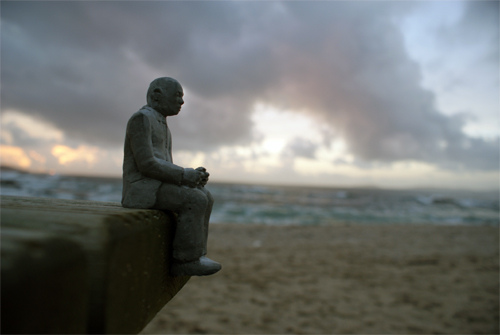
Cementeclipses2

"Five Psalms" by Mark Jarman:

Let us think of God as a lover
       Who never calls,
Whose pleasure in us is aroused
       In unrepeatable ways,
God as a body we cannot
       Separate from desire,
Saying to us, “Your love
       Is only physical.”
Let us think of God as a bronze
       With green skin
Or a plane that draws the eye close
       To the texture of paint.
Let us think of God as life,
       A bacillus or virus,
As death, an igneous rock
       In a quartz garden.
Then, let us think of kissing
       God with the kisses
Of our mouths, of lying with God,
       As sea worms lie,
Snugly petrifying
       In their coral shirts.
Let us think of ourselves
       As part of God,
Neither alive nor dead,
       But like Alpha, Omega,
Glyphs and hieroglyphs,
       Numbers, data.

The full poem can be found here.

(Image by Isaac Cordal with more images and information here)

The Symphony Of 9/11

Alex Ross reviews “WTC 9/11,” a new work for a string quartet by the composer Steve Reich:

The beginning is singularly eerie: a sharp, gnawing dissonance in the strings, the sound of a telephone off the hook, and recorded voices of NORAD air-traffic controllers on the morning of 9/11 (“They’re goin’ the wrong way”). The ending is even eerier: after the consoling sound of a cantor singing the Wayfarer’s Prayer—“Behold, I send an angel before you to guard you on the way and to bring you to the place that I have prepared”—the dissonance of the opening returns, and we hear a voice saying, “And there’s the world right here.” In no uncertain tones, Reich suggests that history is circular, that horror will recur.

You can hear an excerpt of the piece at about 6:45 into this interview.