A Swing-State Bounce

Obama_Virgina_Poll

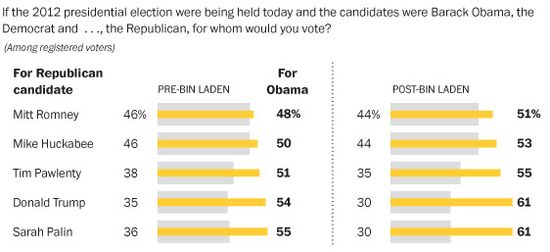
Bin Laden's death gave Obama a decent bump among Virginian voters. Weigel perks up:

Do the math: Obama can afford to lose Ohio, Florida, Iowa, and New Hampshire, if he just holds the rest of the Al Gore states, wins heavily Hispanic Nevada and Colorado, and puts together the black voter/NoVa coalition again in Virginia.

Mark Blumental warns that Obama's bump won't last:

Six years ago, such an event might been more critical in resolving doubts about Democrats among true swing voters. Now those swing voters are more concerned about the economy and what they perceive as an expansion in government.

Cutting Off The Crackdown, Ctd

More details emerge on Iran's increased influence in quelling Syrian dissent:

The claim came as Syria's security forces backed by tanks intensified operations to suppress unrest in three new flashpoint towns on Sunday and it was confirmed that four women had been shot dead in the first use of force against an all-female demonstration. A senior western diplomat in Damascus expanded on assertions, first made by White House officials last month, that Iran is advising president Bashar al-Assad's government on how to crush dissent. The diplomat pointed to a "significant" increase in the number of Iranian personnel in Syria since protests began in mid-March. Mass arrests in door-to-door raids, similar to those that helped to crush Iran's "green revolution" in 2009, have been stepped up in the past week.

Al Jazeera has more on those door-to-door raids. The Guardian has a glimpse of the propaganda at work:

Syrian state has underlined the severity of the crackdown and the difficulty of getting news from Syria by broadcasting the "confession" of a man who spoke to the BBC about the protests. … In his confession [Zakaraiya Mitleq] suggested he had made up reports of security forces firing on protesters.

I was on air in a minute and told the presenter that there were demonstrations in Homs and the security forces were firing at them killing about 20 of them in Baba Amrou area. I told her so although the area is 70 km away from my house and I didn't get out of my house that day.

Will Iraq Ask Us To Stay?

The US is lobbying for troops to remain in Iraq after the official withdrawal date – which requires approval from the Iraqi government. Joel Wing peers into his crystal ball:

With seven months left in the year, Washington is picking up its efforts to convince the Iraqi government to allow some troops to stay in the country into 2012. There have been a slew of meetings over the issue in just the last month. The Iraqis though, are caught up in their own political squabbles, and are afraid of how they will look to the public and to each other if they come out in support of a U.S. troop extension. Their opponents could use that against them, and they could also lose face with the public. That means as of now, there is little to no chance that Baghdad will let the American forces stay past the end of the year. At the same time, if the government formation process is finally settled in the coming weeks and months, Iraq could change its tune. Whether the U.S. stays or go will likely come down to the last minute, which is what happens all too often in Iraq with anything important.

But waiting until the last minute isn’t logistically possible according to Admiral Mullen.

Single-Payer In America

Kevin Outterson sizes up Vermont's single-payer healthcare bill – which is on the cusp of becoming state law:

The first thing I posted on was the incredible power of Vermont’s version of the Independent Payment Advisory Board to control costs. If they do this and they’re successful, there are a number of other states that will want to try it. It’s a 20-year time horizon, but if you think national single-payer is a political nonstarter, this is where the action is. But that’s the question: whether they can control costs. That’ll be everything.

The Christian Other

Twelve people died in Egypt yesterday. A rumor about a Christian-to-Muslim convert being held against her will sparked clashes and a church burning. Brian Ulrich puts the violence in context:

The violence is not coming from a belief that Islam requires hostility to Christianity. It is instead based on rumor and in some cases superstitions about alleged Christian threats to the Muslim community. Contrary to the way these matters are often discussed on the right, what just happened in Imbaba is far more similar to hate crimes against mosques in the United States and Europe than the Ottoman sieges of Vienna. The threat to the Copts is that they are a minority seen as an internal Other posing some imaginary threat to the majority. This is also why we continue to see grassroots opposition to sectarian violence. The battle taking place in Egypt takes the form of Muslim versus Christian, but is part of a larger struggle against ignorance, intolerance, and hatred.

Bin Laden Takes Some Me Time

Over the weekend, the Pentagon released videos of Osama watching TV reports of himself. Erica Chenoweth analyzes:

On the surface, this disclosure seems to confirm an incredibly human desire for notoriety—an attribute that Louise Richardson emphasizes in her book What Terrorists Want. Ultimately, instead of being people with grand objectives—freedom from oppression, the restoration of justice, the purification of souls—terrorists may simply be people who adopt these narratives to justify their own self-glorification. Instead of using violence instrumentally to secure certain political objectives, terrorists may be individuals who already want to use violence to satisfy personal desires for prestige—and look good doing it.

Lawrence Wright weighs in:

"He's always been very careful about controlling his image and here was nurturing his image, watching himself on television in what was the most revealing, most human, least controlled moment of his entire career," Lawrence Wright, Osama bin Laden expert and author of "The Looming Tower," said.

The ’60s vs The ’70s

A reader proposes a new definition for liberals and conservatives:

I just had a revelation that may seem obvious, but I think I now really understand the difference between liberals and conservatives. The former perpetually live in the 1960s, when their ideas seemed to work and were supported by popular movements such as the civil rights movement and the antiwar movement, while the latter live perpetually in the 1970s, when everything they always said would happen under liberal policies—inflation, stagnation, Communist advancement etc—suddenly came true and popular movements such as the anti-tax movement promoted their ideas and even the kookiest among them, such as the gold standard, seemed reasonable under the circumstances.

How can we move both groups into the 1980s and 1990s, when both sides accepted a lot of what was right about what the other side had to say? Reagan raised taxes and accepted the legitimacy of the welfare state, while Clinton accepted the primacy of the free market and gave us budget surpluses. Why is it that the history of 40-50 years ago seems to impact on people’s thinking so much more than the history of 20-30 years ago that ought to be fresher in their minds?