The Sainthood Business

113566843

Ingrid D. Rowland contemplates John Paul II's beatification and his use of the process:

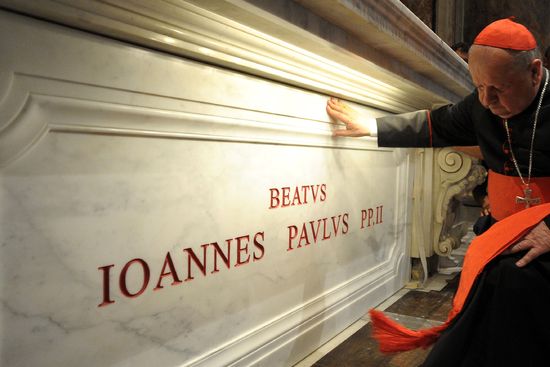
It was, after all, John Paul himself who discovered how lucrative the mass encouragement of sainthood can be, both for the city and for the Church. Over his two-and-a-half-decade papacy, he beatified 1,340 people and canonized 483—more than his predecessors had done in four centuries, attracting millions of Catholic pilgrims to the Vatican in the process.

(Photo: Cardinal Stanislav Dziwisz, Archbishop of Krakow and former personal secretary of Pope John Paul II, prays in front of the Tomb of new blessed John Paul II at the St. Peter's Basilica on May 3, 2011 in Vatican City, Vatican. The body of John Paul II was moved to the new resting place, near Michelangelo's 'The Pieta' statue, after a lavish beatification ceremony. By L'Osservatore Romano – Vatican Pool via Getty Images)

Face Of The Day

Mazzard_Smith

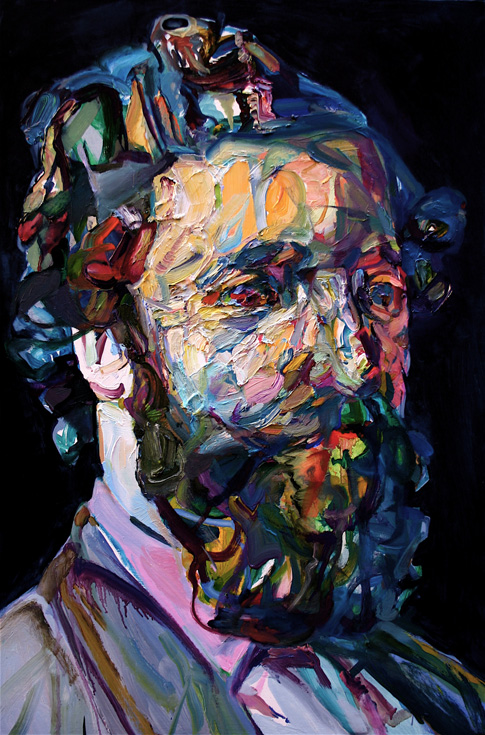
Aaron Smith is an artist whose new exhibition, "Coterie of The Wolly Woofter," featuring various "Bearded Blokes," will open June 2nd in New York City at Sloan Fine Art. The Advocate snagged an interview a couple months back. Their description of the work:

The collection’s focus is on Victorian and Edwardian dandyism as well as the physical culture movement. Smith has produced a new series of paintings based on some of these photographs, featuring portraits of bearded men, with titles culled from Victorian street slang. Despite their historical origins, the new aesthetics of the paintings tend to draw parallels to a playful relationship with the male persona expressed within various contemporary subcultures. Freak folk, steampunk, bear culture, and beard/moustache culture are a few demographics that celebrate and manipulate traditional masculine archetypes. Smith’s paintings seek to compress and heighten these relationships.

The Need For Gladness

Tony Woodlief directs young people to his favorite words of wisdom:

What [Frederick Buechner] says is that our vocation is that place where our deep gladness meets the world’s great hunger. “In a world where there is so much drudgery, so much grief, so much emptiness and fear and pain, our gladness in our work is as much needed as we ourselves need to be glad.”

These are scandalous notions, that we need to be glad, that the world needs our gladness. Our Puritan forbears were certainly suspicious of gladness, and their modern, secular inheritors of grimness—professors and politicians and preachers—demand not gladness, but utility.

A Poem For Sunday

Sky

"Evening Man" by Frederick Seidel:

The man in bed with me this morning is myself, is me,
The sort of same-sex marriage New York State allows.
Both men believe in infidelity.
Both wish they could annul their marriage vows.

This afternoon I will become the Evening Man,
Who does the things most people only dream about.
He swims around his women like a swan, and spreads his fan.
You can’t drink that much port and not have gout.

In point of fact, it is arthritis.
His drinking elbow aches, and he admits to this.
To be a candidate for higher office,
You have to practice drastic openness.

The full poem is here.

(Image via Photopic Sky Survey with a 360-degree interactive map of the stars. Click "i" for the constellations, via Edith Zimmerman)

The Strength To Stay Silent

Morgan Meis compares footage of Saddam Hussein's execution to the unreleased photos of Osama bin Laden's death:

Saddam is brought into a dingy room in what looks like a basement. He is bustled toward a noose and begins praying. Some of the people standing below begin to shout. They are calling out, "Muqtada," in reference to Muqtada al-Sadr, the Shia religious and political leader. Saddam says the name Muqtada back to them and then asks, "Do you call this courage?" Another person yells at Saddam to go to hell. He replies, "the hell that is Iraq?" Then he goes back to praying. All of a sudden, the trap door beneath Saddam opens and he plummets. He is gone. It is impossible to watch that footage without feeling that Saddam stole his dignity back in those final moments. The people in the room gave Saddam the opportunity to do it. They gave him a moment to be the honorable one in death. It lessened those men, those witnesses. They became small in the face of the ultimate thing, the death of a human being.

“A Few Bad Apples”

Geoff Nunberg traces how the proverb shifted meanings:

In 19th century America, it was a staple of Sunday morning sermons: "As one bad apple spoils the others, so you must show no quarter to sin or sinners." Or it could suggest that finding one malefactor in a group should make you suspicious of everybody else. "A bad apple spoils the bin," one journalist wrote in 1898 of the Dreyfus Affair; if one officer is capable of forgery then why wouldn't others be as well?

Back then, nobody ever talked about "just a few bad apples" or "only a few rotten apples" — the whole point was that even one was enough to taint the group. These days, those are the phrases people use to imply that some misdeeds were an isolated incident — a couple of rogue cops, a handful of unprincipled loan officers, two or three sociopathic soldiers. That's a counsel of moral realism: as in, there's evil in the world; get over it.

Nodding Towards Time’s Cavernous Past

Evan Fleischer honors the last veterans from WWI:

Nearly 10,000,000 men were killed in the conflict, 65 million participated, and now we are left with two. Think about that. Think about those numbers. What are you supposed to do when an era is inches away from disappearing? …

[I]t seems to me the planet’s first global war demands a kind of global grief. We need a moment of global empathy. If we can take to Twitter and talk with the Greens of Iran and the revolutionaries of Egypt, head to Flickr and watch everyone photograph everything they see over the course of a day, could we not also take a moment to tilt our heads, and turn our attention from the present to the past?

As if to underline this point, one of the two veterans died two days after Fleischer wrote his post.

Mother’s Day And War

Jean at The New Gay notes that "Julia Ward Howe, a US feminist, poet and social reformer […] wrote the “Mother’s Day Proclamation" in the wake of the carnage of the Civil War." She quotes:

“We will not have great questions decided by irrelevant agencies,
Our husbands will not come to us, reeking with carnage, for caresses and applause.
Our sons shall not be taken from us to unlearn
All that we have been able to teach them of charity, mercy and patience.
We, the women of one country, will be too tender of those of another country
To allow our sons to be trained to injure theirs.”

Bin Laden And The Torah

Enhanced-buzz-32130-1303703510-4

Tzvi Freeman offers an Orthodox Jewish take on the question, "Is it okay to celebrate bin Laden's death?":

If we celebrate that Bin Laden was shot and killed, we are stooping to his realm of depravation. Yet if we don’t celebrate the elimination of evil, we demonstrate that we simply don’t care.

We are not angels. An angel, when it sings, is filled with nothing but song. An angel, when it cries, is drowned in its own tears. We are human beings. We can sing joyfully and mourn both at once. We can hate the evil of a person, while appreciating that he is still the work of G d’s hands. In this way, the human being, not the angel, is the perfect vessel for the wisdom of Torah.

(Photo: A sculpture by graffiti artist Typoe entitled "Confetti Death". More images here.)