"My mother would call Tony Kushner a kapo," – Jeffrey S. Wiesenfeld, to Jeffrey Goldberg.
"Kapos," as Jeffrey explains, were Jews who worked for the Germans in concentration camps.
"My mother would call Tony Kushner a kapo," – Jeffrey S. Wiesenfeld, to Jeffrey Goldberg.
"Kapos," as Jeffrey explains, were Jews who worked for the Germans in concentration camps.
Vote here. Mine goes to J.E.B. Stuart.
OBL is innocent of 9/11 until proven guilty:
In April 2002, the head of the FBI, Robert Mueller, informed the press that after the most intensive investigation in history, the FBI could say no more than that it “believed” that the plot was hatched in Afghanistan, though implemented in the UAE and Germany. What they only believed in April 2002, they obviously didn’t know 8 months earlier, when Washington dismissed tentative offers by the Taliban (how serious, we do not know, because they were instantly dismissed) to extradite bin Laden if they were presented with evidence—which, as we soon learned, Washington didn’t have. Thus Obama was simply lying when he said, in his White House statement, that “we quickly learned that the 9/11 attacks were carried out by al Qaeda.”
Nothing serious has been provided since. There is much talk of bin Laden’s “confession,” but that is rather like my confession that I won the Boston Marathon. He boasted of what he regarded as a great achievement.
Oh, and "uncontroversially, Bushs' crimes vastly exceed bin Laden’s." Uncontroversially. It's that word that proves you are listening to a fanatic.
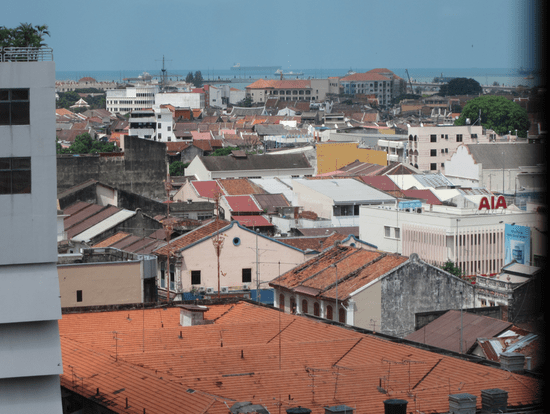
You have until noon on Tuesday to guess it. City and/or state first, then country. Please put the location in the subject heading, along with any description within the email. If no one guesses the exact location, proximity counts. Be sure to email entries to VFYWcontest@gmail.com. Winner gets a free The View From Your Window book. Have at it.
Bryce Roberts recalls experiencing 9/11 via television and compares it to learning of bin Laden's death entirely by new media:
In less than 10 years the world and the technology we use to experience it has changed so completely. On September 11, 2001 there was no iPhone, there was no Twitter, there was no YouTube. But there was a basic human desire to connect, to share experiences and to have our experiences shared and understood by others. … But, having these two events bookend 10 years of experience shines a light on just how much innovation we’ve been a part of in such a short amount of time. So this morning I’m grateful for the innovators pushing forward technologies that bring us together and enable us to share these human experiences. And, I can’t help but be hopeful for what the next 10 years will bring.
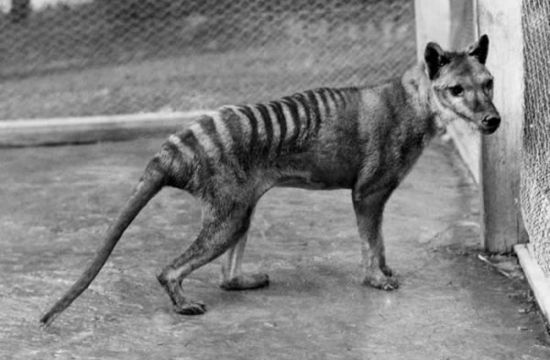
Ed Yong explains the findings of Borja Figueirido and Christine Janis on the now extinct animal, the thylacine, above:
The elbows of dogs and cats are distinct from one another, thanks to their different hunting styles. Dogs wear down their prey over the course of lengthy chases, and their legs are adapted for speed and stamina. To achieve that, they have sacrificed mobility around their elbow joints. Cats are different; they are ambush hunters that rely on stealth and speed to take down their quarry. Their elbow joints are more flexible, allowing them to twist their forearms and wrists, and grapple with their prey. You can see this movement in action when lions swat at the legs of fleeing gazelles, or when house cats bat at a ball of yarn.
By comparing eight thylacine elbows with those of 31 other mammals, Figueirido and Janis found that the thylacines cluster with ambushers rather than pursuers. It might have the skull of a dog, but it has the elbow of a big cat.
"Humiliation is one of the most common words in bin Laden's vocabulary. Certainly there have been many Muslim men who have been physically humiliated, especially Arabs and Egyptians in those prisons. For instance, Ayman al-Zawahiri, the number two guy in al-Qaida, experienced three years of torture in Egyptian prisons, as was true of many people who are in al-Qaida today. I think that accounts for the appetite for bloodshed that's so characteristic of al-Qaida and so unusual in many respects for a terrorist movement, which is normally just interested in theater….When he uses that term, it resonates with many Muslims who feel that Islam has been in retreat for hundreds of years and been displaced from his proper place in the world," – Lawrence Wright, from a previous interview with Art Beat, for PBS.
Alex Carp interviewed architect Eyal Weizman:
People tell you that architecture is built to protect you against the elements. Primarily architecture is built to protect you from other people. More interesting for me is the way in which power operates through an ability to both control and interrupt.
Look at Gaza, bounded by a perimeter fence that is its master. How many calories should enter into Gaza? Israeli soldiers sit and calculate this, which has been documented by NGOs. Two thousand one hundred calories per adult male, one thousand seven hundred calories per adult woman, then children according to gender and age, and that’s what’s flowing. Or electricity. How many megawatts should be allowed in? How much water should enter? That’s what the wall does—it’s a membrane that regulates and controls people by modulating flows, rather than being simply, in the medieval sense of the word, a fortification.
Ejaz Ghani examines how more than 70% of the world’s poor now live in middle-income countries but can't break out of the cycle of poverty:
Consider South Asia, where the poverty rate fell from 60% in 1981 to 40% in 2005 – not fast enough, given population growth, to reduce the total number of poor people. In fact, the number of poor people (defined as those living on less than $1.25 per capita per day at 2005 purchasing power parity) in South Asia increased from 549 million in 1981 to 595 million in 2005, and from 420 million to 455 million in India, where almost three-quarters of the region’s poor reside. …
The paradox of South Asia is that growth has been instrumental in reducing poverty and improving social outcomes, but poverty rates and social outcomes have not improved fast enough to reduce the total number of people living in misery.
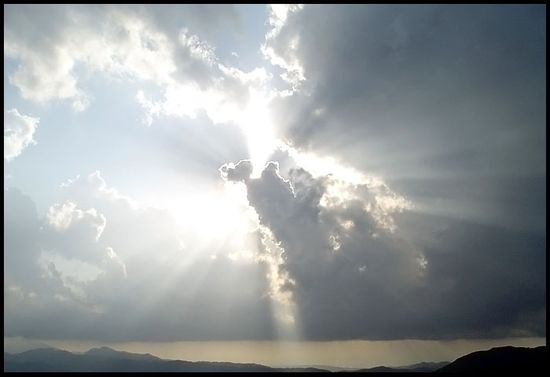
"Abbottabad" by Major General James Abbott:
To me the place seemed like a dream
And far ran a lonesome streamThe wind hissed as if welcoming us
The pine swayed creating a lot of fussAnd the tiny cuckoo sang it away
A song very melodious and gayI adored the place from the first sight
And was happy that my coming here was rightAnd eight good years here passed very soon
And we leave you perhaps on a sunny noonOh, Abbottabad, we are leaving you now
To your natural beauty do I bow
Jeremy Bernstein has more on the city.
(Photo of Takia Kakul, Abbottabad by Flickr user ilawar)
 The Dish