The Weekly Wrap

Today on the Dish, Andrew begrudgingly defended Tony Kushner from charges of anti-Semitism, and recalled the past infighting around gay marriage. We rounded up the reax to last night's GOP debate, including some defenses of torture, and checked in on today's jobs numbers.

The torture apologists continued to baffle Andrew, he differentiated between capital punishment and killing war enemies, dogs of war rocked titanium teeth, and we honored the boring parts of the Osama mission too. Carl Prine filed a FOIA request for the assasination photos, Tim Fernholz and Jim Tankersley tallied the cost of wars, and Allahpundit corrected the record on the birthers change of pace. The violence in Syria shifted cities, Daniel Levy got frank on the Israeli-Palestinian conflict, and Marc Lynch glimpsed into the crystal ball on Iraq's future. Alissa J. Rubin went undercover in a burka, and readers analyzed the economics of the South.

Yglesias defended standardized tests, we chuckled at Shit My Students Write, and Terry Miller was a different sort of cool in high school. Andrew Romano tested the Dems with Senator Jon Tester, Paul Ryan rationalized certain debts, and Sarah didn't stack up to Demi. Peter Moskos took issue with libertarianism, Felix Salmon picked apart the Groupon model, Niall Ferguson weighed in on inflation, and Trump had a very bad week. David Bloom feared a population explosion in Africa, the war on drugs couldn't even succeed in our prisons but that didn't stop the medical marijuana raids. Beardpocalypse arrived, and Britain fluffed up its wedding viewership.

Obituary of the day here, view from your airplane windows here, VFYW here, MHB here, and FOTD here.
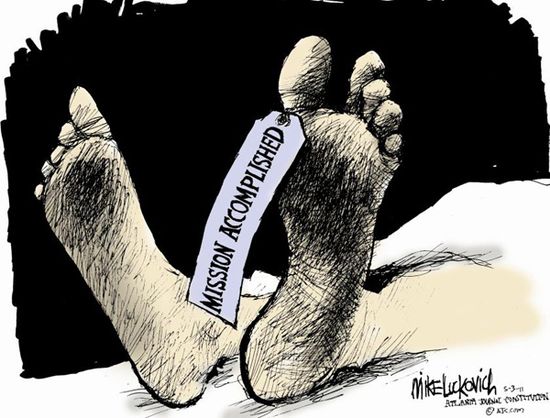
Mission
By Mike Luckovich.

Thursday on the Dish, Andrew bemoaned torture creep from the GOP, and set the record straight on Dick Cheney's war crimes. McCain even admitted torture wasn't key, and Rob Delaney rubbed it in Palin's face. We analyzed how Osama was shot, Reuters released other gruesome corpse shots, Harold Evans examined history's other gruesome shots, and Ambinder explained why the Osama photos were nixed. Tony Dokoupil ran through the Navy SEAL training, and we cooed over the dog that helped take down Osama. Nancy Pelosi shifted gears, readers looked on the bright side of teenage naivete about bin Laden, and this is a beautiful tale of forgiveness.

Steven Cook pressured the US to undermine Assad and consequently Iran, Joel Wing tracked deaths in Iraq, and Andrew considered conservatism's war on Jihad. Andrew got excited for Gary Johnson on the drug war at tonight's debate, Hertzberg hyped Mitch Daniels, the vegetarian, Ben Smith feared for Pawlenty, and Romney didn't flip-flop, the GOP did. Birthers came around after the birth certificate came out, and we parsed PEW's reading of ideological divides. Andrew weighed in on Jews fed up with Israeli hypocrisy, and welcomed New York's embrace of gay marriage. Sara Mayeux defended prison guards for the hard work they do, we assessed voting based on the economy, and Massie wasn't optimistic about a republic in Britain. We explored birth control's evolution of the IUD, Bollywood tackled the right to marry who you love, and old people married.

Map of the day here, chart of the day here, cool ad watch here, Moore award here, creepy ad watch here, quote for the day here, MHB here, VFYW here, FOTD here, and Dishtern casting call here.

Apache from oneedo on Vimeo.

Wednesday on the Dish, Andrew dismantled the desperate torture arguments, and heralded the NYT's breakthrough in actually using the word. Andrew backed Obama's decision not to release the photos, Palin came out swinging, and Bush made important announcements. We contemplated what happens when you cut the head off the snake, admired the photo that encapsulates Obama's leadership, and critiqued the media's coverage of the raid. We tracked Obama's tiny bump, grabbed all the info we could from Osama's lair, and Larison stood by Pakistan. Some teenagers had questions on Osama, teachers grappled with explaining it to students, DiA defended the celebrations, and Douthat argued American decline belongs to us, not bin Laden. Syria remained under seige, and Mona Yacoubian argued Assad has lost the fight. Alex Massie reconsidered our the war in Afghanistan, Andrew invoked Niebuhr on Christian forgiveness, and Bradley Manning got his clothes back.

Readers requested a ban on Limbaugh coverage, Weigel hyped the first Republican debate, we previewed Britain's vote change vote, and Joyner didn't appreciate the pundit ratings. Werner Herzog could never believe in capital punishment, the US doubled our water productivity, and Zuckerberg slimed his way out of the tax question. The South suffered economically after the Civil War, we charted the decline of the working man, and scientists weren't incentivized to make new drugs. Richard and John celebrated 61 years of togetherness, drummers brains beat our own, and we celebrated a month at the Beast.

Gaffe of the night redux here, Moore award reax here, Hathos alert here, quote for the day here, Trump bait here, MHB here, and FOTD here.

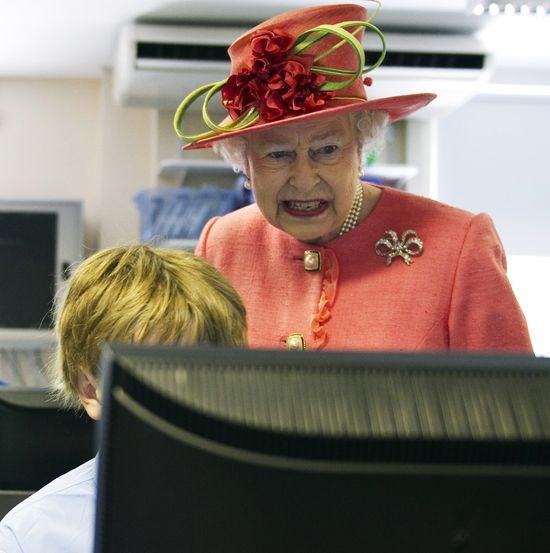
Face
By Sean Gallup/Getty Images.

Tuesday on the Dish, Andrew dismantled the Big Lie that torture got bin Laden, and student geographers got pretty close to predicting where Osama had been hiding. We debated whether to release the photos, the White House walked back some of Osama raid details, readers maintained skepticism, and Obama's approval rating jumped. Beinart praised Obama for altering the course on Democrats and foreign policy weakness, Larison urged caution, and Palin kept it classy.

Hitchens summarized bin Laden's preaching, and a reader wondered what we would have done with him if we'd caught him instead of killed him. A Marine cried but understood why we celebrate, a Catholic grappled with forgiving bin Laden, and Conor nailed Limbaugh's hedge on Obama. Salman Rushdie rejected Pakistan's double game, some came to Pakistan's defense, and Bruce Schneier parsed Americans' ability to feel secure. Egypt moved to relax its border with Gaza, and Juan Cole envisioned Obama's grand plan to change the reception of America in the Middle East.

We sized up Ron Swanson's politics, Matt Steinglass reached to sympathize with the birthers, and Palin's foreign policy crew deserted her. Trump compared gay people to putters, Krugman's predictions were fairly spot on, and Felix Salmon discounted individual actions against global warming. The South's racism hindered its economics, we contemplated abandoned malls, and Charles Kenny didn't want to return to pre-modern, uncontacted tribal lifestyles. Alcohol made us want cocaine more, Angry Birds crossed over to mind control, the hunt for Dishterns continued, and a perfumer recreated the musk of a man's butt.

First Muslim playmate here, Moore award here, Yglesias awards here and here, cool ad watch here, quotes for the day here and here, correction of the day here, FOTD here, MHB here, VFYW here, and contest winner #48 here.
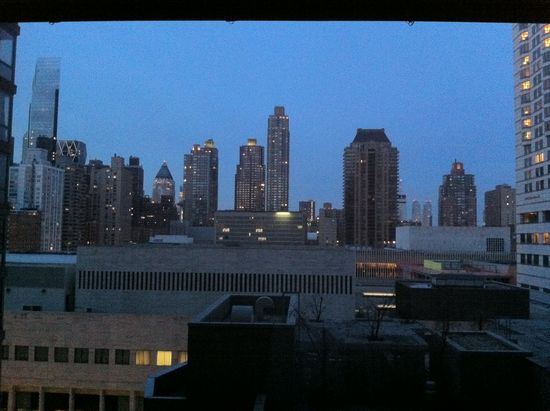
View
New York, New York, 6 am

Sunday night the Dish live-blogged news of Osama bin Laden's death. On Monday, Andrew remembered all those who enlisted to kill Osama bin Laden, listed Obama's accomplishments thus far, and elected this as his greatest thus far. Osama hid behind his wife, the US buried him according to Islamic custom, and readers reflected on his death. We rounded up the full left and right reax from around the web, Heather Mac Donald waited for Obama to get his due from the right, Limbaugh praised Obama, and Dish readers were convinced it was all sarcasm.

Peter Beinart kissed the war on terror goodbye, and Trump acted like the executive he is, by bringing LaToya Jackson back. Weigel celebrated at the White House, as did the US Naval Academy, and New Yorkers persevered. Ezra Klein tallied the bill on Osama's head, Hollywood shifted gears on its bin Laden flick, and we all waited for a real photo. Think Progress tracked the new conspiracy theorists on the right, Kit Eaton surveyed the DNA science, and Christopher Preble commended the government for keeping its mouth shut.

We pondered Pakistan's involvement here, Nate Silver charted Obama's Osama bump, and we closed the books on whether Obama's a real American. Issandr El Amrani gauged Al Qaeda's growing irrelevance, Hamid Karzai seized the moment, the Saudis were mute and Iran pivoted. Steve Coll thought Pakistan too big to fail, Jonah Lehrer pecked at the psychology of revenge, and Glenn Reynolds got caught with his pants down.

Tweet of the day here, gaffe of the night here, video of Osama's compound here, chart of the day here, quote for the day here, MHB here, FOTD here, VFYW here, and the view from Osama's window here.

–Z.P.
The Arab Spring And Iraq

Joel Wing finds few stories on Iraq's protest movement:

The protests and fighting in the Middle East and North Africa continue to this day. There are still stories about Libya, Syria, Bahrain, and other countries. That’s no longer true of Iraq. It got a little coverage in the beginning of the year, but no more. The media, even for those few organizations that maintain bureaus in Baghdad, has forgotten Iraq’s demonstrations. It used to be the number one news story in both the United States and England. Now it usually only gets mentioned when terrorists blow something up. That gives a very distorted view of the country, and ignores how it is going through the same youth-led transformations as other nations in the region. Unfortunately, what becomes of it will largely be unknown for those outside of the Middle East, except for those that actively search for news on Iraq because the western media has lost interest.

Judging Inflation

Niall Ferguson claims inflation is at 10 percent. Ponnuru isn't buying it. Nor is Yglesias:

Normal people judge inflation by watching fluctuations in the price of low-cost, high-frequency purchases. That means that common perceptions of inflation are dominated by things like gasoline and milk that people buy a lot. It also means that those of us who are lactose intolerant and walk to work are perennially out of touch with popular concern. But when discussing this point the next thing you’re supposed to do is observe that people are making a mistake when they reason this way.

Josh Barro rescues "a nugget of a reasonable idea buried within Ferguson’s piece":

[C]onsumers vary in what they consume. Households that have consumption baskets that are heavily weighted toward food and fuel are experiencing faster price rises (and slower growth in real income) than households whose consumption is weighted toward items that are flat or falling in price, like housing and electronics.

This doesn’t mean that inflation isn’t “really” 2.7 percent. … But it is true that some households are experiencing effective inflation that is higher than 2.7 percent, perhaps substantially higher, while others are experiencing less inflation.

The Bloodshed Spreads, Ctd

The death toll rises:

Human rights group Insan said that at least 16 people had been killed in the central city of Homs, six in Hama and two in Jableh. It said the total death toll was 26 but didn't specify where the other two deaths occurred. A human rights activist told the Associated Press news agency that 30 people had died, while Syrian state television said an army officer and four police were killed in Homs by a "criminal gang".

The above video from Homs "appears to show people being shot from behind." Meanwhile, the UN is finally taking some action against Syria, having failed to formally condemn the regime last week:

In an emergency session on Friday, the UN's top human rights body voted to condemn Syria for using deadly force against protesters and launched an investigation into the situation. "With today's vote, the Council has stood against attempts to silence dissent with the use of gratuitous violence, which is not the act of a responsible government," said Susan Rice, U.S. ambassador to the United Nations in New York.

More movement:

European Union officials have agreed [to] punitive sanctions against 13 Syrian officials but — for the moment — have refrained from naming President Bashar al-Assad. Diplomats told AFP that ambassadors of the 27 nations would take a new look on Monday at whether to add Assad's name.

Others aren't as slow:

The cyberactivist group Anonymous has launched another round of attacks against Syrian government websites. Anons said on Twitter that the attacks, dubbed #OpSyria, are for "Great Justice" and to demand the release of imprisoned Al Jazeera journalist Dorothy Parvaz. At the time of writing, Al Jazeera verified that both the site for the Syrian interior ministry and an unidentified website had been taken offline by "distributed denial of service" (DDoS) attacks.

The latest on Parvaz:

The United States said Friday it is seeking diplomatic access to Al Jazeera's Dorothy Parvaz, who was detained by Syrian authorities last Friday. "We are certainly aware of the case of this detained American journalist  for Al Jazeera," Mark Toner, a spokesperson for the US state department, told reporters, adding Washington is "concerned" about her case. "And we've asked for, obviously, given that she's an American citizen, for consular access," Toner added.

The Guardian zooms out:

Wissam Tarif […] has counted protests in 68 towns and villages so far today. He says at this time last week they had 43. But he says this week's protests have not been in central areas. "The security divided up the cities and prevented people gathering in central areas, so most people – spontaneously – protested in their neighbourhoods," he said, pointing to two separate protests in al-Tel as an example.

Earlier Dish coverage here.

How The South Got Left Behind, Ctd

A reader writes:

As a native Southerner and someone who lived in the Northeast for a considerable amount of time, I can tell you that attitudes such as those suggested of Southerners by a previous reader go both ways. 

My accent immediately identified me as an outsider to many native Northeasterners and was often followed by an attitude of dismissiveness in personal and professional settings.  (Anecdotal this may be, but no more so than the previous reader’s comment regarding non-Southern contractors.) While suggesting that Southern clients only hire Southern contractors, it seems that the reader is suggesting that non-Southern transplants are only hiring other non-Southern contractors.  This would seem to support the idea that no matter where you go, there will always be a segment of the population for whom you are an outsider and that people will likely favor individuals or groups with whom they feel a greater degree of familiarity.  C’est la vie. 

But considering the most recent census data showing many Americans relocating to the South, surely us Southerners aren't too disagreeable.

Another writes:

The history professor blames emancipation for helping to underdevelop the South, claiming, "Emancipation meant the destruction of $4 billion of Southern capital." If the economic value of a slave was the value of his future expected labor, less the cost of his subsistence, then to destroy his value as an asset would require that he be killed or disabled. In fact, Emancipation simply took that value from the slaveholder and returned it to the former slave, the rightful owner. For this transfer to be destructive of economic value workers would have to have been more productive enslaved than working freely for wages, which is unlikely.

The historian seems to suggest that possession of slaves had become a status symbol, causing overinvestment in this variety of asset. If this is true, then there was a "slave bubble", the popping of which would have erased value with or without Emancipation. In fact, if slavery had still existed when the bubble popped, the result would have been terrific brutality, as slave owners attempted to use starvation and the whip to salvage what profit they could. The rationalizing force of the market took the evil that was always present in slavery and made it an efficient evil.

Another:

This is more of a question for the history professor who estimates $4 billion loss in capital due to emancipation. The 14th Amendment also declared "illegal and void" any "debt or obligation incurred in aid of insurrection or rebellion against the United States" and prohibited the US and States from paying such debts and obligations. It is my understanding that the CSA government and the Confederate states borrowed heavily to finance its end of the Civil War, including the sale of bonds to individuals. Has this loss of capital been calculated? I would imagine any financial institution, investor, or any individual who bought a Confederate bond would have been financially destroyed more by this than by emancipation.

Another:

The Confederate states had, and have always had, two things going against them:

1.) Water. The map you published showed the only wealthy areas of the south were either on the coast or next to the Mississippi. When boats were still the main form of transportation, business was more lucrative in places with access to the Ocean, either via the Mississippi and Ohio, or via the Great Lakes.

2.) Heat. Its no coincidence the growth in the modern South corresponds with the development of air conditioning. Early manufacturing was a hot process, and it was impossible to keep things cool enough to keep factories habitable and prevent machines from breaking. Until the Tennessee Valley Authority and beyond, the South remained a place where it was too hot to mechanize, and with little access to inland water transportation. That's more important than any cultural factor.

Another:

It's also interesting to point out how the cheap workforce and the desperation for jobs led to the South in many ways becoming the original model for outsourcing. They offered a cheap workforce, and for decades textile mills and other manufacturing moved in a steady stream across the Mason-Dixon from the North, often driven by the South's willingness to institutionalize a non-union workforce and look the other way on regulation. It's a model that would haunt them later when manufacturing would leave the South for much the same reasons for first Mexico, then eventually overseas to Asia and now especially China.

Undercover In A Burka

Alissa J. Rubin recently donned a burka for the first time:

I looked out at the men in the small bazaars we passed through. I could see them and they couldn’t see me, and I felt a certain satisfaction — and dismay. They did not care about seeing me. I knew that many Muslims would say that when a man does not look a woman in the eye, it was a sign of respect, but for me it was also a sign of their not being interested in who I really was. I was simply “a woman,” and “a woman” deserves respect — not necessarily this particular woman.

The Groupon Model

Felix Salmon explains it:

[R]estaurants are much like Groupon itself. It makes money on every sale — but it will only see its margins start to rise impressively if and when its merchants start coming back on a regular basis. At that point, the cost of setting up and selling a new deal comes down dramatically, and Groupon’s profits on the deal — after accounting for the cost of their salesperson’s time — rise substantially. Groupon itself, as much as its merchants, is counting on repeat business. And that comes from having a positive reputation which can spread like wildfire over Facebook and other social networks.

What’s Next For Iraq?

Marc Lynch doesn't think that "the presence of U.S. troops [in Iraq] is really a decisive strategic factor anymore." He advocates "thinking past the military mission and devoting adequate resources to the civilian sector:"

Iraq is slowly evolving into a position to be a player in regional politics, rather than an arena where others wage their proxy wars.  Whether that Iraq becomes an effective, independent partner of the United States or develops an alliance with Iran, and how Iraq relates to its Arab neighbors, are among the most crucial variables shaping the the future regional order in the Middle East — as important as consolidating Egyptian democracy or the Iranian nuclear program.