A reader writes:
I think you cannot have a reasonable discussion about this issue without at least giving mention to Devra Davis' book Disconnect, published last year, which makes a compelling, scientific case about the radiation dangers from cell phone use. The book presents a very strong argument that there are dangers with cell phone use and points out the significant flaws in the scientific research and, moreso, the flaws in the (mis)interpretation of the results of those studies.
Significantly to me, as a parent of a tween and a teenager, we know that growing brains have different chemistry than the brains of full-grown adults, along with thinner and more absorptive skulls.
Moreover, the "testing" on cell phone radiation standards are based on the Standard Anthropomorphic Man (SAM), a "standard" of a 200 pound, 6'2" man with an 11 pound head using a phone for just minutes at a time – a completely irrelevant standard to the way cell phones are used today. Models (and phone instruction manuals) assume that people do not hold the phones directly against their heads, but rather up to an inch away, depending on the specific phone's manuals. That's sort-of like assuming a Q-tip will not be used to clean in your ear.
Davis points to evidence that cell phone radiation can break down DNA, and can disrupt the blood-brain barrier. The effects are even more significant with newer phones than older "2G" phones.
Maybe my background makes me more willing to believe in the dangers. A decade ago, I was working with the then-CEO of a company that had developed an antenna technology that could be configured to use much lower power and emit less radio waves than other antennas. Behind closed doors, there was discussion that this technology presented a possible advantage of lower risk of impact on brains – this was not long after an earlier wave of concern about brain tumors. But the company never promoted that fact. Alone after a meeting, I asked the CEO about that, when I noted he was using a wired headset whenever he used his phone. He told me that he had seen studies that made him concerned about the impact, but that as an industry, you would never see the issue discussed. Then he leaned in to me and said, "you know, it's the same wavelength used in microwave ovens." (Yes, this is a true story.)
Much of the evidence is anecdotal, but there is a growing body of clues that should give people pause. The defensiveness shown by many about this issue, including in what you have published, worries me, because people are saying, "Well, if it's not proven, I don't have anything to be concerned about." Sure, let's wait until our kids have brain tumors (and I sure hope that the evidence eventually points the other way, because too many people don't care to change their habits) to decide if the risk was real.
It's the same argument as global warming denialists – we should do nothing until the evidence is certain, when the only way to have certain evidence is if an irreversable catastrophe occurs. Public safety isn't a game of chicken.
Another writes:
Perhaps a physicist rather than a physician should be consulted on this issue. Scientific American had an article last year talking about the difficulty of proving a negative but debunking this story from a different direction.
Another:
I'm an electrical engineer by training, so I've had to answer the "cell phone cancer" question quite a few times. A modern cell phone emits radiation in a specific range of intensities, and over a specific range of wavelengths. Given what we know about how radiation causes cancer, cell phones simply don't emit the "right" kind of radiation – in terms of intensity or wavelength – to excite the molecules of your brain cells' DNA enough to cause damage. Anyone with the mathematical chops and access to Google can prove this for themselves.
This is not to say that cell phones do not cause cancer. But if they do, we are at least one very large step away from being able to prove that they do, because they would have to be causing cancer by a mechanism unknown to science. Indications that such a thing is possible come from studies which show increased brain activity near an active cell phone, presumably a result of the tiny currents induced by a cell phone's weak EM field. If this action does indeed cause cancer, however, there are plenty of other dangers to worry about, like the high-voltage power lines which produce much stronger EM fields in their vicinity.
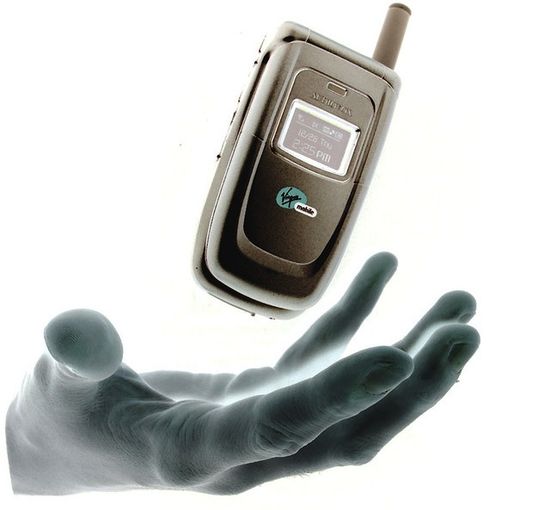
(Photo by Esther Gibbons)
 The Dish