Our popular discussion thread continues in force:
North Americans always have an excuse for not cycling. Tokyo, one of the world's largest cities, with a very warm and humid summer climate, has a bicycle mode share of roughly 25%. Davis, California has average summer temperatures above 90 F, with a bicycle mode share of 20%. Plus, northern Germany and Holland might not have that many hills, but they do have impressive North Sea winds and storms. People are quite adaptable, and those who are interested in riding a bike will find a way around pretty much any problem.
Lastly, there's the electric bicycle, which will do a lot of the work for you. E-bikes now make up 15% of the new bike market in countries like Holland and Germany. There's always a solution, even for pampered North Americans ;-)
Another writes:
Are your readers insane? People bike more in Copenhagen because of the glorious weather? Once, while biking in Denmark, a storm rode in from the North Sea.
My wife and I had to knock on doors to beg rural Danes to let us into their homes to avoid hypothermia. After some rejections and a long huddle in front of someone’s dryer vent we were saved from a possibly serious issue by a kindly man. It was July.
Sure, it can be pretty hot for a couple months in Atlanta or Houston or DC. However, the weather is very mild and temperate much of the year. Meanwhile, it’s rainy, cold, and miserable in Holland and Denmark pretty much all the time. We Americans don’t bike less than Europeans because of the weather. That’s yet another pathetic excuse. It’s our comparative lack of cycling infrastructure and our abject laziness. It’s an empirical fact that we’re fat compared to most of the world. And our obesity and resistance to walking and biking work together in a feedback loop.
I once went jogging at my in laws’ place in Alabama. People stared and laughed at me like I was some kind of circus freak. Maybe they’d never seen this behavior before in their neighborhood. Most, including the kids, were obese. It almost makes me wonder if resistance to biking, or exercise, or eating healthy isn’t becoming yet another front in our culture war. This time “conservatism” won’t be defending strength, vigor, and other martial virtues against liberal wimpiness and decadence as it might have in the past. Instead it will defend our right to be fat, unhealthy slobs in the name of freedom and out of resentment of the slightly healthier, slightly wealthier people in culturally blue enclaves who think biking is hip.
Another:
Many of your readers have echoed the idea that Americans are just making excuses for not using bicycles to get to work, complaining about sweat and rain. Now, beside the fact that sweat and rain (and snow!) are real concerns, no one seems willing to mention an even more elemental problem with biking in most US cities: Our roadways and transport areas were not designed for bikes, nor even pedestrians; they were designed for cars.
I live in Boston and for about four months while I was in grad school I rode my bike from Somerville to Boston University (about three miles). Initially the ride was pleasant, but soon, when traffic was thick, the roads were very difficult to navigate safely. During my experiment I was hit by two cars, forced against a railing by an MBTA Bus, and nearly very seriously injured when I barely escaped being "doored." To compare an average American city to Amsterdam and other European cities which have been designed with bike transport and pedestrians chiefly in mind seems naive. I mean just watch this video about how accommodating Amsterdam is to bicyclists and then look out on the mortal combat between pedestrians, bicyclists and cars in any major US city, such as Boston, New York or Miami. I mean give me a break.
Another:
While nowhere in the US sees 40-50% bicycling rates, many cities have rates climbing towards 5% or higher, accounting for tens of thousands of bike commuters. These aren't cities with perfect weather, either: Portland, Minneapolis and Seattle (rain, cold, rain) lead the way. These are cities which have made a conscious effort to build enough bicycle infrastructure that cycling is an alternative to driving- bikes aren't relegated to the side of ten-lane-wide, 50 mph arterial highways filled with road debris. As for your reader who's worked with 1000 people and never me one who commuted by bike, well, let's just say that if you worked with that many people in Portland or Minneapolis, you'd meet dozens.
Another:
Yes, hills and inclement weather make biking a little less enjoyable. But while Seattle has seven massive hills and legendarily uncomfortable weather it's a city that's very big on bike commuting. Hills are why bikes have lower gears and there's a whole industry of rain gear for bikers. It's one of the things that I love about my city that millionaires and the homeless pass each other on bikes in the rain as they get around town.
Another:
Most of Europe was built before mass transportation methods and the automobile. Most of America was built after (ie suburbs, exurbs). The planning is completely different. The country is becoming more urbanized, and that may increase the trend. But still, many US cities, old and new, are built around the automobile and are often pedestrian/cycle adverse. I recently moved a smaller urban area in New England, from the Midwest. The city road planning is built mostly on top of old carriage routes. Thus the main streets are wider, and allow city bike lanes, even on top of parking.
Another:
I'm sure I speak for many Midwesterners when I point out that we have almost no bike lanes, many of us have to take interstate highways to get to work, and our average commute is over 16 miles. I would LOVE to take a bike to work, but that would require a massive cultural overhaul around here.
Another circles back to the initial theme of the thread:
Often the only costs considered are fuel, vehicle maintenance and time. Another cost to consider is buying the car in the first place. Often, a family would only need one car instead of two if one or both people biked or took mass transit to work. Not having to purchase the car (or its insurance) is a huge savings.
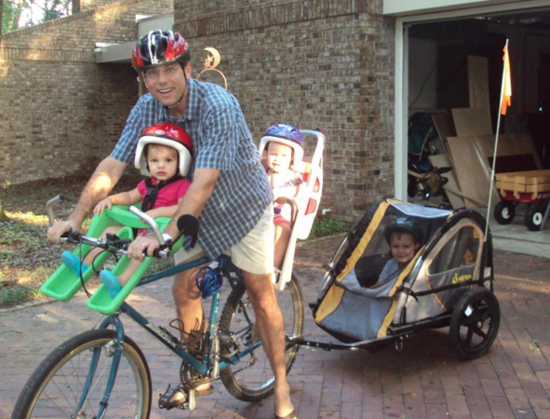
The reader who sent the above photo writes:
My family moved out of the 'burbs and into town a year-and-half ago, specifically so that we could get out of the car and access more places on foot and on bike. The attached photo is the work/school commuting rig for me, and my kids (ages 5, 2 and 2). I haven't figured out how to monetize having more quality time with my kids, but I know has value to me (and to them, too, whether they know it or not).
 The Dish