Goldblog says I misunderstand the Israel lobby:
Andrew now interprets Israel's power in Washington in the manner of Stephen Walt and John Mearsheimer, whose anti-Israel polemic, "The Israel Lobby," blames American Jewish supporters of Israel for most of the bad things that have happened to America abroad over the past decade. Their argument is simple: Without "the Lobby," Israel would be friendless in Washington. This always struck me as wrong, not because AIPAC isn't powerful, but because Walt and Mearsheimer (and Andrew) don't seem to understand what makes a powerful lobby group powerful. The most powerful lobbies, over time, are those that lobby for causes that are already popular among the American people.
Let me just correct the record and insist I do not blame "American Jewish supporters of Israel for most of the bad things that have happened to America abroad over the past decade," and I have not written that. Al Qaeda hated America primarily for broad reasons of unwanted intervention in the Middle East, specifically our troops in Saudi Arabia and was only peripherally and opportunistically interested in Israel/Palestine. Israel's elites were also smart enough to be against the Iraq fiasco. My objections have stemmed from Israel's recent decisions to disporportionately pulverize Gaza and intensify settlement building on the West Bank, even as a responsible partner emerged on the West Bank and an American president had a chance to rebuild US relations with the Arab and Mulism world. In my view, Netanyahu has acted without the slightest concern for the interests of his allegedly closest ally and most powerful supporter.
Jeffrey quotes Walter Russell Mead:
Full-throated support for hardline Israeli positions is a populist position in American politics — like full-throated support for a fence on the Mexican border. It is a foreign policy idea that makes elites queasy and that they try to steer away from, but support for it is so strong in public opinion, and therefore in Congress, that presidents have to figure out how to work with this force rather than taking it on directly.
Really? There is absolutely a broad sentiment of sympathy with Israelis over Palestinians. But this is not always reflected in support for "hardline Israeli positions." A Rasmussen poll last year, for example, found Americans opposed Israel's policy of continuing to settle the West Bank by a margin of 2 – 1. The settlements have been the core issue between Netanyahu and Obama. Yet in that struggle, Obama has lost decisively. (And Rasmussen, if anything, is likely to understate opposition because it tilts Republican).
Polling on the Gaza war, to take another example of a "hardline Israeli position", varied depending on the question.
When posed as which side do you support, Americans backed Israel over Hamas by 2 – 1. But when asked whether the war was preferable to negotiations, the public was divided almost equally (44 – 41), again according to the right-leaning Rasmussen poll. More saliently for whether AIPAC makes a difference, a 55 percent majority of Democrats opposed the Gaza war. Yet every single Democratic Senator voted for a resolution essentially supporting Israel's position. 71 percent of Americans believe the US should be neutral between Israel and Palestine. The US Congress gave the Israeli prime minister more standing ovations when he addressed them recently than they did heir own president's State of the Union, and the Senate Majority Leader backed Netanyahu against Obama on the peace process.
Now check out something called political donations. AIPAC doesn't donate to campaigns itself, but its members do aggressively – and perfectly properly. On political contributions made between 2009-2010, MAPlight.org lists the pro-Israel lobby in the Ideology/Single Issue subset, which it dominates (second only to the Republican/Conservative category), contributing more than four times as much as the pro-gun lobby, ten times more than the gay and Cuba lobbies, three times more than women's rights organizations, and 143 times more than the pitiful "Pro-Arab" lobby. The most popular destination for members of Congress on foreign trips sponsored by non-profits? Tel Aviv.
There is nothing even faintly illegal or fishy about any of this. It is all in the light of day; it is a legitimate form of lobbying the government; it represents the passions of many American citizens. AIPAC has every right to exist and to celebrate the fact that, "except for the State of the Union address, the AIPAC Policy Conference is the largest annual bipartisan gathering of U.S. senators, representatives, administration officials, diplomats and foreign ambassadors.”
But to argue that somehow this does not give one foreign government disproportionate clout, that it acts as a mighty force swaying the political discourse in Washington, that it has a huge edge in setting the boundaries of acceptable policy toward the Middle East, seems perverse to me. If all its positions – de facto defending settlements, defending all of Israel's wars – were supported by vast majorities, it is spending a hell of a lot of money and a huge amount of time on nothing.
I don't think they're that stupid.
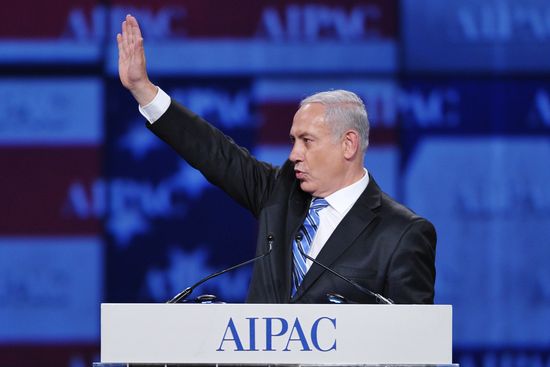
(Photo: Israeli Prime Minister Benjamin Netanyahu waves as he arrives May 23, 2011 to address the American Israel Public Affairs Committee (AIPAC) Policy Conference 2011 at the Walter E. Washington Convention Center in Washington, DC. By Mandel Ngan/AFP/Getty Images.)
 The Dish