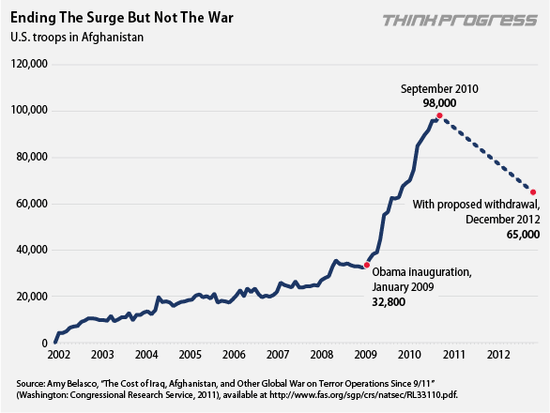
You don't need 88,000 troops in January 2012 to hunt Taliban. You need lots and lots of ISR, some good informants, commandos and some conventional forces to backstop them. The pre-West Point Surge 68,000 is still a ton. The charitable way to put it is Obama's being predictably cautious. The uncharitable way to put it is he's not grasped the implications of his own strategy.
Perhaps the most politically interesting about his remarks last night on U.S. policy in Afghanistan wasn’t related to the troop withdrawals or conditions for Taliban negotiations, but rather, the fact that he talked at some length about the U.S. economy in a speech about national security.
He’s starting the process of the winding down of the war. And I think, politically speaking, it’s necessary for him to do that now that the war is extremely unpopular domestically, and even now, a majority of Republicans are saying they want out, that some of the Republican presidential candidates are campaigning on ending the war and critiquing Mr. Obama for having escalated it, which is quite ironic because originally most Republicans supported the escalation of the war.
Virtually anyone sitting in the Oval Office would be sizing this up the way he is.
Such a withdrawal, particularly without a change in strategy commensurate with America’s actual interests in Afghanistan, will only bring us back to where we in December 2009. Further, an 18 month long process will push the next decision point on the war to January 2013, effectively punting the war from the US’s 2012 election cycle. By not making significant cuts in our troops in Afghanistan and no real changes in our strategy, we will continue to be stuck in Afghanistan’s quicksand for years to come.
Obama's decision to resolutely shift U.S. strategy is a critical recognition that the war in Afghanistan must begin to come to an end — and offers a potential path for accomplishing that objective. While many will likely quibble over Obama's statement that the U.S. is "meeting our goals" in Afghanistan, perhaps a victory lap is the cover that the President feels he needs to begin the process of de-escalation. Tragically, U.S. soldiers, Afghan security forces, and Afghan civilians will continue to be maimed and to perish in Afghanistan. But, for the first time in ten years, the light at the end of the tunnel of the U.S. war there is suddenly visible.
In fact, the immediate changes are slight, and inevitable if all Nato combat troops have to be out by the end of 2014. As Michael O'Hanlon of the Brookings Institution points out, the rate of drawdown will be initially be quite gradual. The US will still have 90% of its current forces in Afghanistan in 15 to 18 months time, and they will still be doing the same things in south and east Afghanistan. This announcement does mean a sudden switch from counter-insurgency to counter-terrorism.
Of the recent signals, political negotiations are by far the most important; the U.S. should do all it can to facilitate power sharing, which is the natural and inevitable outgrowth of a military stalemate. Taken together, these developments are constructive both in and of themselves and as indicators of President Obama’s evolving position on the conflict. After many years of little change, our Afghanistan strategy finally appears to be shifting fundamentally—and in the right direction.
As pleasing as President Obama’s speech is, how we actually go about this process will matter tremendously. For the time being, all we have is Obama’s inspiring rhetoric and the dramatic shift in focus.
 The Dish