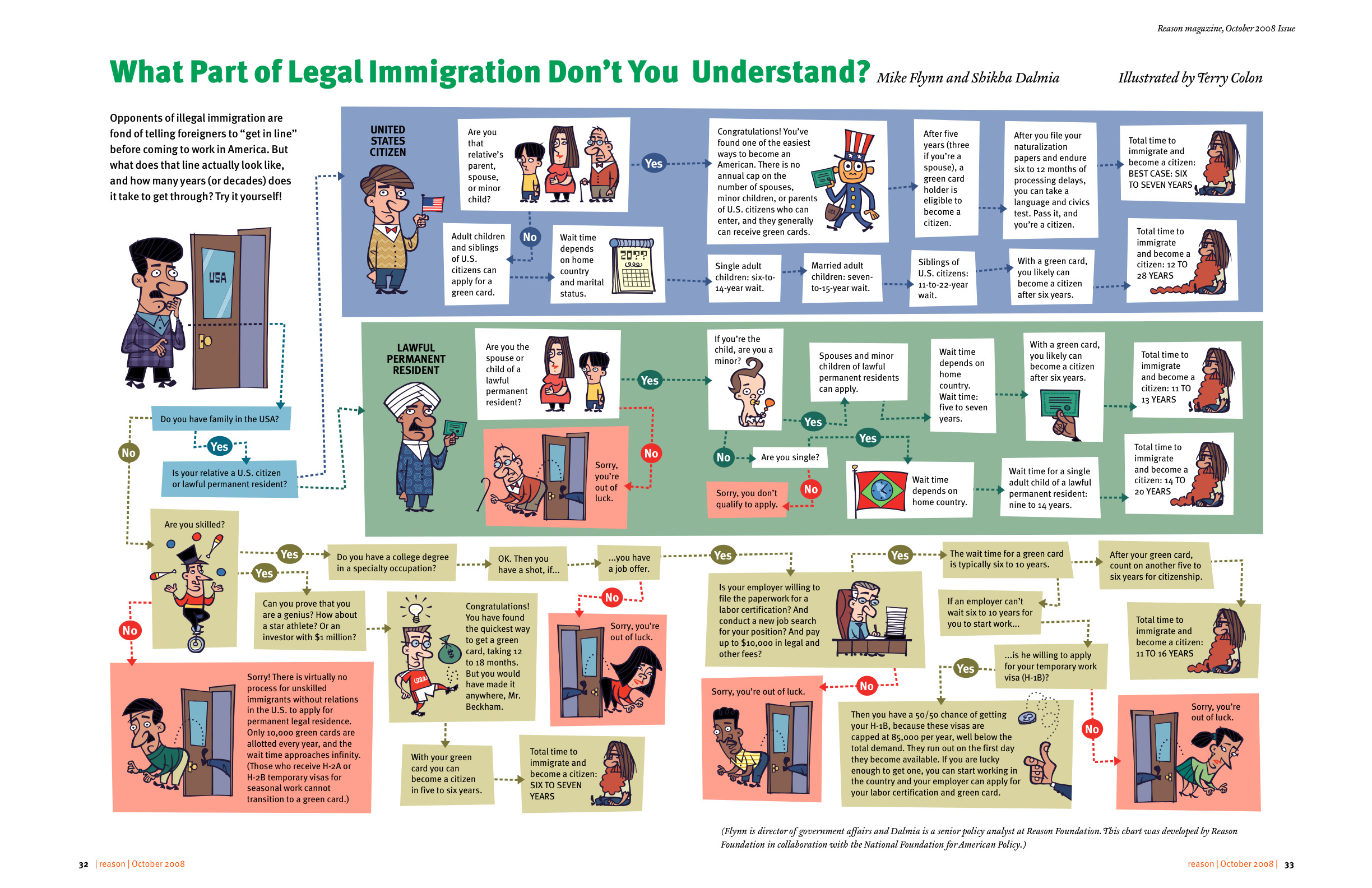
Daniel Foster exhibits sympathy but not total forgiveness toward Vargas:
Reihan has argued repeatedly, and effectively, that we should treat access to the U.S. economy, not to mention its extensive welfare state, as a scarce resource. We can debate and debate the best way of distributing this resource– from “not at all” to “come one, come all” and everywhere in between. But distributing it based on who manages most successfully to violate the law, at the expense of would-be immigrants who are honoring the process, is surely not a valid option.
Serwer blames the system:
Foster's concern about fairness is aimed in the wrong direction. Undocumented immigrants aren't being unfair to those who try to navigate America's baroque, outdated, and inefficient immigration system, that system is unfair to the people who try to follow the rules, because the system itself is dysfunctional.
The other problem with Foster's argument is that it views immigration as essentially a one-sided deal in which immigrants get access to the U.S. economy and Americans get to feel magnanimous. But part of what's so compelling about Vargas' story is how much he's contributed to American society, as an example of how much other immigrants are prepared to contribute to their adopted home, not just socially or culturally, but everything from increasing economic growth to reducing the deficit. If the U.S. economy is a "scarce resource," it's odd to argue that we should be getting rid of people who would make it stronger.
Adam Ozimek asks Foster what he would do if were he in Vargas's position:
Upon turning 18 would [Foster] have left this country and returned to the Philippines because it would be unfair for him to stay? Would he have sacrificed the life he knew here out of a sense of unfairness to other potential immigrants we aren’t letting in? Would he agree that the government should deport him?
Suzy Khimm explores the legal implications of Vargas's actions.
 The Dish