Erin Gloria Ryan proposes a theory:
Saying "I'm an aerospace engineer," or "I enjoy reading Don DeLillo" sounds much more intimidating than "I'm, like, an engineer," or "I enjoy reading, like, Don DeLillo." Maybe women of my generation have been taught, through positive social reinforcement, that we're supposed to pepper our speech with meaningless modifiers that make us sounds a little less sure of ourselves, a little less credible. No one likes a show off or a know-it-all. Better temper your smart-talk with assurance to whoever you're speaking that you're not, like, a threat or anything.
Mark Liberman envisions how technology could cure us:
[N]ow that speech recognition has gotten to be pretty good and very cheap, it's only a matter of time before someone combines a speech recognizer with a style checker, and creates an app for your smartphone that will make it vibrate (or beep, or flash) whenever you indulge in any of the verbal tics that you've asked it to watch out for.
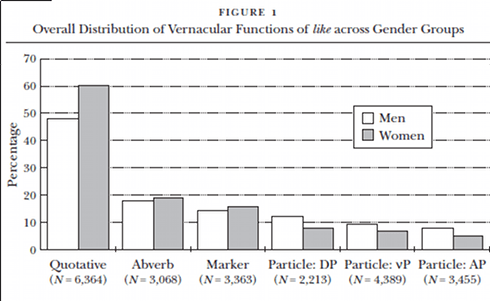
(Image from Alexandra D'Arcy's "Like and Language Ideology: Disentangling Fact from Fiction" (pdf) from 2007.)
 The Dish