
Virgin Gorda, British Virgin Islands, 5.50 pm
Virgin Gorda, British Virgin Islands, 5.50 pm
“Everything is a gotcha question with her,” – Joe Scarborough.
His colleague provides a reminder of the question that spurred Palin’s history lesson on Paul Revere:
What have you seen so far today, and what are you going to take away from your visit?
Jim Burroway marks the date:
[Sunday was] the thirtieth anniversary of the Centers for Disease Control’s publication of a mysterious set of illnesses which took the lives of five gay men in Los Angeles. AIDS had been swirling around unnoticed since the 1930s, and doctors in Europe and Africa began to notice that people were falling victim to a host of diseases which are normally curable in the Congo River basin in the late 1970s. But it took the CDC report of a cluster of cases in southern California to signal that the mysterious deaths were somehow related. The rest, as they say, is history, with a whole lot of stigma thrown in.
Amy Davidson recalls the experience of a gay co-worker in the late '80s:
One day, he said, as I remember, that thirty-six of his friends had died of AIDS, in the space of four or five years. That number was hard to grasp, emotionally; even now, with a better idea of how adult relationships are woven together (and fall apart) I can’t pretend to really know how it would feel to go to that many funerals in that little time—the sheer scale of the mourning. But the math was not so hard to do; one could figure, given the path and relentlessness of the disease, how the number of friends could add up.
I remember the pages and pages and pages of obits, week after week, in the Washington Blade – and the horrible realization that I would probably end up the same way, as friends and acquaintances did. I remember telling a close HIV-positive friend on our almost nightly phone-chats to keep ourselves from total terror, that, if we survived this, we should never forget just how frightened we were. We'd be tempted to gloss it over one day, I suspected.
And yet I have. We humans have a remarkable ability to heal. And an even more striking capacity to forget.

The relationship between religion and politics is, to my mind, the central question of our time. As the false totalisms of the twentieth century – communism, fascism, Nazism – have been revealed as oppressive, murderous lies, insecure and inadequate human beings in need of totalist solutions to the human dilemma have returned to religion. But more accurately, they have returned to fundamentalism, because only fundamentalism, with its absolute certainty and literal precision and binding, unquestionable authority, can assuage the anxieties of a world dislocated from tradition, up-ended by capitalism, globalized to the point of cultural panic.
What we are seeing on the Republican right at the moment, it seems to me, is an extension of this response to anxiety. The new orthodoxy is fundamentalist Americanism. This is not regular American exceptionalism of the kind that the president adheres to: a belief that this miraculous new world has opened up vistas of democratic opportunity to the rest of the planet, that its inspired constitution has enabled stability and freedom in equal measure, that it played an indispensable role in keeping freedom alive during some dark, dark times, and that its core idea – government by, for and of the people – is universalist in nature. No, the Americanism now heard on the right is that America was uniquely founded on Christianity, that America is therefore a chosen instrument of divine Providence, and that this moral superiority is so profound that indicting America on any prudential, moral or political grounds is un-American or, if it comes from abroad, evil.
This is how a country with one of the least efficient healthcare systems in the world must retain it for fear of mass serfdom. This is how a country that has tortured prisoners, using the classic brainwashing techniques of totalitarian dictatorships, has actually done nothing but apply enhanced interrogation to terror suspects. This is how a country allowed the critical regulation of a free market to lapse, and then suffered the consequences not of capitalism but of risk-seeking cronyism and self-serving irresponsibility. This version of American exceptionalism is the one that sees a stimulus regarded by most economists as a no-brainer in the face of a potential depression as an assault on freedom. It is the one that sees a successful bail-out of the banks and auto-companies as a form of communism, that regards the integration of gay citizens into the civil order as demonic, that views any engagement with our foes as appeasement, even when it has been accompanied by a massive surge in the Afghan war and the killing of Osama bin Laden.
This ideology comes perilously close to arguing that something must be right because America does it, or has done it. It paradoxically removes the potential for moral improvement and reform by arguing that America was immaculately conceived, and that all that is required for its revival is what Sarah Palin calls a “fundamental restoration”. The core moral narrative of the country – its founding on slavery and its bitter brutal internal conflict to achieve racial justice over the centuries – is simply ignored. This is what we are hearing from Santorum and Romney and Palin: American fundamentalism.
All of this is routine for authoritarian nationalist movements. What distinguishes this one is a co-optation of Christianity. But, of course, Christianity cannot be co-opted by nationalism. It is opposed to all such distinctions:
There is neither Jew nor Greek, there is neither bond nor free, there is neither male nor female: for you are all one in Christ Jesus.
Yes, the Messiah came from a Chosen People, but in Christianity, Jesus’s death and resurrection made the whole world that chosen people. At the Feast of the Ascension yesterday, we Catholics heard at Mass the words of Jesus from Matthew:
Go therefore and make disciples of all nations, baptizing them in the name of the Father and of the Son and of the Holy Spirit, and teaching them to obey everything that I have commanded you.
And so the notion of America as a unique nation in the eyes of God is a Christian heresy. And the rest of the current Republican agenda is also, extremely hard to square with Christian orthodoxy. A reader writes:
Let us count the ways in which Republican doctrine contradicts Christian teachings:
1. Randian “me-first” capitalism & support for corporate interests (Jesus’s disdain for wealth)
2. Attacks on the welfare state & Medicaid (Jesus’s charity)
3. Support for torture and neoconservatism in the name of security (turn the other cheek)
4. The entire project of fusing the Christian religion with conservative politics in the first place (Render unto Caesar…)
And that is not even counting social issues like gay rights, where Republican Christianists privilege a narrow reading of the Old Testament (Leviticus) at the expense of the entire breadth of teaching in the New (Love).
This goes a little too far, I think. But let me tackle it one by one. 1. There is no question that Ayn Rand despised Christianity because of its insistence on catering to the other before oneself. In fact, Randianism is, apart from Nietzsche, one of the most brutal attacks on the Sermon on the Mount ever written. You can argue that maintaining prosperity is essential for fostering private charity, that compassion requires wealth to succeed, that the free market, which assumes selfishness, is simply an accommodation to the fallen world. And there are legitimate differences among Christians about the prudential manner in which one can achieve certain ends.
But the problem even here is that the ends themselves – the greater material enrichment of human beings – is anathema to the Jesus of the Gospels. His radicalism with respect to property is extreme:  we should have nothing. Indeed, if we retain anything, we will not enter the Kingdom of God. Now look at Wall Street. Could anything be more alien to that message? Or the engine of economic growth: the desire to better ourselves materially. The structure of modern America is therefore anti-Christian. Its worship of wealth and fame as the greatest of all things – yes, Palin comes instantly to mind – is the antithesis of Christianity.
2. Christians can and must retain a debate about the means of economic justice. I find little to rejoice over when government penalizes the rich simply because they are rich, or when it controls so much of the economy it inhibits creativity and growth. And the point of Christianity is that it cannot be imposed but must be chosen. So forcing charity on others by punitive taxation is a contradiction in terms. Nonetheless, again, Jesus is very clear, and the Catholic Church adamant, that the first to be protected in any policy debate should be the poor. Protecting the vulnerable comes before enriching the talented in Christian theology. The notion that the extremely wealthy should sacrifice nothing for fiscal reform, while the very poor should sacrifice access to healthcare is simply anti-Christian.
3. Torture is, of course, an intrinsic evil, regardless what one calls it. The imposition by force of freedom for others is equally anathema. Force should only be used, in Christian just war theory, in defense against an imminent or ongoing attack. The Afghanistan war was therefore justified, although not when al Qaeda and the Taliban had been eradicated. The Iraq war? Not so much.
4. The apolitical nature of Christianity. It seems to me that one of the core messages of Jesus was that his kingdom was not of this world. Politics is a necessary evil, but it is not a spiritual vocation. Between a life in the world and a life that is otherworldly, it is hard to see Christianity in a political mode. By wresting it from its proper context, attaching it to a single nation-state, using it to defend public policies that are, at bottom, anathema to the priorities of the Gospels, Christianists are indeed not Christians.
The distinction’s relevance has not merely endured. It becomes more and more pertinent by the day.
A huge development out of Yemen:
After weeks of angry protests, Yemenis took to the streets of Sanaa in celebration on Sunday following the departure of President Ali Abdullah Saleh on Saturday night. Saleh, who has ruled Yemen since 1978, left to seek medical treatment in Saudi Arabia for wounds sustained during a rocket attack on his palace and temporarily ceded power to his vice president.
Saleh's top officials insist his absence is only temporary, but it's unclear whether Saudi authorities will allow him to return. They may use his presence in the country to pressure him to sign the power-transfer agreement inked by the Gulf Cooperation Council and agreed to by the opposition, which Saleh has so far refused to sign.
Jane Novak relays the demands of the Civil Coalition of Youth Revolution. Juan Cole wonders if a revolution has already occurred:
If Saleh does not return within 60 days, according to the constitution, there must be new elections. [Vice president Abd-Rabbu Mansour] Hadi’s grip on power is likely insecure, and rebel forces are speaking of setting up a transitional council that would presumably include the ten-tribe coalition of Islah Party leader Sheikh Sadiq al-Ahmar, who emerged in the past two months as Saleh’s major rival.
Peter Beinart predicts Obama will get re-elected:
[W]hy do I still think Obama will win in 2012? Because if the Ronald Reagan analogy may not exactly hold, the George W. Bush analogy just might. Unemployment wasn’t particularly high when Bush sought reelection in 2004, but Americans were in a sour mood nonetheless. Throughout the summer and fall of 2004, a clear majority of Americans said the country was on the wrong track. The numbers, in fact, were only marginally better then than they are now. So how did Bush win? For one thing, people’s feelings about him outpaced their feelings about the state of the country. Despite saying the country was on the wrong track, a slight majority of Americans approved of his job performance, and he was reelected by essentially that margin.
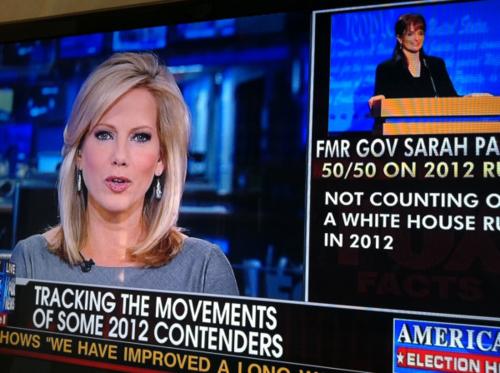
The Daily What captures it:
A Fox News report on Sarah Palin’s ambiguous presidential aspirations, which aired this morning, inadvertently used an image of Tina Fey as the former Alaska governor in lieu of, you know, Sarah Palin.
Well, to be fair to Fox, the two are increasingly hard to tell apart. The Paul Revere thing is pure Fey.
A reader writes:
If Mr. Obama's supporters were as rabid/delusional as Ms. Palin's, they would have argued that Mr. Obama had in fact visited Westminster Abbey on May 24, 2008. Is there a reason her supporters cannot simply acknowledge that she made a mistake?
Yes. Because she is a cult, not a politician. Another:
Saying that Revere's mission was to warn the British because he was captured by redcoats is like saying U-2 spy plane pilot Francis Gary Powers' mission was to warn the Russians.
Rollo Romig provides background on this NYC time-lapse:
To make the video, Owens spent the first month and a half of spring staying at eleven different Manhattan hotels, shooting from their windows and roofs for around twelve hours every day, weather permitting. (Lodging was free—in return, Owens is letting each hotel use the footage shot from its property.) His only real obstacles, he told us, were wind, snow (in April!), and people on the street. “I would often gather a crowd, mostly other photographers asking what I was doing with this strange-looking nine-foot-long thing on tripods,” he said. The tourists were more of a hazard. “People are so distracted by the lights in Times Square that I would often have to physically keep them from walking into the camera.”
Mesmerizing. We are living in a renaissance of documentary shorts.
A succinct and devastating analysis of why we're FUBAR in Afghanistan.
 The Dish