A Tall Target

C.J. Chivers examines how Bryan Denton, at 6' 6'', photographs in a war zone:

In the chaotic and random ways that high-explosive ordnance fells its victims, size matters at many moments. The more space something takes up, or the higher it rises from the ground, the more likely it is to be struck. Anyone who has been under mortar, artillery or rocket fire, or been exposed when improvised explosives or airstrikes detonate nearby, knows the feeling: being low and compact often mean, in a word, life.


A Poem For Sunday

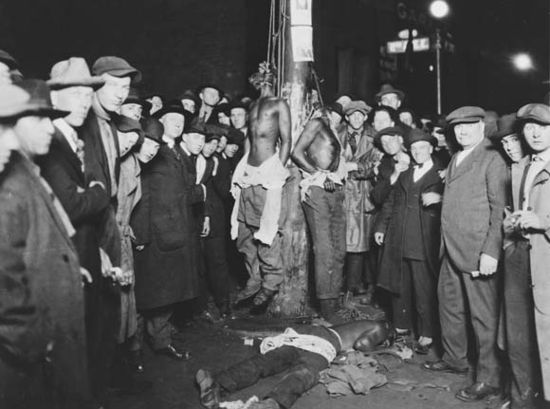
Duluth-lynching-postcard

"Reverse: A Lynching" by Ansel Elkins:

Return the tree, the moon, the naked man
Hanging from the indifferent branch
Return blood to his brain, breath to his heart
Reunite the neck with the bridge of his body
Untie the knot, undo the noose
Return the kicking feet to ground
Unwhisper the word jesus
Rejoin his penis with his loins
Resheathe the knife Regird the calfskin belt through trouser loops
Refasten the brass buckle
Untangle the spitting men from the mob
Unsay the word nigger
Release the firer’s finger from its trigger
Return the revolver to its quiet holster
Return the man to his home
Unwidow his wife
Unbreak the window
Unkiss the crucifix of her necklace
Unsay Hide the children in the back, his last words
Repeal the wild bell of his heart
Reseat his family at the table over supper
Relace their fingers in prayer, unbless the bread …

The full poem is here.

(Photo: A postcard of a Duluth lynching, June 15, 1920 via Wikimedia Commons)

Murder Studies

Theodore Dalrymple recounts the disturbing story of Stephen Griffiths:

If a satirist had come up with the idea of a violent criminal who had spent time in an asylum being admitted by a university to its doctoral program in “homicide studies,” thereafter turning into a serial killer, that satirist would have been denounced for poor taste. But this is precisely what a British university did recently. A man with a long history of criminal violence became a serial killer while working on a Ph.D. thesis at the University of Bradford, the subject of his thesis being the methods of homicide used in the city during the nineteenth century. He himself used methods more reminiscent of the fourteenth.

A Trip To Space

Alexis Madrigal interviews Chris Abbas about his new short film. Abbas spliced together still images from NASA:

I downloaded thousands of images from NASA which was a rather tedious process. Throughout the labor of retrieving the imagery however I was completely awestruck at the quality and clarity of the objects I was saw… The nature of the raw imagery is interesting; interspersed between the erratic, often chaotic frame sequences are long, majestic moments of graceful ring revolutions or slowly turning moons. This juxtaposition of erratic and graceful movements was something I wanted to play with and it was the criteria for my shot selection. It's always an extremely difficult process when all your source imagery is beautiful to begin with.

A Reason For Language

Pat Shipman links our desire to understand animals to our development of language:

Prehistoric art allows us to eavesdrop on the conversations of our ancestors and see the topic of discussion: animals, their colours, shapes, habits, postures, locomotion and social habits. This focus is even more striking when you consider what else might have been depicted. Pictures of people, social interactions and ceremonies are rare. Plants, water sources and geographic features are even scarcer, though they must have been key to survival. There are no images showing how to build shelters, make fires or create tools. Animal information mattered more than all of these.

The overwhelming predominance of animals in prehistoric art suggests that the animal connection – the evolutionary advantages of observing animals and collecting, compiling and sharing information about them – was a strong impetus to a second important development in human evolution: the development of language and enhanced communication.

The Daughter Test

A couple weeks back, Steven Levitt admitted a moral shortcut:

If the answer is that I wouldn’t want my daughter to do it, then I don’t mind the government passing a law against it. I wouldn’t want my daughter to be a cocaine addict or a prostitute, so in spite of the fact that it would probably be more economically efficient to legalize drugs and prostitution subject to heavy regulation/taxation, I don’t mind those activities being illegal.

Douthat defended Levitt's overarching point from Will Wilkinson's initial complaints:

The fact that I would want to be able to involve the police if my daughter became a streetwalker, but not if she became a Hari Krishna, tells me something important about what kind of legal regime I should support. (There’s a touch of Kantianism in it: One’s (legal) preferences for one’s daughter should become a universal law …) And the fact that Wilkinson disagrees doesn’t prove that he believes in logic and reason, whereas I believe in raw emotion. It just proves that his answer to the daughter test is — for now, at least — different from my own.

Wilkinson came back at him:

It's true, as Mr Douthat concludes, that my answers to the daughter test are different from his. But my argument against prohibitions on drugs, gambling, abortion and prostitution is not that these restrictions do not fail my daughter test. My argument against them is that they fail the test of public justification, that many of us have perfectly reasonable grounds for rejecting and resisting the imposition of these constraints. … We are, all of us, a confusion of sentiments. The advance of liberal civilisation consists in no small part in unwinding the tensions between our liberal and illiberal impulses.

Kevin Drum put the entire debate in perspective:

There are lots of activities we AP-class types find acceptable — drug use, gambling, etc. — because we sort of assume that everyone has the same level of impulse control that we do. And if you have good impulse control, then drugs and gambling are just pleasant ways of filling in your free time. … But if you're not part of the AP-class cohort, there's a pretty good chance that your impulse control isn't quite as good as all that, and an excellent chance that even if it is, you're keenly aware that good impulse control isn't exactly universal.
The Roots Of Bad Christian Art

Tony Woodlief doesn't shy away from a harsh truth:

I’m convinced that bad art derives, like bad literary theory, from bad theology. To know God falsely is to write and paint and sculpt and cook and dance Him falsely. Perhaps it’s not poor artistic skill that yields bad Christian art, in other words, but poor Christianity.

Morality And Free Will

Sam Harris contrasts the two:

Clearly, we need to build prisons for people who are intent upon harming others. But if we could incarcerate earthquakes and hurricanes for their crimes, we would build prisons for them as well. The men and women on death row have some combination of bad genes, bad parents, bad ideas, and bad luck—which of these quantities, exactly, were they responsible for? No human being stands as author to his own genes or his upbringing, and yet we have every reason to believe that these factors determine his character throughout life. Our system of justice should reflect our understanding that each of us could have been dealt a very different hand in life. In fact, it seems immoral not to recognize just how much luck is involved in morality itself.

The Equation For Dates

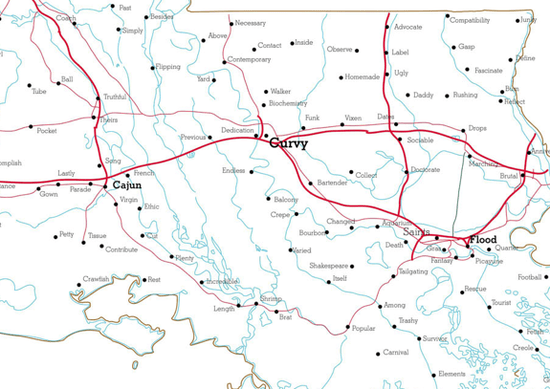
Louisianadating

Eric Barker excerpts from Richard Wiseman's book Quirkology. On what makes for a successful online dating profile:

The results showed that a 70 percent “this is me” versus 30 percent “this is what I am looking for” balance attracted the greatest number of replies. It seems that if you devote more than 70 percent of the ad to describing yourself, you look self-centered. Less than 70 percent and you look suspicious.

(Image: a map of Louisiana, with the "names of cities, towns, and neighborhoods replaced with the words people use to describe themselves and those they want to be with" from online dating profiles, by media artist Roger Luke DuBois from his series, A More Perfect Union)