The Fringe Could Win, Ctd

Jonathan Bernstein counters Daniel Larison:

[R]ight now, I'd almost completely ignore the polls. I'd pay attention to high-profile endorsements, fundraising success, and any other signs of party support — success in signing up prominent staffers, for example. I'd also pay a lot of attention to anti-endorsements: any strong statements by important GOP leaders that a candidate or a candidate's issue positions are unacceptable (or just the fact of unacceptable issue positions; that's why Hunstman isn't, in my view, a plausible nominee).

Larison is unsatisfied with this answer.

Faces Of The Day

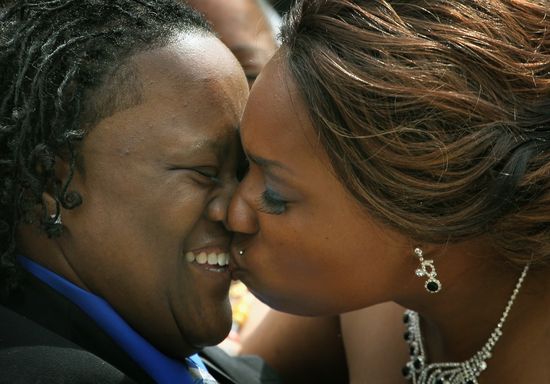
GT_CIVIL-WEDDING-110602

Shanelle Moffett (L) and Tenisha Watkins kiss at their civil union ceremony in Millennium Park June 2, 2011 in Chicago, Illinois. More than 30 same-sex couples were joined in civil unions today during a ceremony in the park. Illinois is the sixth state to allow same-sex civil unions or their equivalent, which provide gay couples the same rights as heterosexual married couples. By Scott Olson/Getty Images.

The Cost Of Your Commute, Ctd

A reader writes:

I would bet that the emailers who are militant cyclists and use loaded phrases such as "lazy arses" and "fools who drive" are not the primary caregiver to a child or children, and most likely don't even have any. They live close to work – yippee for them! Pick up your sick kid on your bike, at your inner-city private school. The smug condescension makes me want to drive even more.

Another writes:

I wonder how many readers defending biking to work are men.

I like biking and there are certainly environmental and health benefits to commuting with a bike. But as a woman in a field that doesn't allow me to look a disheveled mess at work, it's not at all feasible. Sweat's not a huge issue for me, but make-up, hair and work clothes all get messed up, and while the men in my office can get away with red, shiny faces and close cut hair that still gets flattened by a helmet, the other women and I can't.

Another shares:

Apparently none of your readers ever considered baby wipes.  My logic was this: If it can clean up and get rid of the smell of baby poop, then it can certainly get rid of the smell of schvitz from me.  So, I did a test run one weekend and asked my husband to tell me if I was smelly (I had him check everywhere).  The answer?  No. 

So when I didn't have to worry about going to a meeting that day and wearing dressier clothes, I would bike in, shut the door to my office, cool down, then take a baby wipe "bath" before changing into work clothes that I packed that morning.  If I wasn't in my own private office and was working from a cube, I would use the bathroom.  No shower or gym required. 

Cellphones And Cancer, Ctd

Cell

A reader writes:

I think you cannot have a reasonable discussion about this issue without at least giving mention to Devra Davis' book Disconnect, published last year, which makes a compelling, scientific case about the radiation dangers from cell phone use.  The book presents a very strong argument that there are dangers with cell phone use and points out the significant flaws in the scientific research and, moreso, the flaws in the (mis)interpretation of the results of those studies.

Significantly to me, as a parent of a tween and a teenager, we know that growing brains have different chemistry than the brains of full-grown adults, along with thinner and more absorptive skulls.

Moreover, the "testing" on cell phone radiation standards are based on the Standard Anthropomorphic Man (SAM), a "standard" of a 200 pound, 6'2" man with an 11 pound head using a phone for just minutes at a time – a completely irrelevant standard to the way cell phones are used today. Models (and phone instruction manuals) assume that people do not hold the phones directly against their heads, but rather up to an inch away, depending on the specific phone's manuals. That's sort-of like assuming a Q-tip will not be used to clean in your ear.

Davis points to evidence that cell phone radiation can break down DNA, and can disrupt the blood-brain barrier. The effects are even more significant with newer phones than older "2G" phones.

Maybe my background makes me more willing to believe in the dangers.  A decade ago, I was working with the then-CEO of a company that had developed an antenna technology that could be configured to use much lower power and emit less radio waves than other antennas. Behind closed doors, there was discussion that this technology presented a possible advantage of lower risk of impact on brains – this was not long after an earlier wave of concern about brain tumors.  But the company never promoted that fact. Alone after a meeting, I asked the CEO about that, when I noted he was using a wired headset whenever he used his phone. He told me that he had seen studies that made him concerned about the impact, but that as an industry, you would never see the issue discussed. Then he leaned in to me and said, "you know, it's the same wavelength used in microwave ovens."  (Yes, this is a true story.)

Much of the evidence is anecdotal, but there is a growing body of clues that should give people pause.  The defensiveness shown by many about this issue, including in what you have published, worries me, because people are saying, "Well, if it's not proven, I don't have anything to be concerned about." Sure, let's wait until our kids have brain tumors (and I sure hope that the evidence eventually points the other way, because too many people don't care to change their habits) to decide if the risk was real.

It's the same argument as global warming denialists – we should do nothing until the evidence is certain, when the only way to have certain evidence is if an irreversable catastrophe occurs. Public safety isn't a game of chicken.

Another writes:

Perhaps a physicist rather than a physician should be consulted on this issue. Scientific American had an article last year talking about the difficulty of proving a negative but debunking this story from a different direction.

Another:

I'm an electrical engineer by training, so I've had to answer the "cell phone cancer" question quite a few times. A modern cell phone emits radiation in a specific range of intensities, and over a specific range of wavelengths. Given what we know about how radiation causes cancer, cell phones simply don't emit the "right" kind of radiation – in terms of intensity or wavelength – to excite the molecules of your brain cells' DNA enough to cause damage. Anyone with the mathematical chops and access to Google can prove this for themselves.

This is not to say that cell phones do not cause cancer. But if they do, we are at least one very large step away from being able to prove that they do, because they would have to be causing cancer by a mechanism unknown to science. Indications that such a thing is possible come from studies which show increased brain activity near an active cell phone, presumably a result of the tiny currents induced by a cell phone's weak EM field. If this action does indeed cause cancer, however, there are plenty of other dangers to worry about, like the high-voltage power lines which produce much stronger EM fields in their vicinity.

(Photo by Esther Gibbons)

Telling The Young To Save

David Von Drehle begs politicans on both sides to get "honest with younger Americans—people 50 and under—and [let] them know that they need to save more of their own money if they want to have the sort of retirement their parents are enjoying":

No matter who is in charge, health care spending is not going to be able to rise indefinitely at twice the rate of inflation. Cost will, inevitably, become “a measure of efficiency,” whether the government applies that discipline directly or through vouchers. Call it rationing, call it “bending the curve”—whatever. It means that some things that would be paid for under the current system will not be paid for in the future. If younger Americans want those things, they will need to have money socked away to pay for them.

I've lived under the assumption for the last ten years that if I make it to retirement, the boomers will have ensured I have no benefits at all. I'm a manic saver as a result.

“Inches Away From Ceasing To Be A Free Market Economy”

That was one of Romney's vague, unsubstantiated hyperboles from today's policy-empty announcement. Politifact declares it's "so far off base that it's ridiculous." According to the Heritage Foundation's study on an index of economic freedom:

The U.S. ranked ninth out of 179 nations on the list, with a score that placed it near the top of the "mostly free" category. The only nations to be considered more "free" than the U.S. were, in descending order, Hong Kong, Singapore, Australia, New Zealand, Switzerland, Canada, Ireland, and Denmark.

What's maddening is the use of the short-term impact of a recession on revenues and equate it with a permanent shift in American governance. But context must matter. If Obama had come in with a boom at his back and had then raised government spending as a percentage of GDP from the lower 30s to the upper 30s, Romney would have a point. But he doesn't. The president who grew government during years of economic growth was George W. Bush.

Or maybe Romney's assertion was not intended as a factual statement.

Fisking Romney’s Speech

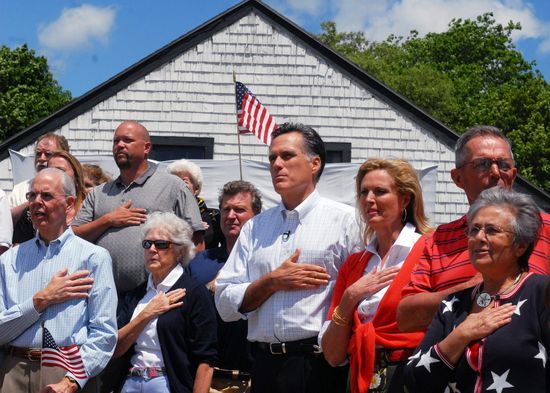
115061160

Just some observations on the text:

Weird: "We go to different churches or maybe don't go to church so much."

But Romney doesn't go to Church. He goes to a Temple. [Correction: yes, temples are places Mormons attend, especially someone as prominent as Romney. But on a weekly basis, Mormons do go to church. Apologies.] And where are the synagogues and mosques?

Wrong: "As the Red Sox like to remind the New York Yankees, there are no dynasties in America."

Er: the Adamses, the Roosevelts, the Kennedys, the Tafts, the Bushes, the Daleys, the Romneys, to name a few. America has the most dynastic democracy in the West.

Wrong: "When [Obama] took office, the economy was in recession. He made it worse."

Worse?  The recession formally ended in July 2009. Unemployment is higher now than when Obama was inaugurated. But we all know that unemployment is a lagging indicator. But how exactly did Obama make it worse? Does Romney believe there should have been no stimulus? Does he believe that rescuing GM made the recession worse?

Implausible: "I will cap federal spending at 20% or less of the GDP and finally, finally balance the budget."

I presume Romney intends a balanced budget within his maximum term of office. That is a staggering goal, give the structural forces propelling the debt. It's way more draconian than the Ryan plan, which won't deliver a balanced budget for more than a decade. So what would he cut? Given his pledge to abolish all the cost-controls in the ACA, how does he propose to reform Medicare? How much would he cut from defense? Which taxes would he raise? By not even suggesting a single specific to reach a truly radical goal, the pledge is basically meaningless. Or maybe he means this:

I will make business taxes competitive with other nations, modernize regulations and bureaucracy and finally promote America’s trade interests.

Really: that's it? That's the jobs program? Modernizing regulations and bureaucracy? Really?

I guess this was a broad anouncement and so its emptiness is not too damning. The out-takes I've featured are underwhelming. He says nothing about how he would have dealt with the Arab Spring and the excruciating choices in foreign policy it presents. He says nothing about how to tackle the debt, or to reduce healthcare costs. His proposal for unemployment is risibly thin. 

But he is an American. That was heard loud and clear. As was his inference that the president isn't. That's the ugly part. But in a competition for ugly, he will always be bested by Palin.

(Photo: Darren McCollester/Getty Images.)
The Market For Cable A La Carte

Young people think cable is a bad deal. Alyssa Rosenberg agrees:

The bundle of channels that come in a cable package are a truly random spread of things, and while that may seem like it provides a lot of choice, it’s not actually letting me pay directly for the things I’d like to purchase. No one would stand for a model where to buy George R.R. Martin books, I had to guy the whole Left Behind series. The music industry’s evolved to a point where I am no longer required to pay for the skits on hip-hop albums. Cable’s obviously much more dependent than either of those kinds of art on delivery mechanism, but if I were the strong, profitable, critically acclaimed network, I would totally gang up on the dead weight I was packaged with and insist on letting consumers do something like pick ten channels for a set price and then pay a la carte for extra channels