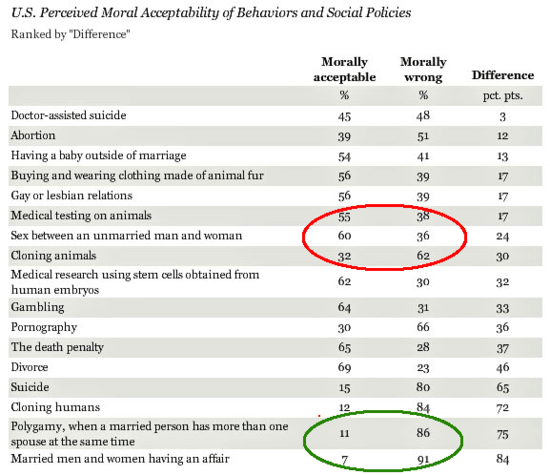
Chart Of The Day

Chart

DiA tries to wrap his head around the fact that  more people find polygamy "acceptable" than extramarital affairs:

I would probably agree that cheating on your spouse is "morally wrong", but given that about half of married people do it I'm not about to shun anybody. … Still, even accounting for the simplistic framing, the extremely high "Morally wrong/acceptable" ratio there suggests to me that judgmental puritanism is in pretty good shape in America these days.

Philo-Semitism: A Primer, Ctd

A reader points to a classic Onion item on the subject:

Henry McCullers, an affable Plano-area anti-Semite, praised the Jewish people Monday for doing "a bang-up job" running the media. "This has been such a great year for movies, and the new crop of fall TV shows looks to be one of the best in years," McCullers said. "And the cable news channels are doing a terrific job, too. Admittedly, they're not reporting on the Jewish stranglehold on world finance, but, hey, that's understandable."

How Much Did GM’s Bailout Cost Us?

Manzi says it’s a near-impossible question to answer with much certainty:

Anybody who tells you they can answer all of these questions reliably is full of it. And that doesn’t even start to get to the really long-run considerations of what effects this has on rule of law and moral hazard (or if you want to make the case for the bailout, social solidarity and degradation of the working class)…. I don’t believe that human beings currently have the capability to conduct the kind of analysis that should convince a rational observer to change his mind about the GM bailout in isolation from a more profound paradigm-shift-like change in his beliefs about the world.

What are the implications of grasping the limits of our understanding?

Decentralized decision-making, experiments, and entrepreneurial groping toward knowledge.

Quote For The Day III

"In my opinion, any mandate coming from government is not a good thing, so obviously … there will be more the explanation coming from former governor, Romney, on his support for government mandates … Even on a state level and even a local level, mandates coming from a governing body, it's tough for a lot of us independent Americans to accept, because we have great faith in the private sectors and our own families … and our own businessmen and women making decisions for ourselves. Not any level of government telling us what to do," – Sarah Palin, tweaking Romney on the day he announced his candidacy.

Meanwhile, PPP finds a national two-way race between Palin and Romney with each garnering 15 percent support, followed closely by Cain and Pawlenty. But there's an unexpected element for Romney – the Rapture:

18% of GOP primary voters believe it will occur in their lifetimes and 31% of them support Palin to 15% for Romney, 11% for Cain and Gingrich, and 10% for Pawlenty.

Unless Palin voters literally disappear into Heaven, Romney will be running as the liberal/centrist candidate, while Palin has the Christianist right in the palm of her ink-stained hand.

What Sarah Palin Could Have Done (If She Weren’t Sarah Palin)

Josh Green continues his tour into counter-factual fantasy:

Palin’s greatest vulnerability is the impression that she’s erratic. A well-orchestrated campaign like the one that Karl Rove rolled out for Bush ahead of the 2000 primaries could have mollified some skeptics. Like Palin, Bush was regarded as callow and not quite up to the job. Those doubts mostly vanished after a carefully arranged regimen of policy conferences, thematic speeches, and personal appeals to major GOP donors. By contrast, Palin’s support among Republicans has declined steadily since the last election. As her bus zigzags between national landmarks, trailed by an army of reporters mystified about her plans and intentions, she seems more erratic than ever.

Prayer: Tina Fey Style

From "A Prayer For My Daughter," in Tina Fey's new book:

Lead her away from Acting but not all the way to Finance. Something where she can make her own hours but still feel intellectually fulfilled and get outside sometimes and not have to wear high heels. What would that be, Lord? Architecture? Midwifery? Golf course design? I’m asking You, because if I knew, I’d be doing it, Youdammit.

The Cost Of Your Commute, Ctd

6a00d83451c45669e2015432b7563e970c-550wi

A reader makes a solid point:

One aspect that seems to be missing in the conversation about biking to work is the huge difference in daily weather we have in the United States. I live in Houston. The high today, depending on which weather site you look at, is either 98, 99, or 100 degrees. While we are currently in a severe drought, the summer is predicted to be a wet one (knock on wood). So your talking about about riding a bike on days when the temperature and humidity are extremely high. On those days, I get sweaty just walking from my car in the parking lot, and contrary to what one of your readers said, most people I know do not have easy access to showers at work. Sorry. No bike riding to work for me.

Then there are the hills – more of them in US cities than the notoriously flat Amsterdam:

Your reader who cited the examples of Amsterdam, Copenhagen, Groningen, etc. is offering an apples and oranges comparison with the US. All those places have relatively mild temperatures and are flat. Indeed, Holland and Denmark are possibly the flattest countries in the world, and northern Germany isn't too much different.

Subject the citizens of these cities to hills and 97 degree temperatures like we had in Washington yesterday and rest assured the story would change completely. Personally, even when the weather is in the low-80s I still turn into a sweaty mess simply pedaling from the Whole Foods up to Columbia Heights, which takes less than 10 minutes.

Too true. I use a bike for everything. But around now until September, you can barely walk, let alone bike, a block in DC without getting drenched in sweat. Mercifully, most subway trains are air conditioned.

(Photo: Amsterdamize)