A reader writes:
You have to be fucking kidding!
Another writes:
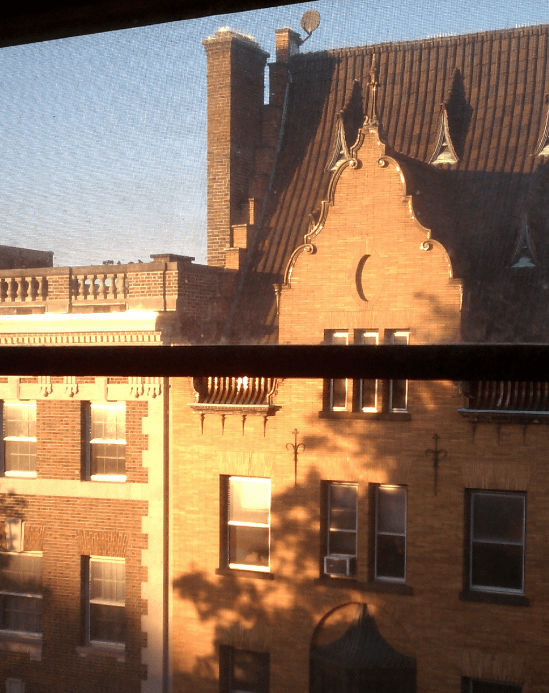
Summary of clues: satellite dish, satellite dish direction, a steep Dutch gabled roof, the shadows of two deciduous trees, a dusky evening/morning sun, an air conditioner. Only those those pinched windows are unique, but they are not googlable. “Search by Image” turns up a set of brown faces.
Oh! another clue: pigeons on the ledge! Sigh. You aren’t giving us very much to work with. But, the compact neighbouring house is reminiscent of countless NYC buildings (that faded brick and the stone lacing, those keystones over the windows), and the Dutch-styled one next door of course complements the notion that this window’s view is part of a Manhattan milieu.
So, I nominate: Manhattan, in the neighbourhood of Washington Heights. I’ll be surprised if the person who gets this didn’t live next door for some period in their life and thus win by destiny rather than prowess. Is this VFYW deducible? Or am I an inferior sleuth?
It’s deducible, particularly if you think outside the window a little. Another:
Somewhere in New York City. I can’t get more specific than that, but I wanted to give at least a shot. I suspect Brooklyn, but I’m not sure.
The building on the left is classic NYC public school construction, circa 1929-40. I went to two schools on Staten Island with that basic look (PS 19 and Port Richmond High) and there are literally dozens of others still extant throughout the five boroughs. The style of that other building, while vaguely European, was a common motif on apartment buildings in the early years of the 20th Century. Wherever it is, the view is undoubtedly looking north, as the satellite dish (assuming a northern US location to be correct) would be pointed south.
Another:
The photo reminds me of Philly, when I visited last summer. It seems like the US on the East Coast based on the age of the buildings, which, in my non-expert opinion, seem to be from the late 1880s. The building strikes me as something a wealthy industrialist of the area would build. It’s an advertisement of wealth, but fit within the confines of the location. If you’re ever in Philly, check out the Lippincott House. It’s a beautiful bed and breakfast near Rittenhouse Square that I stayed at with my fiancee.
P.S. I’m still amazed by NY’s backbone last night. Now, if only California, my current state, can fix its mistake. I’m still ashamed of Ohio’s, my old home state, constitutional amendment in 2004. As progressive as Columbus can be, the rural areas and Cincinnati are not.
Another:
This screams Chicago to me. Where in Chicago, I don’t know. I say Chicago because of the unique edifice, suggesting some kind of East European influence. But the satellite dish, well-kept screen, apparent height (3 to 4 stories), and the color of the bricks. I’ve not responded to this contest before, but I’m always entertained by the Tuesday posts and the devotion of your readers.
Another:
I ran a diffraction analysis on the sky area. The distinct spacing of the bug screen is of a type only installed in Krakow, Poland.
Actually, I’m flying to Krakow shortly and won’t have a chance to contemplate this one for more than a few minutes, so that’s my guess.
PS. Don’t know if Andrew himself reads these contest entries, but I had the Dish and the live-feed from New York up side-by-side last night, and I’m celebrating with him and everyone else. We’re not equal until we all are, and this is a step towards that.
Another:
In this photo, the satellite dish appears to be pointing south. So the place in question is probably in the northern hemisphere. The proximity of the building in the picture and the one from where the photo has been taken suggest narrow (European?) streets. The curved roof with similarly curved dormers appears to be northern European. Googling a bit, I found that parts of Belgium seem to have a predilection for roofs that look a lot like that, and the city of Bruges seems to have a lot of them – so I’m going to go with that. Not many other clues available, as far as I can tell.
This is my second attempt at the VFYW contest – my first was last week, and I guessed Luanda, so I’m hoping I’m one of the seven people you mentioned as having guessed correctly!
Yep, you’re on the list of correct guessers. Another:
Judging from the abrupt juxtaposition of neo-Georgian and neo-Dutch architecture, this view could easily be Dupont Circle or adjacent neighborhoods in DC. Is this the view from YOUR window, Andrew?
Nope, but it can be found in the foreword of our book. Another:
Eugene, Oregon? Specifically, the building looks a LOT like St. Mary’s Episcopal Church, at the corner of Pearl St. and East 13th Avenue. I realize I’m probably about 7 or 8,000 miles off, but that’s my guess.
Closer to 3,000. Another:
Albany, New York? The style of the buildings looks like what you might see on State St. in Albany, near Washington Park. State Street also runs by the State Capitol. I’m guessing this location might not be a coincidence this weekend.
Good guess! It was sent to us two years ago and we never posted it. Another:
I recognized a building I have seen all my life and confirmed by walking a few blocks. I will be able to figure out the building from which the picture was taken when the threat of lightening subsides.
The reader never got back to us, so we pray the lightening wasn’t involved. Another:
When you put a Flemish Revival building up the day after the historic vote, Albany was the obvious place to go. I’ve never been, but I know the kind of street in a Northeast town where you find high-quality turn of the century architecture, and State Street fit the bill. Looks like the picture was taken from a third floor window of the Romanesque Revival townhouse across the street (one of the flat windows, not the bay).
Oh, and the building to the right of this Flemish Revival gem – a style briefly popular in the former Dutch colonies – is the Republican State Committee headquarters. But you knew that, already, didn’t you.
And congratulations. I watched live last night. It was inspiring and emotional. And Ruben Diaz aside, it was a remarkably thoughtful and eloquent display from a body we New Yorkers have grown to deplore. But Cuomo’s had a real effect – not just on this subject, but across the board. I don’t really know why or how. I voted for him, but I didn’t expect him to be so effective – on the budget, ethics reform, and now marriage equality. We’re a better state for it.
Another:
I won’t bother with getting Google Earth coordinates or screenshots of exactly what window the photo was taken, as I bought the VFYW book for my wife this past Christmas and we don’t need another. This is a great opportunity to tell you guys, however, that I took Post-It strips and covered the location of every single photograph in the book to make it a VFYW Contest book for her because she can’t get enough of this weekly feature.
Also, it seems a bit like cheating because we live in SmAlbany and I lived on that block about 10 years ago. Fun to finally get the answer correct, though! Keep up the great work, all.
Eight readers in all correctly guessed Albany, and none of them have nailed a difficult window in the past. But the following reader, an architect, was the most specific and closest to the actual address:
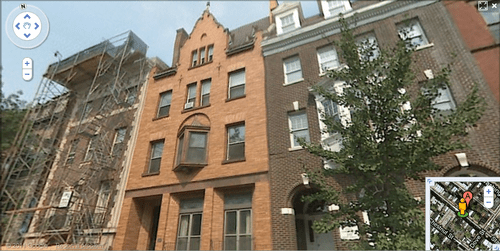
This was a piece of cake. I knew instantly that I was looking at a Dutch-Revival step-gable and not the real thing (in Amsterdam, say) – the Roman brick was a dead giveaway, and for this style of house to be located next door to a brick neo-Federal/Georgian with a dash of Beaux-Art (a.k.a. Modern French) there was only one state where this particular cultural confluence of architectural styles could possibly occur – New York.
Familiar with appearance of all the step-gable Dutch-Revival houses in New York City, I was quickly able to rule that out, and immediately asked myself: in what other prosperous cities in NY State before the turn of the last century would a private house require such a knowing, showy (and costly) display of state history? Albany, of course.
Ah, ha! How nicely you’ve worked in yet another layer of history by selecting the city of the moment on the morning of the historic marriage vote! And yes, two blocks away from the State Capitol! Knowing that all the best houses of that era in Albany are on State Street, it was very easy to locate the roof profile on Bing Maps aerial view (step-gables are uncommon, even in NY State), and boom! There we were! The houses at 300-315 State Street; shot from across the street, probably not coincidentally selected by you as another sly political reference – as it appears (per Google Maps) to be adjacent to the NY State Republican State Committee at 315 State Street … well, you can take over from here; I’m an unapologetic Roosevelt Democrat!
(Archive)

 The Dish