Home News

TrafficGraph

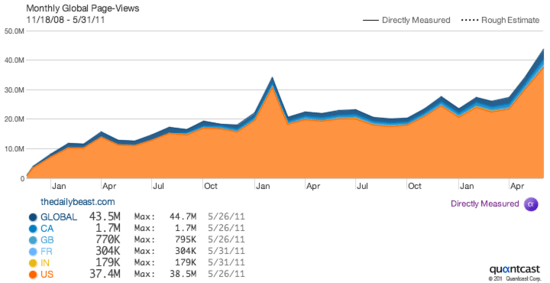
May was a great month for us at the Dish. We garnered more pageviews than at any time since we added the 'read-on' feature over a year ago and had a near record number of visits outside the fall election season. The Beast as a whole, moreover, is at a new plateau of readership – up from around 27 million monthly pageviews to 44 million in two months. Yes, last month – between OBL and DSK – was a great news month. But we kept up.

Thanks for coming with us, and for adding new momentum to the experiment that is Newsweek-Daily Beast. Don't forget the check out the Beast home-page as well. It's been on fire lately.

What Happens When Voters Start Paying Attention?

A number of polls have found that the Ryan budget is very unpopular once it is explained to voters. Nate Silver sees trouble ahead for the GOP:

If these poll results are right, they represent a lot of danger to Republicans because they suggest that voters’ assessments of the Medicare proposal are not yet fully “priced in” to their views of the parties more broadly. Right now, most people aren’t paying all that much attention to the budget debates or to domestic politics more generally. But they will tune in at some point between now and next November, and when they do they may find that the Republicans’ approach to the budget is not to their liking.

The Wrong Way To Oppose Obamacare

Some GOP governors are refusing to set up their states' healthcare exchanges. Aaron Carroll thinks they will come to regret this:

[R]efusing to prepare the exchanges is a real risk. It’s unlikely the law will be repealed soon. Should it not be found unconstitutional and thrown out entirely, the exchanges will still stand. The PPACA clearly says that if a state doesn’t have an exchange, then the federal government will create and run one for it. It’s going to take some time to set one up, and if 2014 rolls around and states don’t have an exchange ready, then it will be the feds, not locals, who will dictate terms.

Egypt’s Slow Change

Emma Sky visited the country:

I leave Egypt knowing more and understanding less than when I arrived five days ago. Will elections make the Muslim Brotherhood the dominant party in Egypt? Are we witnessing the beginning of the end of religious minorities in the Arab world? Will the pressure of poverty, over-crowding, and population growth lead to society breaking down? But I remind myself of the comment made by one vendor who interrupted me when I asked about the new post-revolution Egypt saying: "Excuse me, Madame, Egypt is a very old country. Our civilization goes back 7,000 years." And I remember the words of the Muezzin of al-Hakim mosque who scoffed at those who think that substantial change will come overnight and told me: "It even took Allah seven days to make the world. So it will take Egyptians much longer!"

Another Tragedy In Tehran

An Iranian reader writes:

I woke up to the horrific news of Haleh Sahabi. I knew her personally. She was in jail to serve a two-year sentence because she gave BBC Persian a call on the day of Ashora protest and described the scene of the police car running over protesters.

On Monday her father, a prominent opposition figure, died at age of 81 while she was in jail. They gave her a few days of leave to attend the funeral. But, as it has become an ugly tradition since the birth of the Green Movement, the regime, very fearful of funerals by political figures turning into mass protests, send agents to take the body of the deceased away so the funeral would not go for long. When Haleh Sahabi protested the attempt by the security forces to take her father's body away this morning, the response was severe. They beat her up in front of everyone, and she falls and dies instantly due to a very strong punch to the stomach. Here is the Guardian's report (there are already calls for mass protest in response).

Cellphones And Cancer

The World Health Organization says that cell phones are "possibly carcinogenic." Balko is skeptical:

Incidence of the most common type of brain cancer in the U.S. has dropped 0.4 percent per year between 1987 and 2007. This would be about the very same period that we all started using cell phones. That doesn’t necessarily mean the drop wouldn’t have been steeper had we not used cell phones. And it doesn’t necessarily mean cell phones don’t have a long-term effect that we may see in years to come. It does mean that brain cancer incidence has plummeted just as cell phone use has taken off.

A cancer research blog goes into more detail. Bottom line:

It is understandable that people are concerned about mobile phones, especially because they are so widely used. But so far, the published studies do not show that mobile phones could increase the risk of cancer.  This conclusion is backed up by the lack of a solid biological mechanism, and the fact that brain cancer rates are not going up significantly.

However, all of the studies so far have weaknesses, which make it impossible to entirely rule out a risk. Mobile phones are still a new technology and there is little evidence about effects of long-term use.

Setting The Bar High For Teachers

A new report (pdf) studies the top-performing education systems worldwide. A major finding:

The logic for raising standards for getting into teacher education programs is the same everywhere. Low standards for entry means that people who could get into professional programs perceived as hard to get into see teaching as attractive only to people who do not have the skill or ability to do anything else, so they do not want any part of them. If these schools and programs are easy to get into, the message in the college or university is that they are low status and so higher education faculty who can get higher status jobs in their institutions do not want to teach in the education programs. Raising the standards for admission will attract a higher quality of applicant, and, at the same time, discourage lower quality applicants, and it will also attract a higher quality faculty, which also attracts a higher quality applicant.

The lesson Dana Goldstein draws:

[T]eaching reform efforts should focus more heavily on rebuilding the pipeline into the profession and less on creating complex reward and punishment systems for current teachers, most of whom oppose increased testing, and many of whom are demoralized by the direction of U.S. education policy.

The Cost Of Your Commute, Ctd

Makesufat

A reader writes:

Like some of your readers, I disagree with Lloyd Alter's food cost math. Almost every American consumes far more calories per day than their bodies require, and the exercise would help offset those extra caloric extravagances. In other words, most people are already paying for those calories and not using them.

But I fail to see how one could ever ride so slow as to take 1.5 to 2 hours to go 15 miles. Heck, I can RUN that fast, and I'm not a particularly fast or adept runner. As for the sweating, that is one crutch of the problem. The other is rain. But if you look around, I bet most people have access to showers at work or a nearby gym. Many employers in Pacific Northwest already offer gym memberships to employees. One previous employer of mine had showers at work.

All I hear are excuses from people not wanting to get off their lazy arses.

Another problem I see has to do with the very core of commuting itself: why do we live so far from where we work? I have purposely chosen to live close to where I work so that I can walk or ride my bike or take public transit, even though I pay a little more in rent. Why live farther away to save 50 bucks per month when I would have to drive to work, find a place to park on the street which inconveniences people who live there like myself, or pay hefty parking fees to park in a structure?

Another writes:

Seeing some of the feedback from your readers is frustrating.  Yeah, you get sweaty; and yes, it may take longer to get to your job, but I guarantee you will feel great.  Bike commuting is doable if our culture wasn't so car-centric.  The real issue is sprawl.  People are driving more and causing issues with health, happiness and marriage, as this recent piece by Annie Lowrey attests.

Another:

"The whole concept of biking to work is nonsense" is, well, nonsense. For some people it doesn't make sense, I'll give your reader that much. But there are a whole lot of us that it does make sense for. We live in cities, and we don't work in uptight office parks. My commute by bike takes half the time it does by train or bus (don't even get me started on the fools who drive to work in a city with transit options), and most of my co-workers bike as well.

The thousands of us who already do physical labor during the day (including service sector and retail jobs) don't have to worry about changing clothes at work, but that is an option for people who can't wear shorts and T's in the office. And as far as the smell goes – being packed into a train during rush hour in the summer is about the worst thing my nose has ever experienced, and I know I come out of there just as sweaty as I get on my bike.

Another:

People are always so quick to dismiss something as "nonsense" simply because it wouldn't work for them. They have to realize we live in a hugely diverse country with an enormous number of different lifestyles.

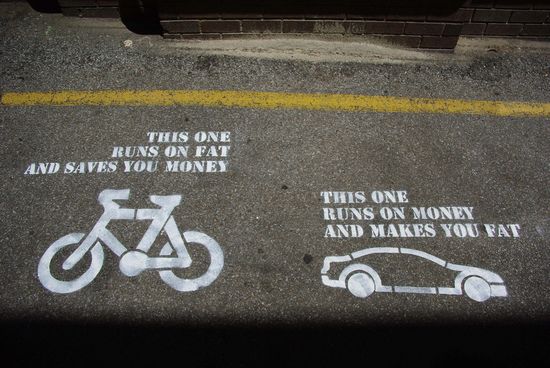
(Street graffiti by Peter Drew)
Medicare Must Be Reformed

William Galston wants a real debate about Medicare's future:

[T]here’s a huge stumbling-block at the threshold: the American people don’t believe that the status quo is unsustainable. Until they do, they’ll reject not only the Ryan plan, but also alternatives that are far more balanced and less draconian. So both political parties face, and cannot avoid, the bedrock challenge of every democracy: persuading the people, who are the ultimate arbiters of what’s possible, to accept a bitter truth and its necessary consequences.