Who Isn’t Paying Any Federal Taxes?

Bruce Bartlett angers up the blood a little:

According to new data from the Tax Policy Center, this year 46.4 percent of tax filers will have no federal income tax liability.

Much of that is due to poorer EITC households and some middle class ones with child credit. But it also true that:

There are 78,000 tax filers with incomes of $211,000 to $533,000 who will pay no federal income taxes this year. Even more amazingly, there are 24,000 households with incomes of $533,000 to $2.2 million with zero income tax liability, and 3,000 tax filers with incomes above $2.2 million with the same federal income tax liability as most of those with incomes barely above the poverty level.

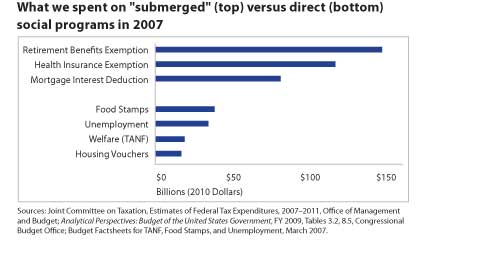
Doesn't this pose a risk to social stability and market efficiency? And don't forget the impact of tax expenditures, i.e. middle class subsidies. They have long since displaced aid for the poor in the outlays of the federal government:

1107.mettler_VisSubSoc_chart
Suzanne Mettler makes a compelling progressive case for ending these tax breaks for so many.

The Amazing Debate At National Review

Like the Berlin Wall crumbling, or Twitter reaching Iran, the New York marriage decision seems to have prompted major glasnost at NRO. Suddenly there are voices on the subject not given a papal imprimatur. Mike Potemra, leading the charge for a more open debate, imagines "redefining marriage" in the early monarchy of Israel:

I’m just an ordinary Israelite who has an idea for moral reform. Should I try, through nonviolent political persuasion, to convince my fellow Israelites and our King David (blessings be upon him!), of my point of view? Or would this be an attempt on my part to impose a “dictatorship of relativism,” or something even worse — not just a relativist dictatorship, in which I claim that my opinion is equally as good as King David’s, but an absolute dictatorship, in which I claim that my opinion is actually better than King David’s?

At the very least, I would be trying to change society’s clear definition of marriage — as a sacred relationship of a man and a woman and a woman and a woman and a woman and a woman and a woman, and a concubine and a concubine and a concubine and a concubine and a concubine and a concubine and a concubine — in conformity to my own whim. They didn’t have the word Jacobin in ancient Israel, but my brazen view would certainly qualify as something analogous.

And it's one reason I am now regarded as un-conservative, because I did the same thing. But my own position, unlike Mike's imagined one centuries ago, was also shaped by an emergent social reality. Liberated by economic freedom and becoming a critical mass in parts of the country, gay Americans were de facto married anyway, lesbian and gay families already had kids, and AIDS had shown that we needed the broader society and that a ghetto was a fantasy we couldn't afford. My point was that our social arrangements required adjusting to accommodate this new reality, especially when total neglect had led to AIDS. In fact, my point was almost pure Burke: it was to resist foisting a new and untested arrangement, domestic partnerships, on society because they really could undermine marriage. Check out the 1989 original and you will see that the impulse for this was not, on my part, liberal utopianism but Burkean conservatism.

I'm more than glad others now see the point. Gladder still that the Republican party in New York tipped the balance.
Look, She’s Improving, Ctd

A reader writes:

You spoke too soon. Check out this gem from this morning's episode of "Good Morning America":

[S]he defended her “pants on fire” statement that the “Founding Fathers worked tirelessly to end slavery” (they didn’t) by insisting that John Quincy Adams was a Founding Father (he wasn’t). After host George Stephanopoulos pointed out that John Quincy Adams — the son of John Adams — did fight against slavery “decades later,” Bachmann stood by her historical interpretation.

The thing about this that I would emphasize is that slavery remains a problem for originalists. If America was born pure, then it cannot have had slavery. So if your vision is to return the US to the 1770s, you have to find a way to argue that slavery was not inherent in the Founding. And this is the best Bachmann can do. At least it gives her some answer to the question.

For her, America was born in freedom for all and Fundamentalist Christianity. It was born instead in the Enlightenment, slavery, the subjugation of women, and rebellion against the Crown. That is far too complicated a thought for Bachmann to absorb. It would require her to ask questions, even to doubt the immaculate conception of America. And doubt is something these contemporary reactionaries do not do. Sticking to untruths is far preferable.

The Thatcher Model

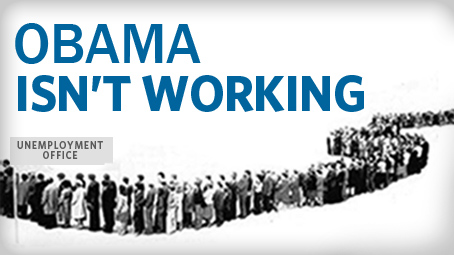
Rfp-blog-obama-isnt-working_0

Like many Brits alive at the time, I recall the amazingly fresh – for 1978 – billboards with the better pun: Labour Isn't Working. Romney is running with the message:

Labeled the poster of the century by the magazine Campaign, the image pointed to Britain's economic climate of rising unemployment, rising inflation, and a large and growing national debt. Those conditions and the public discontent throughout the country during that election and the parallels that Americans face today cannot be ignored. With unemployment rising from 3.6% in 1974 to 5.3% in 1979, the British knew there was a problem. Now, America faces 9.1% unemployment, record deficits, a soaring national debt, and millions of struggling families. One thing is clear – Obama isn't working, either.

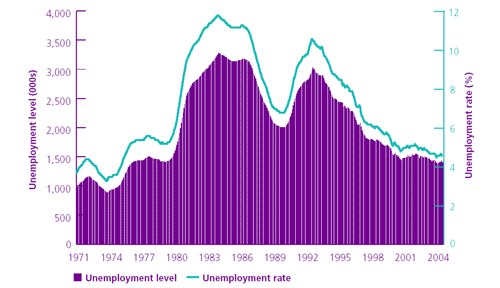
One small detail worth adding is the unemployment rate that occurred after Thatcher imposed sharp spending cuts, and kept the pound strong. The chart below gives you an idea:

Unemployment-71-05-736294

If unemployment was 5.3 percent in 1979 when Thatcher was elected, it was peaking at close to 12 percent as she sought re-election. It took until 1989 – a full decade – for the rate to bottom out again at around 6 percent. I'd argue some of the pain was vital, because so much of the British economy had become inefficient, over-staffed and stifled by union power and punitive taxation (try a top rate of 98 percent).

But if Romney is going to run on Thatcher's unemployment record, he might want to reassess.