The Economist notes:
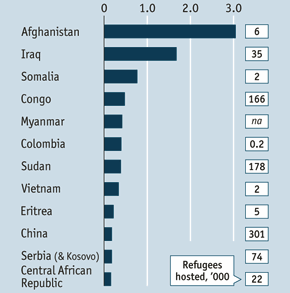
America’s wars continue to account for many of the world’s refugees: 4.7m originate from Iraq and Afghanistan, almost half the world’s total, according to the UNHCR’s annual report.
The Economist notes:
America’s wars continue to account for many of the world’s refugees: 4.7m originate from Iraq and Afghanistan, almost half the world’s total, according to the UNHCR’s annual report.
A new tactic attempts to herd the virus into an evolutionary dead end. Ed Yong follows it:
HIV out-evolves us. HIV can produce around 100 billion new virus particles every day, and it does so with unusual imprecision. When most genetic material is copied with great fidelity, HIV goes for a sloppier approach. It duplicates itself with errors galore, creating a swarm of genetically variable viruses. It leaves a host looking very different to when it entered. In the face of this rapid shape-shifting, any drug or vaccine soon becomes obsolete. Fighting HIV is like fighting a hydra – there are several heads and every time you lop one off, two more grow in its place.
To tackle this continually changing adversary, some scientists are looking for parts of HIV’s proteins that tend to stay the same. These “conserved sites” tend to be important in some way; mutating them would compromise the virus’s ability to reproduce. By training the immune system to attack these sites, we would give the virus an unenviable choice – do nothing and die, or change and become weaker.
Sent by readers from the parade in NYC today:


We found this one on Flickr, taken by Lindsey J. Testolin:

 |
 |
 |
 |

Our reader writes:
The First Presbyterian Church of NY is on 5th Ave & 12th St., which is on the Pride Parade route. What I couldn't fit in the picture are the congregants passing out water and the huge welcome banner, complete with triangles. I don't believe in god, but I do believe in humanism, and it put a smile on my face.
One more:

Janet Albrechtsen summarizes Matt Ridley's argument:
On an average wage today, half a second of work will pay for an hour of light. In 1950, the average wage earner worked eight seconds to run a conventional filament lamp; in 1880, 15 seconds of work was needed for a kerosene lamp; and more than six hours of work for an hour of light by tallow candle in the 1800s. In 1750BC, your average ancient Babylonian needed to work more than 50 hours to get an hour of light from a sesame oil lamp. That 43,200-fold improvement, says Ridley, signifies "the currency that counts, your time."
(Hat tip: Kirstin Butler)
“Church Going” by Philip Larkin:
A serious house on serious earth it is,
In whose blent air all our compulsions meet,
Are recognized, and robed as destinies.
And that much never can be obsolete,
Since someone will forever be surprising
A hunger in himself to be more serious,
And gravitating with it to this ground,
Which, he once heard, was proper to grow wise in,
If only that so many dead lie round.
Lorin Stein does a deep reading .
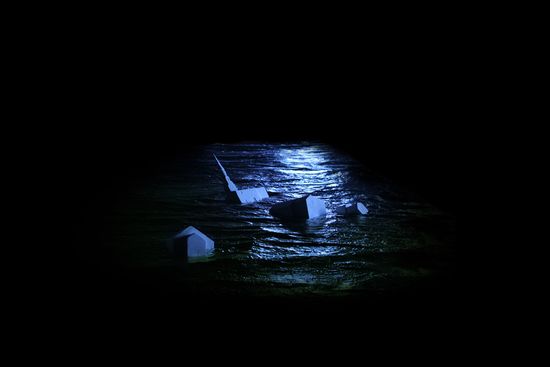
(Image: "Vesper Puritanus/ substratum forever enough now" by Jon Bobby Benjamin)
Carl Zimmer relays a theory about recurring pain:
As time passes, we store the memory of the pain without vividly reliving it every day. But for millions of people the memory doesn’t fade and the pain doesn’t go away. To ?A. Vania Apkarian, a neuroscientist at Northwestern University, the connection between the living memory and the never-ending pain suggests a glitch in the brain.
Ordinary pain might turn chronic, he hypothesizes, when inflammation caused by conditions like arthritis or nerve damage provokes an abnormal rush of signals from nociceptors. When these aberrant signals reach the pain network in the brain, Apkarian argues, they overwhelm it. The brain doesn’t get a chance to forget the pain. Instead it learns to feel it continuously. Eventually the neural connections become so strong that we no longer need the original stimuli anymore. The network begins to sustain itself, continually relearning its pain. It can also send signals back down into the body, turning previously painless sensations into painful ones.
Lori Gottlieb skewers overbearing parents and explains how they might be ruining their kids' ability to be happy:
We can expose our kids to art, but we can’t teach them creativity. We can try to protect them from nasty classmates and bad grades and all kinds of rejection and their own limitations, but eventually they will bump up against these things anyway. In fact, by trying so hard to provide the perfectly happy childhood, we’re just making it harder for our kids to actually grow up. Maybe we parents are the ones who have some growing up to do—and some letting go.
Anna North praises her final conclusion:
This is a message I wish she'd gotten much earlier, when she was telling women that if they just made all the right dating choices, then they'd be rewarded with a happy marriage and family. But now that she's wised up to it, it's worth repeating: whether you're looking for a partner or raising a kid, it's worthwhile to remember that there are some things you just can't control. And trying to control them often causes more harm than good.
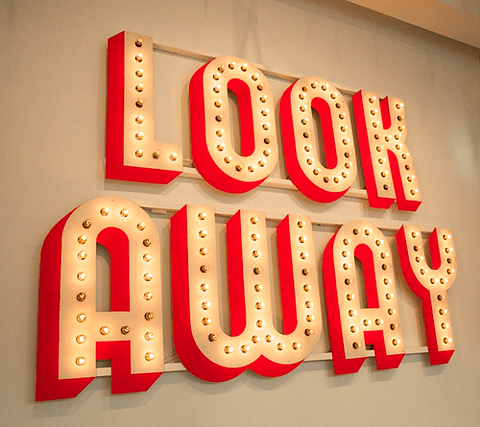
(Image by Steve Lambert via this isn't happiness)
George Watson reminds us that compulsory health insurance began with Bismark's Prussia in 1883:
That created a sudden panic on the left. Karl Marx had died weeks before, so the socialist leader August Bebel consulted his friend Friedrich Engels, who insisted that socialists should vote against it, as they did. The first welfare state on earth was created against socialist opposition.
Watson extrapolates a larger lesson:
The forgotten truth about health provision is that socialism and state welfare are old enemies, and welfare overspending is a characteristic of advanced capitalist economies. Nobody doubts that California is capitalistic, and its public debt is notorious; the People’s Republic of China, by contrast, is a major creditor in international finance. When the two Germanies united after 1990, the social provision of the capitalist West was more than twice that of the socialist East, and the cost of unification to West Germany proved vast.
Stars of a bygone era:
Epigentics explores "not just how cells control the genes inside them but also how altered genes are passed on when cells reproduce—both within an organism's lifetime and, more fantastically, across generations." Christine Kenneally examines those changes over time:
Epigenetic changes can occur in adulthood, in childhood, even in utero […] Epigenetic change means that not only do we start out as unwitting participants in a genetic lottery, but environmental forces we cannot see or control can mess with our genetic hardware and change our destiny.
Researcher and author Richard Francis is fortified by "the wonder of epigenetics and the molecular rigor it brings to the idea that life is a creative process not preordained by our genome any more than it is preordained by God."
 The Dish