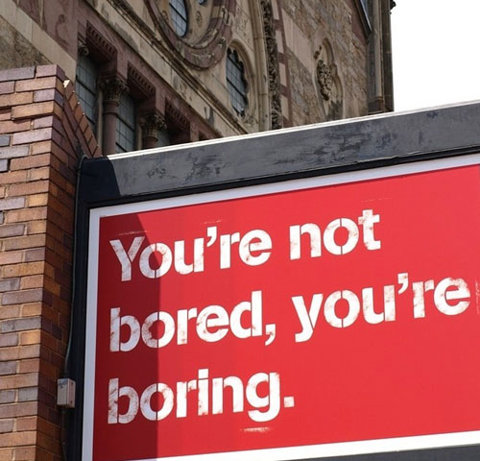
What’s Boring?

Bored

Nothing, if you're doing it right:

I love to hear of people devoting their lives to pursuits that sound dull to me, for I know that their enthusiasm is right and my boredom is wrong, and I am happy for the rebuke. I convert my specific boredoms into general fascination with passion's possibilities, reflecting that, under altered alignments of choice and chance, I might have given my days to different causes. There is more worth loving than we have strength to love. A foolish trope of modernity is that experience leads to disenchantment and ennui. Boredom with life does not result from exhausting life's riches, but from skimming them.

(Photo via fffound!)

“The Correct Use Of A Semicolon Is A Big Red Flag”

From a dialogue between "Teach," an adjunct philosophy instructor at a public university in New York, and "Cheat," who has authored over 100 papers for pay. Here's Teach:

My favorite case this semester was plagiarism within plagiarism. When I informed this student that I suspected her paper was plagiarized, she said to me, “I got my paper from one of the students who was in your class last semester. How was I to know that she had plagiarized?” Which indicated to me, along with a number of the other email responses I got from students, that many of them don’t even know what plagiarism is.

Food For Thought

Andrew McConnell Stott catalogs the unusual diets of the romantic poets. On Percy Bysshe Shelley:

He liked to test the inspirational qualities of various foods, and once badly poisoned himself by eating laurel leaves. Laurel is the garland of the poets, and also contains prussic acid. He also liked to lick tree sap.

Philosophers' stomach troubles were more commonplace:

Charles Darwin’s friends understood that his uncontrollable retching and farting seriously limited his public life. In 1838 Darwin announced that ‘I find the noodle & the stomach are antagonistic powers … What thought has to do with digesting roast beef, – I cannot say, but they are brother faculties.

Face Of The Day

Olddogs

Nancy LeVine photographs aging dogs across America. Kerri MacDonald interviews the artist:

Ms. Levine doesn’t want to see her project as being about death; it is about the dignity of age and, perhaps more than anything else, the luxury of aging without human concerns. “The dog lives in the present,” Ms. Levine said. “We don’t. Our body is fragile. We’re thinking about the past and what we could have done differently; we’re thinking about the future and what is going to happen to us.”

What Ecstasy Doesn’t Do To Your Brain

Ecstasy-time

The UN reported this week (pdf) that ecstasy use "rose in the USA from 0.9% of the population aged 12 and above in 2008 to 1.1% in 2009." While we're on the subject, we're not sure how The Dish missed this study from February, which tested users on cognitive tests:

[The researchers] took into account four factors that may explain why MDMA users in other studies did not score as well as non-users: consumption of other drugs, intoxication during the study, pre-existing differences in cognitive ability, and the rave lifestyle, which often includes sleep and fluid deprivation. After Halpern and his co-authors controlled for these variables, the test gap disappeared. … They added that “this finding might have reflected a pre-morbid attribute of ecstasy users, rather than a residual neurotoxic effect of the drug.”

Sullum pointed out the obvious:

[The head of the study, John Halpern] did not mention that all these hazards are either created or exacerbated by prohibition, which makes drug quality unreliable, pushes consumption underground, and impedes the dissemination of reliable guidelines for responsible use.

Judy Berman compiles a highly subjective timeline of ecstasy in pop culture.

Rawls And Egypt

Nathan J. Brown connects the two:

The country was experiencing what might be called a “Rawlsian moment.” Before his death in 2002, American political philosopher John Rawls had made a name for himself 114841235 leading a couple generations of scholars in exploring ways to assess and maintain the justice of a political order. His basic approach included an invitation to imagine what sort of system people in a society might construct if they did not know in advance what their position would be in it. Rawls never envisioned this “veil of ignorance” as something that was actually possible; imagining such an abstract deliberation among people writing rules under such circumstances was simply a good way of assessing whether the rules in place were fair or not.


But in February and March, Egyptians seemed actually to be living in a Rawlsian environment. Nobody knew who the relevant political actors would be, what shape their platforms would take, or how strong they would be electorally. Of course, general tendencies could be discerned, but when Egyptians argued about questions of constitutional design, the political scene was so unclear they could put abstract principles above partisan interest.

Brown uses this device as a starting point to discuss the state of constitutional deliberation in Cairo.

Death Bed Regrets

Screen shot 2011-06-22 at 7.29.42 PM

Bronnie Ware reveals the top five regrets she hears from terminally-ill patients in palliative care. Massimo Pigliucci absorbs number four – a wish to stay in touch better with friends:

For Epicurus, friendship is a major way to ataraxia, or tranquility in life: “Of all the things which wisdom provides to make life entirely happy, much the greatest is the possession of friendship.” Aristotle developed a sophisticated theory of friendship, recognizing three types: of pleasure, of utility, and of virtue. The first kind applies to situations in which one is a person’s friend because of the direct pleasure that friendship brings — for instance because you like people who are good conversationalists, or with whom you can go to concerts, and so on. Friendships of utility are those in which one gains a tangible benefit, either economic or political, from the relationship. … For Aristotle, though, the highest kind of friendship was one of virtue, where you are friends with someone because of the kind of person he is, because of her virtues. I suspect it is largely the latter — most precious and difficult to achieve — that Ware’s patients had in mind during the last few weeks of their lives.

(Image by Balla Dora Typo-Grafika)

Suicide: A Sign Of The Good Life?

Regions with a higher quality of life have a higher suicide rate. David Lester has a theory:

If your quality of life if poor, and it may be you’re unemployed, you’re an oppressed minority, whatever it might be, there’s a civil war going on, you know why you’re miserable. You know as the quality of life in a nation gets better and you are still depressed — well, why? Everybody else is enjoying themselves, getting good jobs, getting promotions, you know, buying fancy cars. Why are you still miserable? So, there’s no external cause to blame your misery upon, which means it’s more likely that you see it as some defect or stable trait in yourself. And therefore you’re going to be depressed and unhappy for the rest of your life.

The Medium That Made The Message

Media theorist Marshall McLuhan's devout Catholicism opened his eyes:

Belonging to a Church that gloried in cathedrals and stained glass windows made him responsive to the visual environment, and liberated him from the textual prison inhabited by most intellectuals of his era. The global reach and ancient lineage of the Church encouraged him to frame his theories as broadly as possible, to encompass the whole of human history and the fate of the planet. The Church had suffered a grievous blow in the Gutenberg era, with the rise of printed Bibles leading to the Protestant Reformation. This perhaps explains McLuhan’s interest in technology as a shaper of history. More deeply, the security he felt in the promise of redemption allowed him to look unflinchingly at trends others were too timid to notice.