The Daily What captions:
Fusing together 36 separate YouTube covers of Radiohead’s “Paranoid Android,” Ohadi Amram created a synergistic cover that is far beyond the sum of its parts.
The Daily What captions:
Fusing together 36 separate YouTube covers of Radiohead’s “Paranoid Android,” Ohadi Amram created a synergistic cover that is far beyond the sum of its parts.
That's Virginia Woolf on James Joyce, in a roundup of great author insults. Another classic, from Nabokov:
As to Hemingway, I read him for the first time in the early ‘forties, something about bells, balls and bulls, and loathed it.
A reader writes:
It struck me as fitting that your post on Rep. Cantor and the inflexible and passionate ideological purity of the Tea Party/neocon right on financial issues happened on the same day as your live blog of the marriage equality victory in New York.
Over the last decade or two, individuals holding what we now identify as neocon views had been driven by social issues. Sure, they had opinions about taxes and spending, but the hyper-passionate ideological inflexibility – the thing that got them out of bed in the morning ready to fight – derived from social issues. The same sort of reckless and passionate inflexibility in the face of reality that they now apply to issues of taxing and spending used to be applied to issues of discrimination, religious intolerance, and fighting marriage equality. The same "litmus test" now being used to blackball any GOP candidate willing to consider revenue increases mirrors the old social-issue litmus tests on issues like marriage equality.
And now, with a lot of those social-issue battles in the process of having been lost – a bi-racial president, marriage equality spreading, a growing and dynamic population of racial and ethnic minorities in America – it seems fitting that these ideologically driven purity tests have moved into the fiscal arena.
Looking at the battle for marriage equality gives me hope that, in the end, truth and justice and just-plain-facts-on-the-ground win out over harmful and inflexible rhetoric (though the fight is by no means over, and I don't want to minimize the work that brave people still have to do). But I am also sobered by the fact that so many gay Americans have had to suffer for so many decades while fighting for right. And I fear for the millions of Americans likely to suffer the consequences of Tea Party economics over the next decades as this new fight emerges.

A reader writes:
You tackled this subject when the world thought you were crazy. You were sane. You beat the drum for this when the world deemed you wild-eyed. You were sane. You have been slapping this horse the world thought was dead for decades, while the world (and I) were vaguely embarrassed for you, and wished you would attend yourself to more sensible goals, like maybe gay partnerships.
You were right. I am humbled. I was remiss not to have larger, fairer dreams. I give you great credit tonight, and send you my reader's affection and gratitude.
I've been overwhelmed by the emails from gay and straight alike on these lines. All I can say is that the case for marriage seemed obvious to me when Mike Kinsley put my essay for gay marriage on the cover of TNR in 1989, and then it became a vital cause for me when I found out I may not live long enough to see it. I wrote Virtually Normal, assuming it would be the only book I ever wrote. And then God's joke was to allow me to survive, something I interpreted as a mission to make the case and fight the cause for those who had fallen before I had managed to escape.
After I quit running TNR, I spent the rest of the 1990s campaigning for this, among gays and straights. With my friend Joe Landau, I produced an anthology of arguments. I went on any radio or TV show that would have me. I lectured on the issue at countless campuses and book talks. I tried – badly – to raise money. At one point, it was all but two of us – me and Evan Wolfson. But the arguments were so strong, more and more allies arrived, gay and straight, and it was a joy for me to march within the parade, not at the front of it. Others have done so much of the work this decade, and the victory is theirs'. But it is, of course, all of ours', gay and straight, who finally saw what justice means and humanity requires.
I slept twelve hours last night. Something had lifted. And now, I must call my husband, yes, my husband, to check in on the new water heater in our cottage in Ptown.
You know what? I never thought it would happen in my lifetime. And if it did, I never thought it would happen to me.
Know hope.
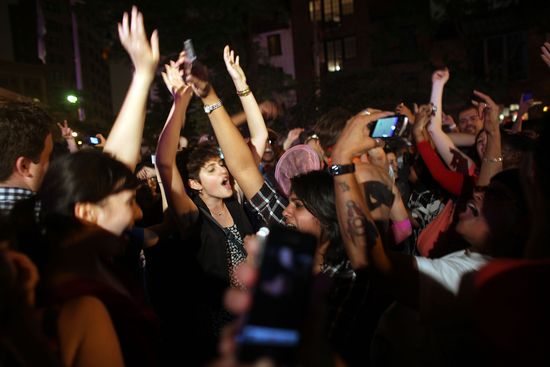
"I learn tonight that the annual gay-pride march is on this very Sunday; perhaps there will be a louder, more in-your-face contingent there. But here, tonight, I see neither the face of anarchy, nor that of a nascent “North Korea.” I see smiles on young people — and also, on some quiet senior citizens who are actually old enough to remember Stonewall 1969.
And speaking of 1969, here’s a little bit of perspective. In 1969, Spain was a conservative religious republic, led by the legendary Generalissimo Francisco Franco; and New York City was already Babylon-on-the-Hudson, well on its way to being the crime-sex-drugs-porn-and-atonal-music capital of the world. If I had said to you then, “Forty years from now, one of these places will allow homosexuals to marry each other with the blessing of the state” . . . well, let’s just say you would have made a lot of money if you had bet on Spain.
Spain did it in 2005, six years ahead of the Empire State; and now we have it here in ol’ Babylon. I call it Babylon affectionately; let no one question, on this night, my patriotism as a citizen of the state of Alexander Hamilton, Theodore Roosevelt, and the Marx Brothers," – Michael Potemra, in a fair and moving post, at NRO. I repeat: NRO.
My take here. Live-blog from last night here.
(Photo: Revelers celebrate in front of the historic gay bar The Stonewall after the passing of a bill legalizing gay marriage in New York State on June 24, 2011 in New York City. New York State now joins Connecticut, Massachusetts, New Hampshire, Vermont, Iowa and Washington, D.C. in legally recognizing gay marriage. By Spencer Platt/Getty Images.)
A good Catholic and a good legislator.
Errol Morris's new five-part series explores the origins of email. It began at MIT in the 1960s, where a time sharing system allowed people to post files to each other and access them from their own computers. According to Tom Van Vleck, then part of MIT's programming staff:
The idea of time sharing was to make one big computer look like a lot of different little computers that were completely unconnected to each other. But it turned out that what people really liked about time-sharing was the ability to share data.
Kottke rhapsodizes:
It seems completely nutty to me that people using computers together — which is probably 100% of what people use computers for today (email, Twitter, Facebook, IM, etc.) — was an accidental byproduct of a system designed to let a lot of people use the same computer separately. Just goes to show, technology and invention works in unexpected ways sometimes…and just as "nature finds a way" in Jurassic Park, "social finds a way" with technology.
Craig Mod dreams of a different sort of book:
Imagine a future where instead of lending someone a book, you lend them your bookmarks. Where your notes, annotations and references are synchronized across platforms and applications. Where your bookmarks belong to you, and a record of every book you read is saved and stored securely, no matter how or where you read it.
Kevin Kelly envisions how the publishing industry will adapt. Alexis Madrigal explores how the New York Public Library has moved beyond books, existing now as a social network with three million active users.
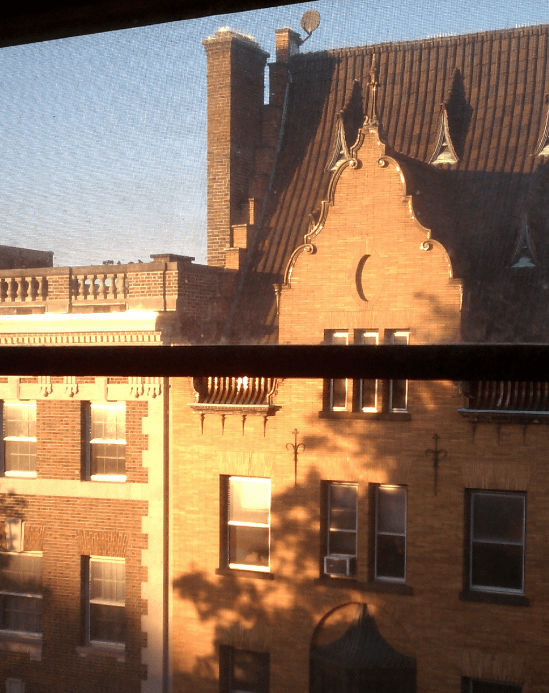
You have until noon on Tuesday to guess it. City and/or state first, then country. Please put the location in the subject heading, along with any description within the email. If no one guesses the exact location, proximity counts. Be sure to email entries to VFYWcontest@gmail.com. Winner gets a free The View From Your Window book. Have at it.
Jordan Michael Smith skewers the playwright:
Mamet seldom mentions liberal programs or Democratic ideas he opposes; for him, the general mentality of “The Left” has prompted his conversion. He declares the evident failings of “feminism, birth control, ‘diversity,’ free love, and the profusion of ‘counter-cultural innovations spawned in the 1960s.’” But modern American liberalism traces to long before the '60s, and whatever their power, it's fair to say that notions of ‘free love’ never found their way onto a platform of the Democrats. Like his predecessors, Mamet has confused radicalism with liberalism.
 The Dish