The Spiritual Power Of Psilocybin, Ctd

It’s an old debate, but this reader makes the point for me:

At the risk of oversimplifying, what things like Psilocybin may bring home experientially, and therefore powerfully, for those that partake is that qualitative states matter.  That the world as we know it is shot through and through by our qualitative experience of it; see Kant’s “Critique of Pure Reason” for a deeply rational account of what may come to be realized experientially for those who use psychotropics.

As Kant rightly showed us, there will always be a gulf between the noumena and us, Psilocybe.mexicana and when someone is tripping balls they can easily experience that chasm, commonly resulting in a radically spiritual effect.  Psychotropics allow for this because they allow one to experience how deeply brain states shape reality, that we will never have complete, direct, or as Kant would put it, “pure” access to “things in themselves.”

Another way to speak of spirituality is to speak of the qualitative frameworks we all have. It’s not something we can step out of. That said, any experience that brings to the foreground our qualitative framework, its contingent nature, and its immense implications for our lives and our reality, will inherently be a deeply spiritual affair.

The disenchantment of the world via scientism, is merely another approach to the world via a qualitative framework, it’s a spirituality as well, with all the moral, emotional, and psychological implications that come with it. I would encourage everyone, especially atheists and science-minded members of the audience to try and have more experiences that allow them to better understand the radical contingency of their own qualitative framework, drug-induced or otherwise.  All of a sudden, science, poetry, narrative, life, and yes, maybe even God-talk may become far more interesting.

Indeed they do. Another echoes:

In regard to brain states and experiences of what Hitch calls “The Numinous”, the scientific materialists miss an important point.

All human experiences are mediated by the brain. It’s thus legitimate to point out that if transpersonal experience can be reductively explained as a brain state only, while disregarding the aesthetic, moral, and transformative aspects of such experiences, the same critique could be applied to anything. Enjoy reading Richard Dawkins? That’s the brain. Gazing at the night sky? Brain again. Good sex? “That’s the brain, honey.” Such a person would rightfully get a slap from his/her lover!

Dawkins et al. might claim they only use this criticism to attack empirical or epistemic and supernatural claims of divinity, but people like Rebecca Goldstein even use “it’s all the brain” to debunk mystics who are clearly speaking metaphorically and poetically.

I’m still working on my own response to the fascinating thread. Busy week. Still only one hand.

(Photo: by Cactu/Wiki here)
“More Than Normal Techniques”

Petraeus resurrected the ticking time-bomb scenario while giving testimony:

Petraeus said "there should be discussion … by policymakers and by Congress" about something "more than the normal techniques." Petraeus… described an example of a detainee who knows how to disarm a nuclear device set to explode under the Empire State Building.

Ackerman fears the general has re-opened the door to torture:

Petraeus hardly reversed course and endorsed torture. But there are many Republicans in Congress who thought Obama made a big mistake by banning it. If Congress revisits the interrogation debate at Petraeus’ behest, torture might very well return to U.S. interrogations.

Greg Sargent extends Petraeus's logic:

By endorsing torture in this “special circumstance,” Petraeus has implicitly conceded two things—that torture is so effective that it might be of use in an extraordinary circumstance, and that it’s morally defensible. Neither of those things happens to be true—and previously, Petraeus had made that clear.

Friedersdorf piles on.

The Lame State, Ctd

A reader writes:

The latest round of emails illustrates why this campaign really bothers me. I have no problem with warning labels (on tobacco or anything else). That, to me, seems like a useful role for government. Consumers should be informed about the potential dangers of any product they are considering and private industry cannot always be relied upon to deliver that (as evidenced by the tobacco companies themselves).

These pictures go beyond that.

It's not enough to inform consumers anymore, because people know the risks and they still smoke. So now the government has to try to scare them into not using the product. (Of course, they have been doing this for years and I would bet that most people are greatly overestimating the odds of a smoker developing lung cancer.) The health care costs are exaggerated and, at any rate, until the government begins offering free lung cancer treatments to all citizens it really has no interest in the matter.

But what about the children? Scare tactics are probably an effective way to prevent children from smoking. They are also a very effective way to instill distrust in the government because, generally speaking, people don't like being deceived.

Another writes:

I can't believe you posted this reader email, especially the following bit:

I think most American people have addictive personalities. If you take cigarettes away, it's going to be something else they smoke, drink, chew, or inject. Americans in general are lacking when it comes to nutrition and health. I'd like to see the insurance companies spend some of their profits to educate the public about healthy lifestyles, and not some brand-building, feel-good, jingly-jangly message, but more of a scared-straight kind of approach.

I'm glad that person "thinks" that, but we shouldn't decide public policy simply on what people "think" is the case. In fact, Terry Gross had a wonderful interview with David Linden (neuroscientist at John's Hopkins) on yesterday's Fresh Air.  First, he noted that cigarettes are 80% addictive, as compared with, for instance, heroin, which comes in at 30%.  Second, he remarked that, "Any one of us could be an addict at any time. Addiction is not fundamentally a moral failing – it's not a disease of weak-willed losers."

As for the "nanny state" issue, sure, one could look at this as an instance of government overreach and micromanaging.  But one could also look at it as an issue of a child's right not to be lured into an expensive and deadly addiction by sexy marketing.  People decry the "nanny" state when it coddles adults, but in this instance the main concern is children, who last time I checked did not have the same fully developed frontal cortex that I presume most adults have.

Another:

Instead of putting obscenely gross photos on cigarette packages and ads, why not try something new and unique – stop subsidizing tobacco!

Cantor’s Cant, Ctd

Ezra Klein asks why anti-tax fundamentalism has disrupted the debt ceiling talks:

[T]he GOP's sudden insistence that taxes have nothing to do with our problems and only a loon would suggest they have a role in our solutions is ahistorical and unempirical. If you've gotten lost, the first thing to do is try and go back to way you came. After a decade of spending increases and tax cuts, that's what a package of spending cuts and tax increases would do. There's nothing radical about that notion, nothing that should force a halt to discussions and the sort of rhetoric we're hearing from the Republican side.

John Dickerson says not to worry:

Before the final stage of backroom negotiations, there are always the denunciations, charges of unseriousness, and accusations of ideological rigidity. Why do we always come to this stage? It's a negotiating tactic, an educational exercise, and stage management. Anyone putting together a deal knows the value of seeming inflexible. Maybe you'll win concessions from the other side. Republican leaders must make a show of how difficult they are to impress their members and constituents. If a deal happened with Biden in a room and there wasn't any public outcry, conservatives would have every right to be suspicious that Republicans got rolled.

Jonathan Bernstein echoes Dickerson.

Getting Jury Independence To Go Viral

Warondrugs

Austin Carr explains Ricardo Cortes' new project:

Now the illustrator of Go The Fuck To Sleep hopes to put a different subject to rest: the war on drugs. [Earlier this week] Cortes released Jury Independence Illustrated, a roughly 20-page booklet delving into the problems of skyrocketing non-violent drug convictions. It's an educational pamphlet designed to teach jurors about the impact they could have on the issue–that is, by taking a more active role in the prosecution process, and basing their decisions not on the evidence before them but on their conscience.

Emergency Care Isn’t Health Care, Ctd

The point that Frakt and Carroll make is well-taken. The fact that emergency room care is guaranteed by the 1986 Emergency Medical Treatment and Active Labor Act does not mean that everyone has access to effective healthcare. But 1986 does seem to me to be the real moment when America socialized medicine – under Reagan! In a real Ron-Paul style free market in healthcare, where everyone has to buy their own insurance or not and deal with the consequences, chronically sick poor people must, in principle, be left, at some point, to suffer and die alone or bankrupted. Something in the American psyche does not want that to be America. Whatever part of the psyche that is, it sure isn't inspired by Ayn Rand. It wants to put a floor under human suffering and sickness, to have a minimal baseline for care. We don't want to see people dying in the streets.

But once you have done that, you have socialized medicine.

You have socialized medicine because most of the people visiting the emergency room will not have sufficient coverage and will be unable to pay. So the costs are shifted to everyone else. Worse, the costs of treatment at this level of emergency are far higher than pre-emptive care. And so we are all in this together already. The question is: does it make any sense to construct a socialized system in this absurdly inefficient way that may actually cost much more and provide much less healthcare than a more coherent system?

This is one reason why America's relatively free market in healthcare has become so costly and inefficient. I mean, here's a question worth asking. In what field of human activity is a free market system consistently far less efficient than a socialized one? Why are those decadent Europeans actually more efficient in providing healthcare than we are?

Cantor’s Cant

117105755

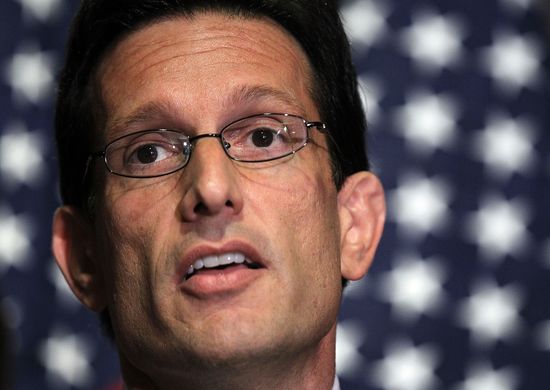
Increasingly, Americans and the markets have every reason to feel scared shitless. The controlling faction in the Republican House is a faction that is not so much anti-debt as anti-government. If they have to choose between tackling the debt and raising even some revenues (while cutting spending dramtically), they will choose to push the US into default. Such a default would risk destroying the savings of Americans, make the debt far far worse, spark a double-dip recession, and throw countless people out of work and make those in work radically less financially secure. Even those of us who have saved for retirement by buying unglamorous bonds could see our financial future wiped out by these maniacs on a mission. That is the kind of small-c conservatism these Savonarolans want to penalize.

They see this ideologically, i.e. not politically. But the political facts are these. Federal tax revenues are at a 50-year low; marginal rates are lower for many than they were when Reagan was president. In a divided government, any achievement requires some sacrifice from both sides. And yet the GOP is insisting that its side offers no sacrifice, even as the other party controls the Senate and the White House. Their own party, moreover, contributed dramatically to the debt we now face. And there is no clear evidence that raising revenues will lead to economic decline. Ronald Reagan's tax hike to deal with a much smaller debt in 1982, as Bruce Bartlett shows, preceded a burst in growth. The tough budget calls, including tax hikes, of GHW Bush and Bill Clinton led the way to economic growth far outpassing that after George W. Bush's bankrupting tax cut.

The notion that no revenues can be raised in the current crisis is, quite simply, nuts. You can even do it without raising rates, by eliminating tax expenditures/breaks. But even that golden Bowles-Simpson compromise is too much for these fanatics – even if the president coaxes his side into swallowing big spending cuts.

This is brinksmanship with all of our lives, our money, our core financial stability and future growth. It is an outrageously reckless way to run a government. And Cantor's refusal to take any personal responsibility for the result of these talks is of a piece with the record of this shallow, callow fanatic who has the gall to call himself a conservative, even as he launches a wrecking ball at the very fabric of the American and global economy.

These current Republicans would rather destroy the US economy than sacrifice one scintilla of ideological purity. They are an imminent threat to the stability of this country's economy and the world's. And they must be stopped before the damage is irreversible.

(Photo: Alex Wong/Getty.)